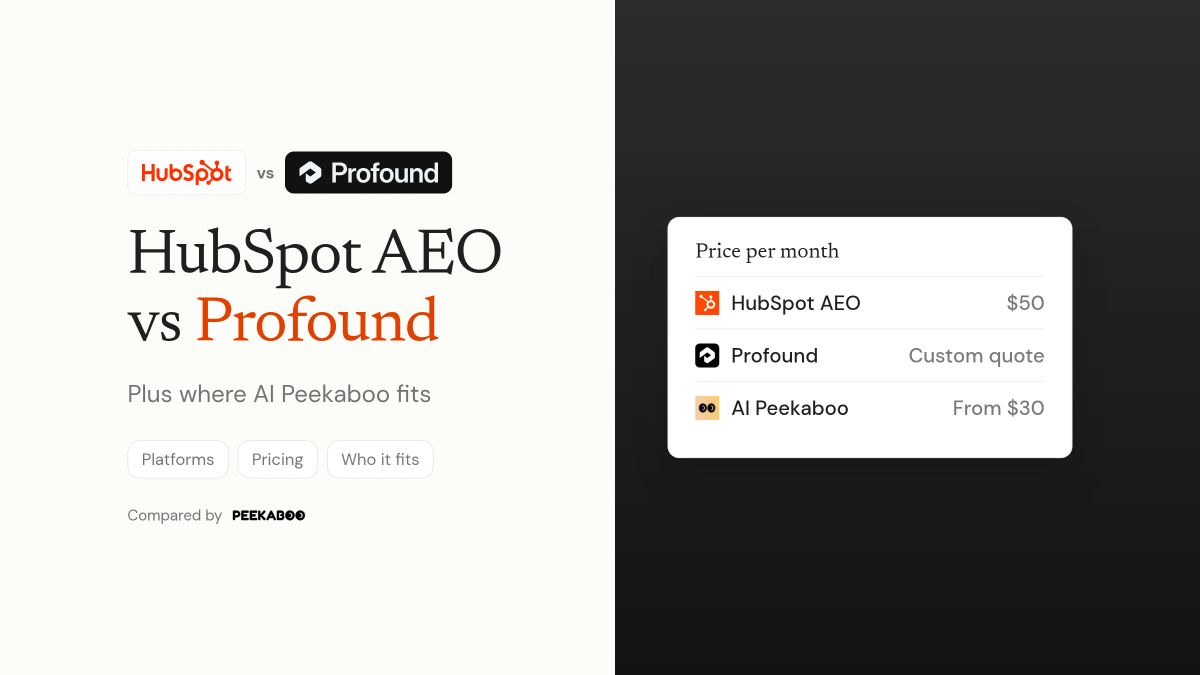
HubSpot AEO suits one brand: $50 a month standalone, and included with Marketing Hub Professional and Enterprise. Profound suits large enterprise programs on custom contracts. Here is how they differ, and where AI Peekaboo fits for agencies.
HubSpot AEO is the better choice for a team tracking one brand on ChatGPT, Gemini and Perplexity, especially one already on Marketing Hub. Profound is the better choice for a large enterprise program that needs up to ten AI platforms, SSO and SOC 2 compliance across several regional teams. Agencies running several client brands should pick AI Peekaboo, which prices by brand, prompt and platform and includes white-label reports on plans from $100 a month.
HubSpot AEO is a $50 tracker that comes from the CRM vendor many marketing teams already use. Profound is an enterprise platform with AI agents for research, writing and reporting, sold on custom contracts for brands.
HubSpot AEO vs Profound: the short answer
HubSpot AEO
Profound
Best for
One brand, especially on Marketing Hub
Large enterprise companies
Price
$50 a month standalone ($45 billed annually); included with Marketing Hub Professional and Enterprise
Custom on Enterprise; free 7-day trial
AI platforms
ChatGPT, Gemini, Perplexity
Up to 10 on Enterprise; 3 in the trial
Prompts
25 a day (50 on Marketing Hub Enterprise)
Tailored on Enterprise; 50 a day in the trial
Content tools
Blog post generation on Marketing Hub
AI Marketer and Agents, billed in credits
Team access
Marketing Access permissions on Marketing Hub
Unlimited seats; SSO through SAML on Enterprise
Free trial
28 days, no credit card required
7 days
Both run your prompts through AI platforms every day and report how often your brand appears, how it is described, which competitors show up and which sources the answers cite. On those basics they're close, so the choice comes down to platforms, prompts, content tools, reporting depth and price.
Who HubSpot AEO and Profound are for
HubSpot AEO suits the marketing team that already plans and publishes in HubSpot, and the covers what the $50 buys. It's included with Marketing Hub Professional and Enterprise, where prompt suggestions draw on CRM data. The standalone $50 plan gives any brand the same daily tracking without Marketing Hub.
Profound fits companies running AI search work across several teams and regions, and its Enterprise plan adds a dedicated support option with a 24-hour SLA; the Profound review goes through the rest of the platform.
Profound also sells to agencies. Agency Growth is for agencies pitching prospects and managing clients, and Agency Enterprise is a custom package for large agencies and networks managing dozens of clients, with a dedicated agency partner and go-to-market support.
A mid-size company with one brand and a HubSpot account doesn't need Profound's enterprise layer, and a global brand with a security team won't settle for three platforms and 25 prompts. A company with a handful of brands or markets falls between them: HubSpot's three platforms stay fixed however many brands you add, and Profound's brand pricing starts at a custom contract.
HubSpot AEO vs Profound: key differences
AI platforms covered
Profound covers far more platforms. Enterprise can track ChatGPT, Perplexity, Google AI Mode, Gemini, DeepSeek, Claude, Google AI Overviews, Exa Search, Muse Spark and Qwen, while HubSpot AEO tracks ChatGPT, Gemini and Perplexity on every plan.
Profound's trial already includes Google AI Overviews, alongside ChatGPT and Gemini, and HubSpot AEO doesn't track it. If your buyers start on Google, that one platform can matter more than the total count. AI Overviews and AI Mode are part of Google Search itself, so tracking Gemini, which both tools do, doesn't show you what Google searchers see in their results.
Adding Google's AI answers doesn't require an enterprise contract, though. AI Peekaboo tracks both Google AI Overviews and Google AI Mode on a self-serve plan, so if that is the only gap in HubSpot, price that before you ask Profound for a quote. A global brand can use all ten platforms; I think a regional B2B company needs ChatGPT and Google's AI answers more than the long tail.
Prompts and tracking
HubSpot lets you shape your prompts from day one, while Profound's trial runs a fixed set and Enterprise lets you edit, disable or add prompts. HubSpot AEO builds suggested prompts from the products and ideal customer profiles you confirm during setup. You get 25 prompts (50 on Marketing Hub Enterprise) and can filter results by answer engine, buyer's journey phase and product. Competitor changes only apply to future runs, so the competitor list deserves care on day one.
On Enterprise, the tracking plan is tailored to your program. Profound also offers Prompt Volumes, which shows what people are asking AI answer engines, and Enterprise adds ChatGPT Shopping tracking. Treat Prompt Volumes as estimates; Search Console is where your real queries are.
Choosing prompts is the foundation of everything a tracker reports, and Profound's trial runs prompts it picked for you. That demos the product, but it can't tell you how visible you are on the questions your buyers ask.
The number of prompts you can track differs too. Say a brand has three products: HubSpot's 25 prompts give it about eight questions per product. Profound's trial runs 50, and Enterprise sizes the plan to your program. A brand with many product lines or markets runs out of HubSpot's 25 prompts quickly, though you can buy more.
Recommendations and content
Profound's agents research, write and publish content, while HubSpot AEO gives you a prioritized to-do list and leaves the writing to your team unless you're on Marketing Hub. HubSpot AEO turns citation patterns into recommendations, each tagged with a content type, a channel and a priority, such as a new page, a technical fix, a video or outreach to a third-party site. On Marketing Hub, those recommendations draw on CRM data and the built-in blog generator drafts the posts. On the standalone plan, the writing is yours. The owned content view adds an Estimated impact report, which estimates the citation gain if you act on every recommendation for your own site, a useful way to argue for writing time.
Profound's AI Marketer researches, writes and reports using a Context Manager that holds your brand knowledge, and Agents let your team build reusable workflows for recurring marketing tasks, with Profound Sheets to run them at scale. CMS integrations such as WordPress, Webflow, Contentful and Sanity let you draft, stage and publish content from Profound. Agents run on credits, and the trial includes only a limited allowance.
If your team wants a list of jobs and will do the writing, HubSpot's recommendations are enough. Profound's agents suit a team with a backlog of pages it never gets to write.
Reporting and team access
Profound has the deeper reporting setup on Enterprise, while HubSpot keeps a simpler dashboard inside HubSpot that covers brand visibility, sentiment from -100 to +100, share of voice and citations, plus an Insights tab for social, owned content and outreach. Citation reports list the pages on your own domain that answer engines reference most and the outside websites they cite most, which turns the dashboard into a short outreach list. On Marketing Hub, users need Marketing Access permissions to see it.
Profound's Enterprise plan includes:
SSO through SAML
CSV and JSON exports and API access
Custom languages and regions
History kept from the start
Profound's integrations include Google Analytics, Google Search Console, Adobe Analytics, Looker, Slack and Microsoft Teams, plus Cloudflare, Fastly and Vercel for tracking AI agent traffic to your site.
Profound's trial has no history, exports, API or support, so you can judge the dashboard but not the data access you'd be paying for. HubSpot's 28-day trial has the same 25-prompt limit as the paid plan, and if you then pay the $50, tracking carries on with no break in your data, so the trial's four weeks become your baseline.
If your program feeds a BI stack and answers to a security team, Profound's exports, API and SSO justify the contract.
HubSpot AEO vs Profound pricing
HubSpot AEO publishes one price: $50 a month, or $45 billed annually. Profound publishes none for brands beyond the free trial; Enterprise is a custom quote.
Plan
Price (USD)
What's included
HubSpot AEO trial
Free for 28 days, no credit card
25 prompts daily on 3 platforms
HubSpot AEO
$50 a month, or $45 billed annually
25 prompts daily on ChatGPT, Gemini and Perplexity
Marketing Hub Professional
Included with the Marketing Hub plan
25 prompts daily
Marketing Hub Enterprise
Included with the Marketing Hub plan
50 prompts daily
Profound trial
Free for 7 days
50 prompts daily on ChatGPT, Gemini and Google AI Overviews
Profound Enterprise
Custom
Tailored prompts, up to 10 platforms, SSO, API
Profound Agency Growth
$99 a month plus add-ons
10 pitch workspaces a month
Profound full client workspace
Add-on at $399 a month
100 prompts on ChatGPT, Perplexity and Google AI Overviews, 400 credits a month
HubSpot extras: you can buy more prompts. On Marketing Hub Professional or Enterprise the add-on is $20 a month for 10 more prompts and 1,000 more answers a month, while HubSpot doesn't publish a price for extra prompts on the $50 standalone plan. Each brand needs its own setup at $50 a month. If you go through Marketing Hub Professional or Enterprise, onboarding is required and bought separately.
Profound credits: agents consume credits, and larger allowances need an Enterprise package. Your account can either bill overage or pause when you reach the limit.
Profound has no plan near $50, so it only pays off if you need its agents, SSO or up to ten platforms. If a custom contract is the sticking point and you already pay for Semrush, the Profound vs Semrush comparison finds Semrush the better fit for small and mid-size SEO teams that want AI visibility beside their existing keyword and backlink work. If you're unsure, run both free trials in the same week: Profound's seven days fit inside HubSpot's 28, so you can compare the two dashboards side by side and judge the reporting rather than your own visibility.
Agencies feel the price difference most: HubSpot charges $50 a month for every client brand, at 25 daily prompts on three platforms, and Profound charges $399 a month for every full client workspace, which includes 100 prompts, on top of its $99 agency plan. Five client brands on HubSpot cost at least $250 a month; HubSpot doesn't publish the price of extra prompts, so treat that as a floor. The five-brand AI Peekaboo setup below runs 50 prompts per brand every 2 days on the same three platforms, the same 25 runs a day, for $188. Past a couple of clients, I think what you pay per client matters more than any feature gap between the three.
Where AI Peekaboo fits
If you run several client brands, HubSpot's three platforms will feel tight and Profound adds a paid workspace for each client. AI Peekaboo sits between them: you set the number of brands, prompts per brand, AI platforms and how often prompts run, choosing from ChatGPT, Gemini, Perplexity, Google AI Overviews, Google AI Mode, Microsoft Copilot and Claude API, from $30 a month. Each client brand keeps its own prompts, competitors and dashboard.
2 brands, 54 prompts each, weekly on ChatGPT, Gemini, Perplexity and Google AI Overviews
$30
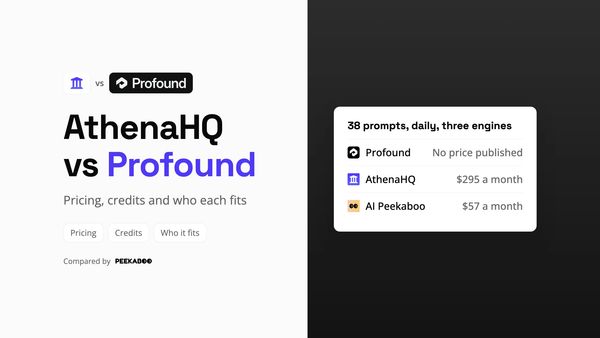
1 brand, 38 prompts daily on ChatGPT, Gemini and Perplexity (the smallest daily setup on these three platforms)
$57
1 brand, 38 prompts daily on ChatGPT, Gemini, Perplexity and Google AI Overviews
$76
1 brand, 100 prompts daily on ChatGPT, Perplexity and Google AI Overviews (a Profound client workspace's prompts and platforms)
$150
1 brand, 100 prompts weekly on ChatGPT, Gemini, Perplexity and Claude API
$110
5 brands, 50 prompts each, every 2 days on ChatGPT, Gemini and Perplexity
$188
Checked daily on the same three platforms, one brand costs more on AI Peekaboo, because it starts at 38 prompts a brand, so HubSpot is the cheaper buy there. Run weekly and the $30 setup above covers two brands and a fourth platform for less than HubSpot's $50, with fewer checks per prompt. I think tracking at least weekly is what matters; daily runs pay off when you need to see a trend day by day, for example during a launch. Profound's client workspace add-on is $399 a month for 100 prompts plus 400 credits; the same prompts and platforms on AI Peekaboo cost $150 a month checked daily. Profound doesn't state how often a client workspace runs, so treat that as a rough match.
Agencies also need something to show clients, and AI Peekaboo includes:
White-label reports and read-only client links on plans from $100 a month, so each client sees its own branded view.
No seat limits, so your whole team works in one account.
Looker Studio and the API to feed your own dashboards.
An MCP server to query any brand's visibility from Claude Desktop, Claude Code or Cursor.
Unlimited pitch workspaces on one extra brand slot, so you can audit any number of prospects for the price of one more brand, where Profound's Agency Growth plan includes 10 pitch workspaces a month.
GA4 and Search Console connections to put each client's AI visibility next to its search traffic.
A single brand that needs Google's AI answers but not Profound's agents can track 38 prompts daily on four platforms, Google AI Overviews included, for $76 a month.
AI Peekaboo stops at prompt suggestions, recommendations and content briefs. It has no marketing agents.
Which tool should you choose?
Choose HubSpot AEO if you track one brand and your buyers mostly use ChatGPT, Gemini and Perplexity, whether you're on Marketing Hub or paying $50 for the standalone plan. Look to AI Peekaboo or the HubSpot AEO alternatives once you add brands or need Google's AI answers, and test Profound before you renew if a security review or new markets are coming. If you'll still be one brand on three platforms next year, stay.
Choose Profound if you're a large enterprise that needs up to ten platforms, SSO, SOC 2 compliance, exports and AI agents across several teams. A single brand on a marketing budget is better served by HubSpot AEO, and the Profound alternatives compare other trackers.
Choose AI Peekaboo if you're an agency or a multi-brand team that wants Google's AI answers, per-client dashboards and a price you can set yourself. Pick Profound instead if you need agents that write and publish.
The free AI visibility checker shows how ChatGPT and Gemini answers name you today, which competitors appear beside you and the sources available to review.
How we checked this
Last checked: 14 November 2026.
Prices, plan limits and trial terms: HubSpot's AEO product page, HubSpot's pricing page and HubSpot's knowledge base article on AEO; Profound's pricing page for brands and agencies; the AI Peekaboo pricing calculator. Integrations: Profound's integrations page. AI Overviews and AI Mode: Google Search Central's AI optimization guide. Neither HubSpot AEO nor Profound was used hands-on for this comparison.
Frequently asked questions
Is Profound better than HubSpot AEO?
For a large enterprise, yes: it tracks up to nine AI platforms, adds SSO, SOC 2 compliance, exports and an API, and runs AI agents for content and reporting. For one brand on HubSpot, no. HubSpot AEO covers ChatGPT, Gemini and Perplexity for $50 a month, and sits inside HubSpot if you already run Marketing Hub.
How much does Profound cost compared with HubSpot AEO?
Profound doesn't publish a price for brands: Enterprise is a custom quote and the trial is free for seven days. Its Agency Growth plan costs $99 a month, with full client workspaces as an add-on at $399 a month. HubSpot AEO costs $50 a month, or $45 billed annually.
Which tracks more AI platforms, HubSpot AEO or Profound?
Profound. Enterprise can track nine: ChatGPT, Perplexity, Google AI Mode, Gemini, Microsoft Copilot, DeepSeek, Claude, Google AI Overviews and Exa Search. HubSpot AEO tracks three: ChatGPT, Gemini and Perplexity.
Does Profound connect to HubSpot?
HubSpot isn't among the integrations Profound lists, which cover analytics, BI, chat and CMS tools. If you need Profound data in HubSpot, plan on an export or API workflow, which means Enterprise.
Start with your own visibility.
See where your brand appears in AI answers and which competitors get mentioned.
 Filipe Lins Duarte