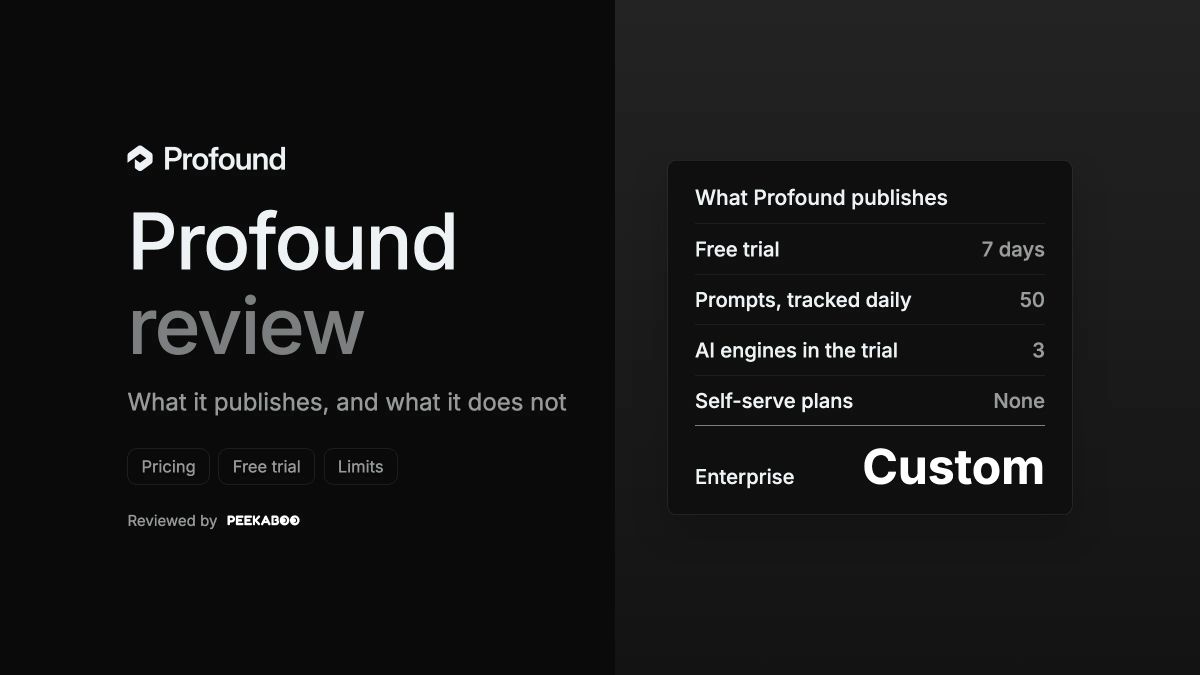
So is Profound worth it? I think it is for an enterprise team that will use the evidence to do something. Its tailored tracking and prompt research can help a large AEO program decide where to work, and Agents provide a production route after the finding.
Start with the buyer's problem. If your team only wants to watch a small set of questions, a simpler tracker can cover that job. If content and PR owners need a connected program, Profound has a stronger reason to be in the comparison. The free brand trial is a prescribed industry preview, so it cannot settle the fit of your own question panel.
Who Profound is for
The question should represent a decision your team can act on. Asking an assistant about your brand may show recognition, but it does not cover the buyer who is still explaining a problem or comparing a capability.
Choose one issue that matters to the business. A product explanation that buyers misunderstand can give the content owner something concrete to investigate. A cited third-party page describing competitors can give PR a different task.
Google Search Console can help identify real Google questions already relevant to the business. Those queries still need to become the fuller questions a buyer might ask an assistant; Google evidence is a starting point rather than proof of AI demand.
I would judge Profound on the work that happens after the response. Answer Engine Insights supplies the observation. The team has to connect it to the right issue and person before the broader enterprise workflow becomes useful.
Suppose you sell software for a large company with a specific compliance requirement. An answer names your brand but describes it as suitable only for smaller businesses. That is a useful issue because the brand appeared and the explanation still failed the buyer's question. Counting the mention alone would miss the work.
The assignment depends on where that explanation comes from:
The content owner can inspect whether the relevant product page explains the capability and its limits clearly.
The PR or brand owner can assess a cited comparison that presents an outdated view of the company.
The technical owner can investigate access to a relevant page if bot evidence gives them a reason to do so.
Av. António Augusto de Aguiar 122C 1050-046 Lisboa, Portugal
Minnesota
202 N Cedar Ave, Suite 1 Owatonna, MN 55060, USA
Profound connects evidence and production for these different owners. I think that is its strongest enterprise argument. A large AEO team coordinating content with brand work has more to gain from the connection than a small marketing team that needs a weekly observation and already knows who will write the update.
Enterprise tracking has capability for up to nine platforms:
ChatGPT.
Perplexity.
Google AI Mode.
Gemini.
Microsoft Copilot.
DeepSeek.
Anthropic Claude.
Google AI Overviews.
Exa Search.
The tailored package determines the actual scope. Languages and regions are custom too. A team serving different markets should choose the audience context alongside the question, rather than treating every response as relevant to every customer. A useful answer for one market may not address the requirement that matters in another.
I would start with the platforms and markets that matter to the commercial issue. More coverage creates more evidence to interpret; it only earns its place if someone will use it. Retail teams also have an Enterprise ChatGPT Shopping capability, which the brand trial excludes. That is a separate fit consideration for commerce, not a reason to assume every general brand question needs shopping coverage.
How Profound measures AI visibility
Profound's visibility score counts brand-containing responses among responses that contain at least one brand. It excludes answers without any brand from the denominator.
That Answer Engine Insights definition changes what the percentage means. Keep the chosen question panel and platform context stable before treating a trend as a useful change.
Don't make another product's headline number the comparison. AI Peekaboo keeps eligible nonmention runs as zeros in its denominator. The values can differ because they count different populations, before you even get to the answer evidence.
Come back to the response and source page. A mention tells you the brand appeared; a grounded citation gives you a URL used in that answer. Neither proves what every buyer sees or that a page change will cause a sale.
Profound also includes Share of Voice and Average Position. These add category context and placement within answers to the presence question. A brand appearing in an answer is not necessarily the brand the answer recommends most prominently. A team comparing competitors needs to understand that difference before treating more appearances as a stronger recommendation.
Keep the competitor set relevant to the same buyer problem. In the hypothetical compliance example, a competitor serving that requirement is useful context; an unrelated product with frequent mentions can distract from the category decision. I would read the underlying answer before assigning work from either comparative metric. The labels do not replace the explanation of why the assistant brought a company into the answer.
Sentiment answers another question: how the brand is portrayed. A visible response can still frame the product negatively or attach the wrong limitation to it. Brand and PR teams have a reason to care about that even when the visibility trend looks healthy. A content team may need to correct a capability explanation rather than produce another broad category article.
FactCheck is part of Answer Engine Insights too. I would still have a knowledgeable owner examine a disputed claim against the product evidence before deciding whether it is wrong. The feature’s presence does not make every answer accurate or establish how reliably every error will be found.
For me, these signals become useful together when they change the assignment.
Presence tells you the brand entered the answer.
Placement helps assess its role there.
Portrayal tells you whether the explanation helps the buyer understand the company.
Profound prompt research and citation analysis
Prompt Volumes adds research about what people prompt AI systems. That can help an enterprise choose where to allocate attention before it funds recurring tracking.
The configured panel is still a set of questions you choose. A question can be important to the product without having a known AI volume. The research should inform that choice, without turning every tracked prompt into a claim of proven demand.
Capability questions, where the buyer needs a product to meet a particular requirement.
Comparison questions, where the buyer is weighing relevant competitors for that requirement.
Replacement questions, where the buyer wants to solve a problem their current product leaves unresolved.
Those are question types for an illustrative panel, not claims about which prompts have the most volume. Each group should lead to a different decision the team could make. Rephrasing the same broad brand question many times does not automatically give you broader commercial coverage.
Profound supports prompt organization through topics and tags. CSV uploads use Topic and Prompt fields, and Enterprise lets you edit, disable or add questions. Use that control to keep the panel connected to current products while retaining a stable group for trend comparisons. If you change the wording or market context, keep a record of the change so the report does not mistake a new question set for a visibility improvement.
That takes an owner who understands the customer problem. Prompt Volumes can help inform their research, but it should not take over the choice of what the business needs to understand.
The same applies to a cited publisher. If a relevant page appears in competitor answers, assess that specific page before deciding on outreach. The citation does not mean a placement is available or that the engine has declared the publication trustworthy above everything else.
The source page also helps you choose between a refresh and outreach. Suppose the answer to the compliance question cites your own page, but the page gives only a general product description. The first task could be to explain the requirement clearly on that page, including the boundary of what the product supports. Writing a separate article may leave the original source of confusion untouched.
If the source is a third-party comparison, inspect the relevant passage instead. An outdated limitation could justify a correction request supported by product evidence. A comparison that accurately describes a competitor's strength calls for a different response: explain your own fit better, without asking the publisher to remove a fair distinction.
Look at the cited URL rather than treating the whole domain as one opportunity. A relevant product comparison and an unrelated article on the same site do different jobs. I would give the writer or outreach owner the exact page and the buyer question it affects. That is enough to make a useful assignment without promising the publisher will change it or that a later AI answer will follow.
How Profound Agents create content
Agents give the team a reusable production route after the finding. They consume credits each time they run, with an estimated credit cost available before execution.
The builder connects research steps to content work. AI Marketer supplies the chat layer around the team's context, so the issue can remain part of the production process.
The supporting capabilities have different roles:
Context Manager provides knowledge about the brand to AI Marketer.
Enterprise Projects provide shared working spaces.
Profound Sheets supports running Agents at scale.
I would use those capabilities to keep a recurring task connected to its inputs and owner, rather than judge the product by how much text it can generate.
Opportunities identifies potential work for the brand. That gives the team candidates to consider, not an editorial priority on its own. The compliance explanation deserves attention if it affects an important buyer question and the team has evidence of the correct capability. An unrelated gap with a more dramatic chart may deserve less effort.
A useful evidence-to-approval sequence for that hypothetical issue would be:
Give the workflow the selected question, relevant answer and source page, alongside the correct product information.
Use research steps to understand the gap between the buyer's requirement and the current explanation.
Produce a proposed update that resolves that gap without extending the product claim beyond what it supports.
Have the content owner approve the explanation and any material capability statement before publication.
Continue observing the relevant questions after the approved change, retaining the original context for comparison.
That is an illustrative team process, not a claim that Profound automatically publishes the approved draft. AI Marketer can help work through the issue conversationally; the reusable Agent workflow gives recurring production a structure. Neither removes the need for someone who knows the product to make the final call.
The practical burden is deciding those inputs and approval responsibilities. If your team cannot explain what a correct output should say, more workflow nodes will not settle it. I think Profound is more useful to an established content team with an accountable editor than to a team expecting automation to decide its product positioning.
Enterprise credits are tailored. There is no public fixed credit price or current brand article allowance that tells you how much recurring work the package funds. Keep that scope clear before putting an ongoing content schedule on it.
If production is the reason you are buying, I would compare the funded workflow before committing to the larger program. Profound vs AthenaHQ puts Profound beside AthenaHQ’s finite Starter credits. Work out what monitoring consumes first, then come back to what is left for the work your team wants to repeat.
Profound analytics, integrations and enterprise access
Agent Analytics supports investigation of AI-bot access and AI-sourced traffic. It is useful when the technical team needs to assess whether an access or traffic issue deserves a change.
A bot reaching the page does not prove the page was cited. A citation also does not establish a conversion effect. Keep those observations clear so the technical owner works on the issue the evidence actually supports.
The integration choices include Cloudflare and Google Analytics. They belong to different investigations: bot access is a technical reach question, while AI-sourced traffic is a visitor question. Start with the evidence needed for the issue rather than connecting another system simply because it is available.
In the same hypothetical product example, a technical owner might inspect bot access when a relevant capability page appears difficult to reach. That is a reason to assess access, not a conclusion that access explains every missing mention. If the team is instead trying to understand visitors arriving from AI, traffic evidence is the useful route. Answer Engine Insights remains the place to investigate the observed response.
A stakeholder report should preserve those distinctions. A technical change can be complete even while the answer remains unchanged. A clearer answer can appear without a corresponding traffic change. The reporting owner needs to say which observation changed and which business question remains open, so the next assignment goes to the right team.
Brand Enterprise provisions include:
Unlimited seats.
API access for programmatic data handoff.
CSV exports.
JSON exports.
SSO/SAML.
SOC 2 compliance.
Dedicated Slack.
A specialist with a 24-hour SLA.
Those provisions can matter to a large organization, but they don't choose the content intervention or approve it for you.
Enterprise also includes all-time history. That matters when the team needs to return to earlier observations alongside its record of content changes. Keep the question set and platform context with any exported result; a percentage without that context gives another analyst too much room to draw the wrong conclusion.
CSV or JSON can support a defined reporting handoff. API access matters when the organization needs programmatic data delivery into an existing workflow. Unlimited seats allow the relevant enterprise owners to collaborate, while SSO/SAML addresses controlled access. Those are different requirements, and a team that only needs a periodic report may have little use for an API.
For the compliance issue, I would want the report to show the response that prompted the work, the assigned page change and its approval status. Subsequent observations can sit beside that record without being presented as proof that the edit caused a sale. Dedicated support can help the team use the broader program, but the 24-hour SLA does not promise resolution of every issue within that period.
Can you customize the Profound trial prompts?
No, the free brand trial cannot run your own commercial panel.
Brand trial term
Included scope
Duration
Seven days
Daily questions
50 prescribed industry prompts
Customization
Unavailable
The platforms are:
ChatGPT.
Gemini.
Google AI Overviews.
Trial research and production
Included scope
Language
One
Region
One
Prompt Volumes searches
Five
AI Marketer credits
Limited
You have room to explore the research before deciding what the broader product needs to fund.
These handoffs are outside the trial:
Historical data.
Exports.
API access.
Support.
SSO.
Confirm trial card terms before starting. The industry evidence can still reveal an issue worth pursuing. It just cannot validate your custom questions or an external data workflow the free scope doesn't include.
I would use the trial to produce one concrete issue record from an included prompt. Read its answer, distinguish a brand mention from a cited source and decide whether the explanation raises a question for a content or brand owner. If it does, describe the proposed next action and the product evidence needed to approve it.
Keep the selected prompt visible in the record so someone reviewing the evaluation understands exactly what was observed.
The trial can introduce the evidence-to-work idea before the Enterprise scope is defined. An enterprise team still needs its own panel and market requirements addressed in the continuing package. A retail team assessing ChatGPT Shopping or an analyst assessing historical exports cannot use this free scope to settle those separate needs.
Profound enterprise and agency pricing
Brand Enterprise has custom pricing.
Come back to the scope you need to continue. The package should fund the tracking panel and the Agents work the team will repeat. Enterprise credit quantities and overage rates are not public fixed allowances, so a precise cost per article needs the quantities in the intended offer.
Agency Growth has a separate monthly price structure:
Agency Growth monthly component or illustration
USD amount
Account base
$99
Each full client workspace
$399
Hypothetical one-full-client total
$498
Hypothetical three-full-client total
$1,296
These are agency totals, not a brand Enterprise quote.
Each full client workspace
Included capacity
Unique daily prompts
100
Language
One
Monthly Agent credits
400
The full client workspace monitors:
ChatGPT.
Perplexity.
Google AI Overviews.
Agency Growth supplies five seats for the account. Its client data handoff has these boundaries:
CSV/JSON exports: client workspaces only.
API access: unavailable on Growth.
SSO: unavailable on Growth.
Agency Enterprise has custom scope. Don't transfer brand Enterprise's unlimited seats to the agency plan.
Temporary pitch capacity
Included scope
Workspaces each month
Ten
Daily prompts per workspace
25
Workspace duration
Seven days
They aren't ten ongoing full clients. Notice the panel difference too: the agency workspace includes Perplexity where the free brand trial includes Gemini.
AI Peekaboo: best for agency monitoring
I'd point your agency to AI Peekaboo instead of Profound when you already have a content process and want monitoring that feeds it, with reports under your own brand. You pay only for what you track. It makes the most sense when your team writes the content itself and wants solid evidence before deciding what to do next.
When a client moves up or down, the exact AI answers behind it are one click away, along with the sources they cited. That turns a vague trend into something you can put in front of the client, and gives your team a clear next step.
Key features
Give every client brand separate prompts, competitors and a dashboard, and trace each score back to the AI answers and cited sources behind it.
Use prompt suggestions, recommendations and content briefs to work out what to track next and give your writers a brief to start from.
Track the AI platforms you choose, up to 7: ChatGPT, Gemini, Perplexity, Google AI Overviews, Google AI Mode, Microsoft Copilot and Claude API.
Share a read-only client link, or route the data into Looker Studio or your own reporting through the API.
Pull visibility and citation evidence into Cursor through the MCP server when a client asks what changed and why.
Connect GA4 and Google Search Console to read AI visibility alongside site traffic.
Prepare for pitches with unlimited pitch workspaces: one extra brand slot covers every prospect, because you reuse it for each new brand.
Pricing
You decide the brands, the prompts per brand, the AI platforms (up to 7) and how often prompts run, and the price is built from those choices as you make them. Six platforms cost the same per check. Claude API is the exception and costs more, so check what it adds first. Example plans:
Brands
Prompts per brand
AI platforms
How often prompts run
USD monthly
8
75
3
Monthly
30
4
40
3
Weekly
32
1
40
4, one of them Claude API
Weekly
62
3
150
4
Weekly
120
1
300
4
Every 3 days
200
10
100
3
Every 3 days
500
Any three standard platforms you pick come out at these prices, so the choice is about your clients rather than the bill, unless you add Claude API.
Pay annually and the monthly list price drops by 15%.
White-label reports and client share links are included on plans of $100 a month or more.
No per-seat charge applies, whatever the size of your team.
How often prompts run is a single account-wide setting, so all your clients run on the same schedule. Choose it before building the plan.
Who should choose it
Choose AI Peekaboo if you run an agency and want branded AI visibility reports for several clients, with evidence of what changed and a clear next action. It fits teams whose SEO and content people already own the page updates and need the buyer question and source evidence, not a second production system. If you want enterprise research and recurring Agents work in one connected program, Profound covers that wider need. A brand that only wants to find out if AI answers mention it, and get some direction on showing up more, can start with AI Peekaboo too.
Skip it if you want finished articles: AI Peekaboo provides briefs, so your writers or a writing tool remain part of the work. And check before you commit if a client needs city-level results in the same report, because local-tracking data is not in standard exports or Looker Studio.
Otterly: best for daily AI visibility tracking
Otterly fits a lean marketing team that wants a fixed daily panel.
Otterly monthly plan
USD price
Daily prompts
Lite
$29
15
Standard
$189
100
Standard includes unlimited workspaces and team members.
The included platforms are:
ChatGPT.
Perplexity.
Google AI Overviews.
Microsoft Copilot.
Paid extra platforms are:
Gemini.
Google AI Mode.
Claude.
The daily rhythm is useful if that is the schedule you need, with less cadence choice than AI Peekaboo.
The Otterly review helps assess that continuing monitoring job. Keep the writing process with your team if the new tool only needs to supply repeated observation.
For a lean team, the daily record can be enough if someone reviews it and owns the resulting page work. Standard's workspace and team scope helps when several people need to work with that record. It still matters whether the included engines cover the audience; a paid extra changes the package you are comparing.
I would favor Otterly when daily observation is the requirement and the team is happy to keep interpretation and production in its existing process. AI Peekaboo gives a different cadence choice, while Profound connects broader research with reusable Agents work. An existing SEO team can act on monitoring evidence from either narrower option without assuming that adopting an AEO tool requires replacing its content workflow.
Is Profound worth it for your team?
A useful Profound evaluation should leave an enterprise issue with an owner and an approved next action. Judge the output against the buyer problem you started with, then establish whether the package funds the recurring work.
For an enterprise AEO lead coordinating content and PR across markets, I would resolve three requirements before choosing the continuing scope:
The custom question panel covers the relevant buyer jobs, with the platforms and market context the team needs.
The recurring Agent credit budget supports the specific workflow and review cycle the content team intends to repeat.
The history and data handoff give the reporting owner enough context to explain changes and assign further work.
A team that needs all three has a clear reason to evaluate Profound as a connected program. Choose around the people who will use the output, rather than a feature inventory that no one has time to act on.
A domain-based free AI visibility checker gives you a one-time starting snapshot. Evaluate a selected buyer question separately before assigning the content or technical intervention.
If the enterprise connection helps your team make and repeat that decision, Profound is worth pursuing. If all you need is the monitoring record, choose the tool that covers that job.
How we checked this
Last checked: 2 October 2026.
Prices and plan limits: each vendor's public pricing page. Features: vendor help docs and product pages.
Frequently asked questions
Can all six people in an agency use Agency Growth?
No, Agency Growth includes five seats for the account, so it does not cover a hypothetical team where all six people need access. Adding a full client workspace should not be treated as adding staff capacity. I would settle who needs to work inside Profound before choosing the plan; Agency Enterprise has custom scope rather than a fixed six-person entitlement.
Do 400 Agent credits mean 400 finished articles?
No, the 400 monthly Agent credits in a full Agency Growth client workspace are a workflow allowance, not an article count. Runs consume credits, and their estimated cost is available before execution. For a recurring writing task, I would budget around the workflow you intend to repeat and the revisions it needs. A generated draft still needs an editor's approval.
Can I carry my existing visibility trend into Profound unchanged?
No, I would start a separate baseline in Profound rather than join the two percentages into one trend. Its visibility denominator excludes responses that name no brand, while AI Peekaboo retains eligible nonmention runs as zeros. Keep the buyer questions and platform context comparable, then examine the answers behind any difference. A higher percentage after switching does not by itself establish that more buyers see your brand.
Start with your own visibility.
See where your brand appears in AI answers and which competitors get mentioned.
 Filipe Lins Duarte