I'd lean toward Profound for a large brand running coordinated AEO and content work. Athena makes sense for a team that wants monitoring and optimization inside a defined credit budget. For an agency mainly measuring clients and delivering reports, I'd also compare AI Peekaboo.
If you want a tool that helps the team do something with AI visibility, Profound and AthenaHQ both deserve a look. I'd lean toward Profound for a large brand running coordinated AEO and content work. Athena makes sense for a team that wants monitoring and optimization inside a defined credit budget. For an agency mainly measuring clients and delivering reports, I'd also compare AI Peekaboo.
The mistake is to compare the biggest platform number and assume the decision is made. Coverage tells you where a product can work. The plan tells you how much work is funded, and the workflow tells you what the team can do afterwards.
What you need to complete
My choice
Reason
An enterprise brand's AI-marketing program
Profound
Answer analysis and marketing workflows together
Monitoring that feeds optimization
AthenaHQ
Starter includes a base agent and a credit allowance
Agency measurement and branded reports
AI Peekaboo
Monitoring can follow the client requirement
Who Profound is for
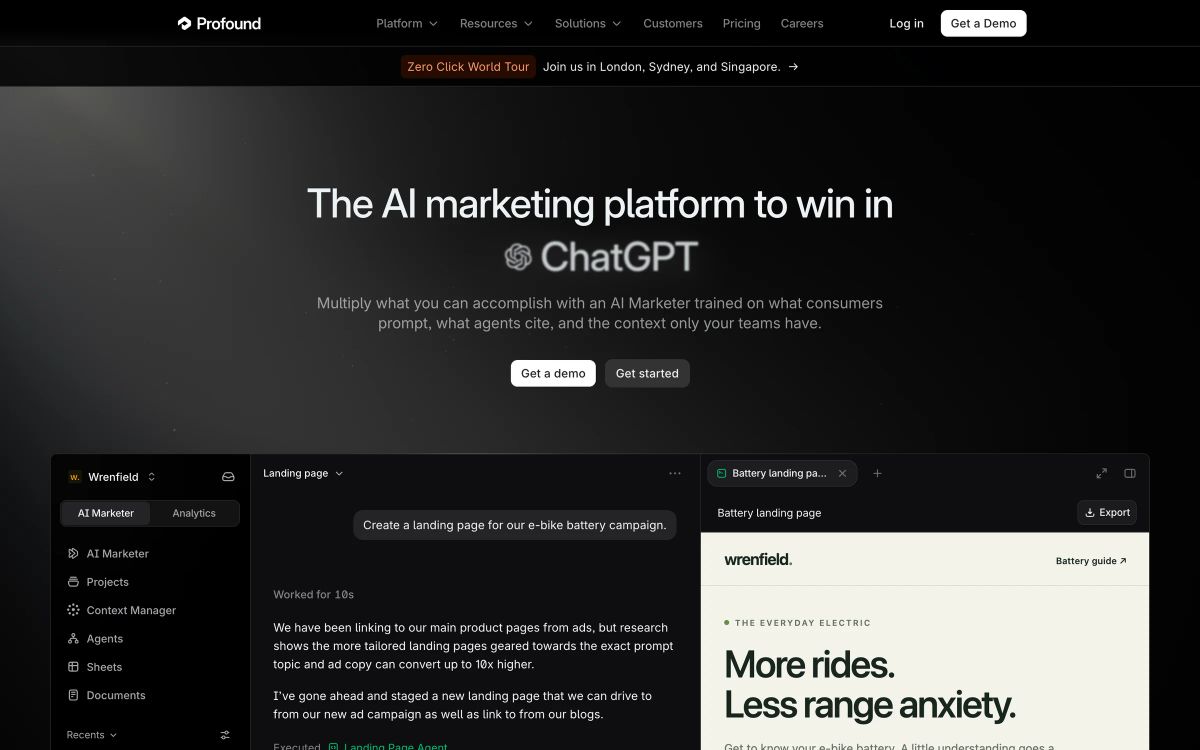
Profound fits larger brand teams that will use AI Marketer and Agents alongside Answer Engine Insights. You can move the finding into a recurring marketing workflow rather than leave it as a number in a report. That's the scope I would want the team to use before choosing it. Its node-based Agents can connect research and content tasks, which suits a brand with people responsible for the whole process. If nobody will own the resulting content work, that broader workflow has less value.
The research question matters too. Answer Engine Insights follows the questions you're tracking; Prompt Volumes helps explore what users prompt AI engines. A large AEO team may need both to decide which topics deserve attention. A configured panel shows how answers respond to your questions, but doesn't establish demand for those questions.
Av. António Augusto de Aguiar 122C 1050-046 Lisboa, Portugal
Minnesota
202 N Cedar Ave, Suite 1 Owatonna, MN 55060, USA
Enterprise includes tailored tracking across up to nine answer engines, with unlimited brand seats. API and exports are included. Agent runs consume separate credits, so don't read tracking capacity as unlimited content work. The Profound review goes further into that workflow.
The free trial gives you 50 recommended questions checked daily for seven days. You can't replace them with your own prompts. It covers:
ChatGPT.
Gemini.
Google AI Overviews.
The trial excludes:
Exports.
API access.
History.
I would treat it as a first look, then evaluate the actual program's custom questions within Enterprise. Those are different jobs. For ongoing comparisons, Enterprise adds daily tracking and all-time history. Keep a stable question set when you want to explain change; changing the questions also changes what the trend represents.
AthenaHQ credits and optimization
Athena Starter's 3,600 monthly credits can fund a focused monitoring panel, but don't assume they cover daily checks across all 11 eligible platforms. An ordinary response uses one credit; heavier platforms use five. Turn on fan-out, with three extra variations, and the baseline monitoring requirement becomes four times larger.
AthenaHQ is a useful fit when the team wants monitoring to lead into optimization work. Starter includes a base content optimization agent and on-page or off-page actions. The advanced agent belongs to Enterprise. Choose Starter when the base optimization scope fits the team's work. Athena's cited-page Outreach kanban gives off-page findings a place to become outreach tasks. That is useful if your team has someone who can assess and pursue those opportunities, rather than treat every citation as a placement to buy.
Athena also offers prompt discovery, with access depending on the plan. I'd use it to challenge gaps in a proposed panel, rather than assume a larger question count means better coverage. CSV upload supports an existing set, but prompt text locks once response data has been collected. To change it, pause the old prompt and create a new one. Settle the wording before building a reporting baseline.
Enterprise matters when the program needs:
Multiple regions and languages.
Persona targeting.
Knowledge Base claim review and discrepancy detection.
SSO and audit logs.
Starter supports a single country and language. Members are unlimited, but API access costs extra on Starter and is included on Enterprise. The AthenaHQ review helps you work out which boundary changes your decision.
Profound vs AthenaHQ vs AI Peekaboo: key differences
The useful comparison is whether each route carries a finding into the work your team owns.
Requirement
Profound
AthenaHQ
AI Peekaboo
Main job
Enterprise AI marketing
Monitoring and optimization
Agency measurement and reports
Your own questions
Enterprise tailored panel
Credit-funded paid tracking
Pay for the prompts you track
Content work
AI Marketer and Agents
Base or advanced agent by plan
Briefs leave writing to the team
API
Enterprise included
Starter add-on; Enterprise included
Active paid subscription
People using it
Unlimited brand seats
Unlimited members
No per-seat fee
Choose the product whose evidence helps you explain a weak answer, not just display a percentage. All three record citations. Profound couples citation analysis with sentiment and competitor visibility; those views help separate being absent from being mentioned unfavourably. Athena identifies cited domains and URLs for source analysis and outreach. AI Peekaboo retains source URLs and domain frequency by platform, so you can investigate whether the same sources recur.
The percentages need care. Profound's visibility denominator includes only responses naming at least one brand. AI Peekaboo's share of voice stays tied to the same observed prompts, platforms, competitors and dates. Compare the underlying answers and their scope before treating two headline numbers as equivalent.
A mention and a cited URL aren't the same result. Neither tells you a sale happened. I would inspect the answer and the source page before giving a score more meaning than its own question set supports.
Technical checks answer a different question. Profound's Agent Analytics covers AI bot and AI-sourced traffic. Athena's Site Health and AI Peekaboo's technical GEO checks help identify crawler-access problems. A bot reaching a page doesn't establish that an answer recommends the brand. Use those diagnostics when investigating a technical obstacle, alongside the actual answers.
For internal leadership reporting, Profound Enterprise combines history with CSV/JSON exports and API access. Athena Starter has CSV export; Enterprise adds executive dashboards with BI tools. Profound Enterprise also includes SSO/SAML and SOC 2 compliance. Athena's Enterprise SSO and audit logs matter when a larger team needs controlled access. I'd confirm the required output and controls together, rather than assume a dashboard screenshot will serve both the analyst and leadership.
Profound and AthenaHQ pricing
Profound's brand pricing offers the free seven-day preset trial and custom Enterprise pricing. It doesn't publish an Enterprise monthly amount. A separate agency workspace fee isn't the price of a brand program.
More credits and Starter API access cost extra, with unpublished amounts. I'd decide which questions and outputs are needed before calling the Starter price the complete budget.
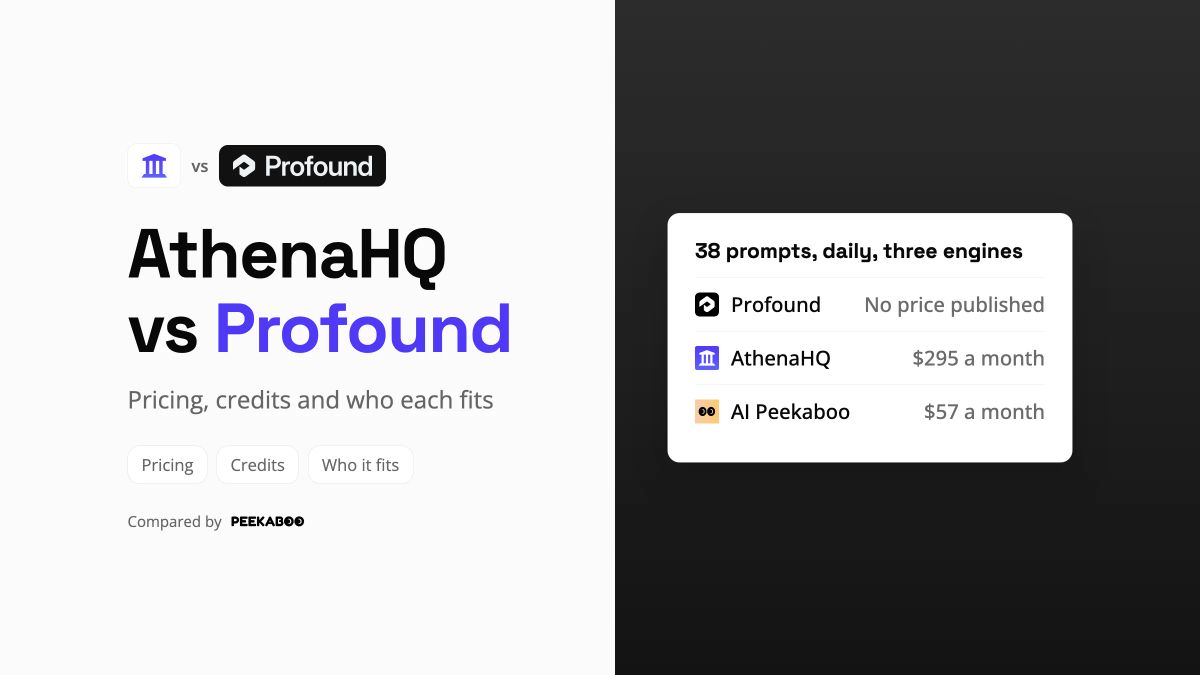
What 38 daily questions cost
This hypothetical panel fits Athena Starter's ordinary-response allowance, but leaves little room for extra monitoring:
One brand in one country.
38 chosen questions.
ChatGPT.
Gemini.
Perplexity.
Daily checks for 30 days.
You need 3,420 ordinary responses, without fan-out or heavier platforms.
Route
Monthly amount for this panel
Keep in mind
Profound brand Enterprise
No price published
Tailored scope; preset trial doesn't run these custom questions
AthenaHQ Starter
$295
Baseline fits 3,600 credits; other usage needs capacity
AI Peekaboo monitoring
Calculated $57
Monitoring only; branded reports excluded
That baseline leaves 180 Athena credits. Fan-out would take it beyond Starter's included allowance; it isn't a free way to deepen this same panel. Extra-credit and Starter API prices are unpublished, so there isn't a defensible all-in top-up total to attach. Profound still needs a brand Enterprise quote for these chosen questions.
AI Peekaboo’s $57 example is an illustrative standard-monitoring calculation. The tools still collect and score answers differently. Matching a panel doesn't make the broader marketing workflows equivalent either.
AI Peekaboo for agency reporting
Profound and AthenaHQ both reach into execution. AI Peekaboo is the one I'd point you to if you run an agency that measures several clients, sends branded reports and already has writers and SEO specialists to act on the findings. You pay for what you track across your clients, and the execution stays with your own team.
Whenever a client's position in AI answers changes, you can open the answers that changed and the citation sources they cited. Instead of reporting a number that moved, you show the client the evidence and give your team a specific thing to fix.
Key features
Pick which AI platforms each client is tracked on, up to 7: ChatGPT, Gemini, Perplexity, Google AI Overviews, Google AI Mode, Microsoft Copilot and Claude API.
Keep each client brand on its own prompts, competitors and dashboard, so every score links through to the AI answers and cited sources behind it.
Open a read-only link for each client, or send the data to Looker Studio or your own reporting through the API.
Query each client's visibility, competitors and cited sources from Claude Desktop over MCP, so report prep starts inside your AI assistant.
Pull GA4 and Google Search Console in, so you can compare AI visibility with the traffic each site receives.
Get recommendations, prompt suggestions and content briefs that show where to look next and give your writers a brief to work from.
Pitch as many prospects as you like through unlimited pitch workspaces, which run on one extra brand slot reused for each prospect's brand.
Pricing
Your plan is the sum of what you choose: how many brands, prompts per brand, AI platforms (up to 7) and how often prompts run. Each choice updates the price on the spot. Claude API carries a higher price per check than the six other platforms, which share one price, so check what it adds before you select it. Example plans:
Brands
Prompts per brand
AI platforms
How often prompts run
USD monthly
5
30
3
Weekly
30
5
50
3
Weekly
50
1
25
4, one of them Claude API
Every 2 days
105
1
100
4
Daily
200
3
60
5
Every 2 days
225
10
100
3
Daily
1,500
You set the platform mix yourself. These prices fit any standard combination, and Claude API is what pushes them up.
An agency willing to pay twelve months at once saves 15% on the list price.
Spend $100 a month or more and you get white-label reports and client share links included.
Headcount doesn't change the bill, because there is no per-seat charge.
The account has one schedule for how often prompts run, and every client follows it, so choose that before pricing anything else.
New workspaces that cost under $100 a month and carry at least 10 prompts per brand can be eligible for a 14-day trial, which requires a card.
Who should choose it
Choose AI Peekaboo if your agency needs AI visibility reports under its own brand for several clients, with the evidence of what changed and a next step to act on. Bear in mind the 38-question daily panel above costs $57 a month, under the $100 line, so it comes without white-label reports or client share links. And confirm that Profound or Athena really gives clients the same branded view before you assume it does. If you're a brand that simply wants to know whether AI answers mention you, and get some direction on showing up more often, it does that job too.
Skip it if you want articles written for you: AI Peekaboo delivers briefs, not finished articles, so you'll still rely on your writers, a writing tool, Profound's Agents or Athena's content agent.
Give the preferred route a concrete evaluation task:
Fix the buyer questions and competitor set, keeping country and selected platforms consistent. Profound's preset trial can't run this custom panel, so evaluate that scope within Enterprise.
Inspect the answer and cited URLs for one question where a competitor appears and your brand doesn't. Decide which action the evidence supports.
Assign that action and produce the report its owner or client needs. Compare recurring results on the same panel, with enough runs for any evidence-dependent brief.
Athena Starter uses its default schedule; custom schedules belong to Enterprise. With AI Peekaboo, how often prompts run is one setting for your whole account, and your history starts when tracking starts. Choose a comparison window the team can maintain. If you're still deciding what belongs in the panel, the free AI visibility checker can give you an initial answer to inspect.
How we checked this
Last checked: 2 October 2026.
Prices and plan limits: each vendor's public pricing page. Features: vendor help docs and product pages.
Frequently asked questions
Should I replace my whole question set while evaluating the tools?
No, keep a core set and put proposed additions aside until you can explain which missing buyer decision they cover. I'd drop an existing question only when it no longer serves the team's work, rather than because a tool suggests something new. That lets you explore a genuine gap without turning the evaluation into a different assignment halfway through.
Should the monitoring panel grow when more colleagues join?
No, give a new colleague a role in the existing findings first. Someone responsible for fixing a content gap may need the same answer that another person reports to leadership. Expand the panel only when their distinct responsibility needs a question the current set can't answer. Ask what they'll do differently with that extra finding before funding more monitoring.
Should conflicting headline scores decide which tool we buy?
No, use the disagreement to see whether either tool changes the action you'd take on the same weak answer. If both lead to the same correction, the score gap shouldn't break the tie. If one makes the reason for that correction clearer to its owner, I'd give that more weight than the higher percentage. You're choosing help with a job, not a number to defend.
Start with your own visibility.
See where your brand appears in AI answers and which competitors get mentioned.
 Filipe Lins Duarte