Profound vs Peec AI: Actions, Workflows and Pricing
Start with Peec AI if you're a marketing or SEO team at a brand, or an agency, and you want a daily view of AI answers and their sources plus a ranked list of what to fix next.
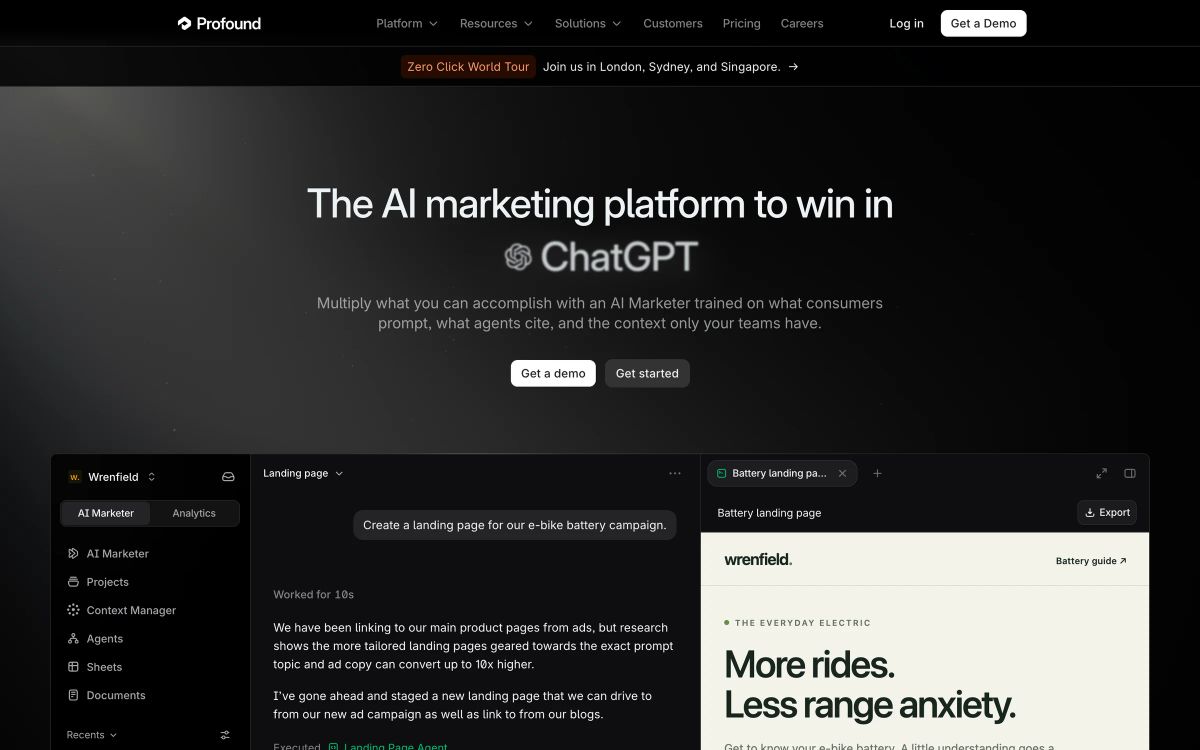
Choose Peec AI for ranked day-to-day actions and Profound for recurring enterprise workflows: Peec AI turns visibility gaps into evidence-backed delivery queues for brand marketing teams and agencies, while Profound Enterprise centers on credit-metered Agent workflows built on a visual canvas for ongoing multi-team enterprise programs.
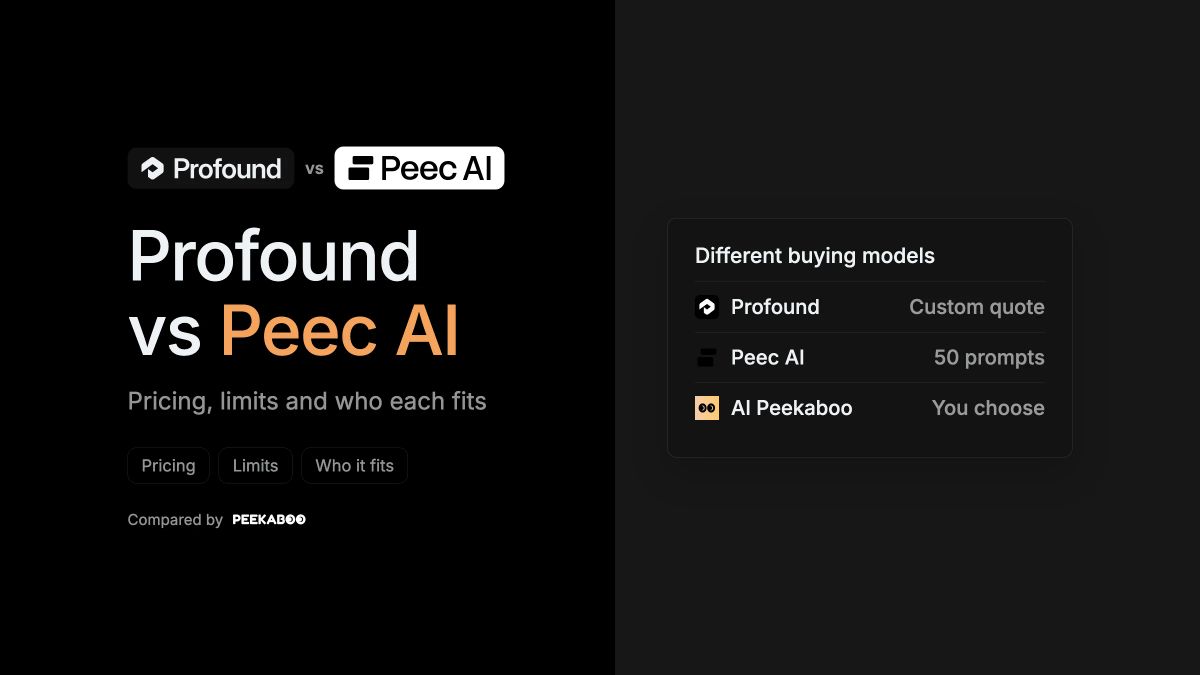
Peec AI publishes fixed EUR tiers while Profound quotes brand Enterprise: Peec AI brand plans cost EUR 85/month (Starter, 50 daily prompts on 3 AI platforms), EUR 205/month (Pro, 150 daily prompts), and EUR 425/month (Advanced, 350 daily prompts), whereas Profound offers a free 7-day preset trial (50 industry prompts) and custom Enterprise quotes covering up to 9 answer engines.
Agency pricing scales differently by workspace model: Peec AI agency plans share allocation credits across projects from EUR 205/month (Essential, 10,000 credits) and EUR 425/month (Growth, 25,000 credits), while Profound Agency Growth charges a USD 99/month base plus USD 399/month per added client workspace (100 daily prompts and 400 monthly Agent credits each).
Agencies and brand teams wanting flexible multi-brand monitoring can use AI Peekaboo: AI Peekaboo starts at $30/month across up to 7 AI platforms with unlimited seats, includes white-label reports and client share links from $100/month, supports MCP, and prices a five-client daily monitoring workload (50 prompts per client on 3 AI platforms) at USD 375/month.
Start with Peec AI if you're a marketing or SEO team at a brand, or an agency, and you want a daily view of AI answers and their sources plus a ranked list of what to fix next. Choose Profound if you're a large enterprise company whose teams run ongoing programs that would reuse the same agent workflows week after week.
Both show where your brand is missing from AI answers, and both help you act on it. The split is the work after a gap: a separate fix for one or two people, which Peec ranks for you, or a recurring program several teams run, which Profound turns into reusable Enterprise workflows. An agency tracking many client brands has a separate monitoring option, discussed after the two: with AI Peekaboo pricing, you pay for what you track.
Av. António Augusto de Aguiar 122C 1050-046 Lisboa, Portugal
Minnesota
202 N Cedar Ave, Suite 1 Owatonna, MN 55060, USA
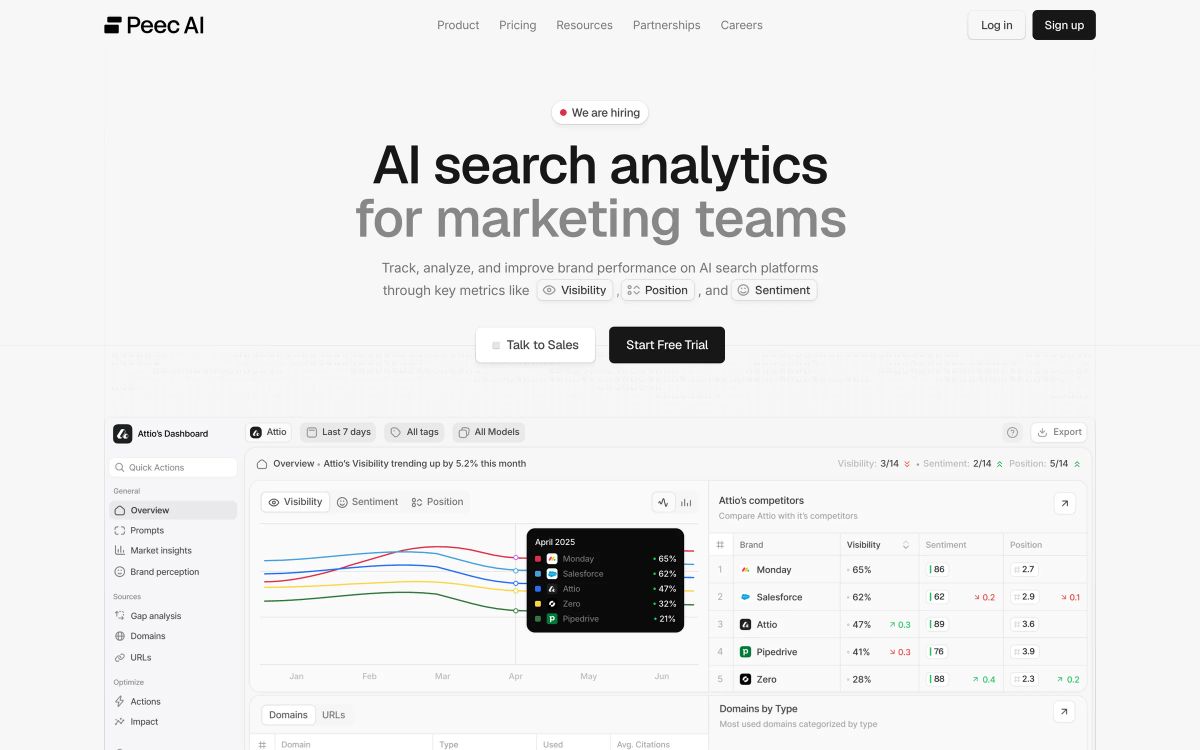
Peec fits the SEO or content team managing day-to-day follow-up; Profound fits several enterprise teams sharing a recurring program. Both track brand mentions and cited sources in AI answers, so the sharper difference is what your team can do after a gap: Peec ranks the next action for the delivery team, and Profound adds reusable workflows for the teams it names. Peec calls itself AI search analytics for marketing teams and serves brands and agencies; Profound's Enterprise package adds up to nine answer engines and AI Marketer credits for the whole team.
Decision point
Profound
Peec AI
Team fit
Enterprise teams and agencies
Marketing teams at brands and agencies
Typical company
Large enterprise brands
Brands and agencies
After a gap appears
Credit-metered workflows on a visual canvas
Evidence-backed delivery queues and a data agent
AI platforms
Up to 9 on Enterprise
3 included, more as paid add-ons; up to 13 on Enterprise
I'd choose Peec for one lead who needs ranked fixes; Profound makes more sense when that lead or a wider team has recurring work to put through its workflows.
How do Profound and Peec AI compare on visibility tracking?
Profound and Peec AI visibility tracking cannot be judged by a single dashboard percentage alone. The useful comparison is whether each product's measures explain the answers your customers care about.
Evidence
Profound
Peec AI
Inclusion
Visibility Score and Share of Voice
Visibility and competitor tracking; SoV in Brand Insights
Prominence
Average Position
Position
Perception
Sentiment and FactCheck
Sentiment, attributes and objections
Sources
Citations
Domains, URLs and citation share
A favorable mention can still sit behind several competitors. A citation identifies a source to investigate; it does not necessarily recommend your product. Share of voice adds relative context, so inspect which rivals occupy the same questions rather than celebrate inclusion alone.
Profound's visibility denominator counts responses containing at least one brand, excluding answers naming none. Treat that as a specific calculation, not a universal visibility percentage. Peec's score should not be assumed to use the same denominator. I'd compare the underlying answers on matched scope before declaring either number stronger.
Prompt selection matters as much as the metric. For the hypothetical project-management brand used below, a useful panel could include:
Comparisons with competing tools for engineering teams.
Use cases such as coordinating engineering releases.
Constraints such as required integrations or team size.
Peec offers suggested prompts and a 1-to-5 volume score alongside topics and personas. That score helps prioritize; it is not an exact search count. Intent classification and bulk import help organize the panel. Profound has Prompt Volumes and CSV prompt upload, with name-matching controls for brand aliases. Verify those aliases before interpreting an apparent absence. Peec's agency sub-brands do not establish identical alias handling or hierarchy. Choose questions that distinguish your customers' decisions, rather than fill capacity with broad prompts.
Collection scope also changes the interpretation. Peec runs daily prompts through UI scraping for a logged-out-user view on its standard AI platforms; some Enterprise engines use APIs. Profound runs structured prompts and builds a response dataset, but that alone does not identify a UI or API mechanism. Neither description establishes equivalence with every customer's personalized session.
For the buying decision, inspect an answer alongside its cited URLs and locale. A score with no usable evidence behind it leaves the delivery team guessing about the next task, regardless of how attractive the trend line looks.
How do Profound and Peec AI handle actions and workflows?
Peec emphasizes recommended actions your team can assign; Profound emphasizes workflows your enterprise team can reuse. The same hypothetical gap makes the distinction tangible.
Suppose you sell project management software, and a tracked prompt, "best project management tool for engineering teams", returns an answer that names three competitors and cites two competitor comparison pages and an editorial roundup. Your brand appears nowhere. Those cited pages give the team an investigation to follow.
Peec AI actions and recommendations
Peec turns a missing mention into ranked actions, each carrying the competitor evidence behind the gap and recommended steps, so whoever picks one up can see why it was suggested. Its Actions split the work three ways, each with a natural owner:
Site audit fixes, such as a blocked AI crawler, for your developers
Owned work, such as the missing comparison page, for your writers
Earned placements, such as the editorial roundup, for whoever handles outreach
Peec labels the Optimize section carrying Actions as beta; evaluate the working queue your team intends to use.
Two features cover the investigation around an action. Peec's agent investigates questions within your tracked data, and crawl insights show which AI bots requested which pages and what status code they got.
Peec also has crawlability checks and AI referral analytics, with CDN and log connections such as Cloudflare or Vercel. Profound's Agent Analytics covers AI bots and AI-sourced traffic, with Google Analytics and infrastructure integrations. For the missing project-management brand, these answer different operational questions:
Crawl evidence helps developers investigate whether bots can reach the relevant pages.
Answer evidence shows whether the tracked response includes your brand.
A successful bot request does not establish a recommendation, and an AI referral does not establish revenue. I'd route a crawl problem to the technical owner before treating it as a missing-content brief.
That's enough to retire the idea that Peec only tracks. For most teams it's the right amount of structure: an evidenced assignment with a receiving owner. The limit is that an action is a recommendation, not a forecast that the answer will change. For a team weighing Peec on its own merits, the Peec AI review gives the full verdict.
Profound Agents and recurring workflows
Profound's Agents turn a gap into a workflow your team can run again, which pays off only if the task recurs and its credits fit your quote. You build the workflow on a visual canvas from connected nodes, each passing its output to the next, and Profound's own examples run as far as generating content and publishing it into a connected CMS.
With Peec, your team works through gaps as they appear. With Profound, a proposed recurring workflow could:
Identify tracked gaps with relevant roundup citations.
Research each cited roundup.
Draft an outreach brief.
The team could rerun the workflow without rebuilding those steps.
The useful automation boundary is the editor's decision. Before a generated brief or article reaches publication, the content owner should check:
Factual accuracy, including claims the company can substantiate.
Relevance to the buyer question and the brand's actual offer.
Source use, so a cited page supports the claim it accompanies.
A connected CMS makes publication possible; it does not make editorial judgment unnecessary. Peec's evidence-backed actions and content briefs also need that receiving owner. Profound becomes more attractive when a stable research-to-review task repeats often enough to maintain its workflow, not simply because it can generate more text.
That reuse is metered: Agents run on credits, and past your allotment the account either bills overage or pauses. Profound's own MongoDB case study claims 30% time saved using Agents, with no period or baseline stated. If your team would run the workflow twice a quarter, you'd be paying for reuse you never collect, and Peec's lighter structure is the better buy.
How does Profound pricing compare to Peec AI pricing?
Peec publishes the fixed-price daily-panel fees, while Profound brand Enterprise is quoted. The comparison must keep the monitoring configuration and workflow usage separate enough to price both.
Peec's three fixed-price brand plans include unlimited users, so collaboration does not require rationing brand-plan seats. Project and country limits still constrain the program. A brand operating in three countries needs more than Starter's one-country scope even if its prompt count fits. Advanced adds project capacity over Pro, but both retain three countries in this comparison.
Keep market-specific evidence separate: a favorable answer in one country cannot establish the same position elsewhere. Profound Enterprise offers custom regions and languages and unlimited seats; its one-region trial cannot establish international fit. I'd choose scope around the markets the team actually serves, not around the largest prompt allowance.
The fixed-price brand plans select three from these eligible platforms:
ChatGPT.
Gemini.
Google AI Overviews.
Google AI Mode.
Microsoft Copilot.
Naver.
Perplexity is an additional model purchase on these plans. Advanced includes Looker Studio. Peec Enterprise is a custom annual package with up to thirteen models and daily or weekly tracking; it explicitly lists API access and SSO. Confirm those integrations on another proposed plan rather than infer an exclusion.
The three-platform comparison below selects:
ChatGPT.
Gemini.
Google AI Overviews.
The five-platform row adds AI Mode and Perplexity. AI Mode could be included in a different three-model selection; it is additional in this particular panel.
Daily panel, one brand in one market
Profound brand package
Peec AI, EUR monthly billing
AI Peekaboo, USD monthly billing
50 prompts on the selected three platforms
Enterprise quote
Starter: 85
75
150 prompts on those three platforms
Enterprise quote
Pro: 205
225
150 prompts on five, adding AI Mode and Perplexity
Enterprise quote
Pro plus two additional models: 345
375
The EUR and USD columns retain their own billing currencies and make no cross-currency savings claim. Annual billing for the corresponding Peec panels is:
Panel
EUR per month, annual billing
50 prompts, selected three models
70
150 prompts, selected three models
180
150 prompts, five-model panel
290
Capacity and coverage create different steps in the bill. The Pro allowance changes the prompt ceiling; additional models change the panel. I would assess each against the work requirement, then compare the full Profound package in its own billing currency.
Profound brand pricing has a free preset trial and quoted Enterprise. Enterprise scope includes:
Up to nine answer engines.
Custom languages and regions.
SSO/SAML.
SOC 2 compliance.
API access.
CSV and JSON exports.
All-time history.
Dedicated support.
Peec Enterprise also lists API and SSO. Those needs alone do not choose Profound; its recurring enterprise Agent workload remains the meaningful distinction.
Profound brand trial attribute
Scope
Price
Free
Duration
Seven days
Prompts
50 preset industry prompts
Collection
Daily
Languages
1
Regions
1
ChatGPT
Included
Gemini
Included
Google AI Overviews
Included
Custom prompt set
No
History
None
Exports
None
API access
None
The preset trial cannot evaluate your own prompt set. Agree that separately if it matters. Agents show a credit estimate before a run, consume credits when run and can pause or continue with overage billing. Larger credit thresholds require an Enterprise package.
How do Profound and Peec AI price agency plans?
Agency cost depends on the allocation unit. Peec shares capacity across projects; Profound Agency Growth charges for added client workspaces on top of a USD99 monthly base.
Credits are allocation slots, not a wallet spent each month, and do not reset or expire monthly. Each project needs at least 900 allocated credits. Essential can allocate about 111 prompts across the whole account on three models daily; that is a configuration example, not a fixed prompt allowance per client.
Profound Agency Growth attribute
Scope
Base fee
USD 99 monthly
Added client workspace
USD 399 monthly
Client prompts
100 daily
Client language
1
Client ChatGPT
Included
Client Perplexity
Included
Client Google AI Overviews
Included
Agency seats
5
Agent credits per client workspace
400 monthly
Opportunities
4 weekly
Pitch workspaces
10 monthly
Pitch prompts
25 daily
Pitch duration
Seven days, extension option
Profound's weekly opportunity allowance is separate from daily client collection. Agency Enterprise has custom scope with API and SSO; Agency Growth has a USD99 monthly base.
The hypothetical agency configuration is:
Field
Requirement
Client brands
Five
Prompts per client
50
Selected platforms
ChatGPT, Gemini and Google AI Overviews
Collection
Daily
It fits Peec Growth allocation at EUR 425 monthly. Profound would require five added client workspaces plus the USD99 monthly agency base, each carrying its own fuller allowance. Its client panel includes Perplexity in place of Gemini in the selected configuration above. That is a capacity comparison, not the same platform configuration or equal packaging. The same monitoring workload is USD 375 monthly on AI Peekaboo, with separate currency columns rather than a cheaper verdict.
Reporting access is a separate requirement from monitoring capacity. Peec offers CSV export and an API, with Looker Studio explicitly included on Advanced; its agency offering includes shareable dashboards. Profound Agency Growth exports CSV and JSON from client workspaces, while API access belongs to Agency Enterprise. Both products offer MCP connections for assistant workflows, but establish access for the intended package rather than assume every plan includes them.
An export supports client reporting handoffs; an API supports downstream data use. MCP connects data with an assistant workflow. Those jobs are related, but one does not replace the others. For a five-client agency, I'd prioritize client reporting the account manager can explain and evidence the delivery owner can use. Extra capacity is little help if the intended reporting connection is outside the chosen package.
How do AI Peekaboo monitoring, pricing and limits compare?
AI Peekaboo offers a third monitoring and pricing route if neither Peec's ranked queue nor Profound's Agents is what you are really after: AI Peekaboo puts all your brands in one subscription and charges for what you track. It suits an agency first, or an in-house team, that already has people doing the content work and wants hard evidence before choosing the next job.
If a brand gains or loses ground, you can read the very AI answers that moved and check which sources they leaned on. You walk into the client call or the leadership update with proof in hand, and your team knows what to tackle next.
Key features
Follow the AI platforms that matter to you, up to 7: ChatGPT, Gemini, Perplexity, Google AI Overviews, Google AI Mode, Microsoft Copilot and Claude API.
Use prompt suggestions, recommendations and content briefs to decide what to track next and to give writers an outline to work from.
Keep every brand apart, each with its own prompts, competitors and dashboard, and check the answers and cited sources that sit behind each score.
Win new accounts with unlimited pitch workspaces, because one extra brand slot can be reused for any prospect you are pitching.
Pass results to clients through a read-only link, or feed Looker Studio or your own reports from the API.
Connect an MCP client such as Claude Desktop or Cursor to read prompts, competitors and citations, or to add new prompts with a read+write key.
Bring in GA4 and Google Search Console data and view AI visibility beside your site traffic.
Pricing
There is no fixed tier to fit into. You set the number of brands, the prompts for each one, the AI platforms (up to 7) and how often prompts run, and the price moves as you go. Claude API costs more per check than the other six platforms, which all share one rate, so price it before you add it. Sample plans:
Brands
Prompts per brand
AI platforms
How often prompts run
USD monthly
3
50
3
Weekly
30
4
40
3
Weekly
32
4
50
3
Every 3 days
100
1
100
4, one of them Claude API
Weekly
110
2
100
3
Every 2 days
150
12
50
4
Weekly
160
The choice of platforms rests with you. Standard platforms are all one price per check; Claude API is billed higher.
Paying yearly takes 15% off the monthly list price.
White-label reports and client share links come with any plan at $100 a month or above. At $75, the 50-prompt daily panel in the comparison table above falls short of that line.
There is no charge per team seat.
The schedule for running prompts applies to the whole account, so each client is checked equally often. Pick it before you build the plan.
Who should choose it
AI Peekaboo pays off most for agencies: you report on several clients under your own brand and can show the answers behind every change, along with what to do about it. A brand that only wants to see whether it turns up in AI answers, and get some ideas for turning up more often, can use it without much setup. It is not a stand-in for the recurring Agent workflows that bring an enterprise to Profound, and its recommendations still need a person on your team to act on them.
Don't pick it to get finished articles: you get briefs, so writers or a writing tool stay in the process. If a client wants city-level results in that same report, check first, since local-tracking data is not part of standard exports or Looker Studio.
How should you evaluate Profound and Peec AI?
Evaluate whether Peec supplies an assignable action or Profound supplies a repeatable workflow your enterprise team will operate. The deliverable must have an owner and an allowance. Agree custom-prompt work separately, rather than assume that booking a demo includes it.
Use three checks to resolve the practical choice:
Inspect a relevant answer and its source URLs, with the market and prompt scope visible.
Trace the resulting task to the person who will execute it and the editorial or technical review it needs.
Confirm that the recurring workload fits the package's credits and required data access, including the Peec beta queue if it is central to delivery.
Support matters when that work stalls.
Peec Starter: chat support.
Peec Pro and Advanced: chat and email support.
Peec Enterprise: dedicated support.
Profound Enterprise: dedicated support.
Profound Agency Growth: email support.
These are service channels, not proof of faster resolution. If nobody will maintain the proposed Agent workflow, that requirement reverses the Profound recommendation even for a large company.
The free AI visibility checker gives a one-time ChatGPT and Gemini sample in about two minutes without a card. Use it to identify an initial question to investigate. It has no historical panel and cannot establish recommendation causation or guarantee a deliverable when evaluating Profound or Peec AI.
How we checked this
Last checked: 2 October 2026.
Prices and plan limits: each vendor's public pricing page. Features: vendor help docs and product pages.
Frequently asked questions
Should I evaluate monitoring and Agent workflows in the same exercise?
No, I'd give them separate acceptance criteria so an impressive workflow doesn't obscure weak monitoring evidence. Compare the answers on a matched prompt panel to decide which product helps your team understand the gap. For a hypothetical recurring Agent task, define the output its receiving owner would accept, then use the credit estimate to assess the intended frequency. A useful monitoring result can justify Peec without also establishing a need for Profound's workflow automation.
Do Peec allocation credits and Profound Agent credits measure the same workload?
No, Peec's agency credits reserve monitoring capacity, while Profound's Agent credits are consumed by workflow runs. A Peec allocation therefore cannot tell you how many recurring research or drafting tasks Profound will support, and Profound's Agent allowance cannot stand in for its daily prompt scope; I'd size the monitoring panel and the recurring workflow separately rather than treat equal credit numbers as equal capacity.
Can either tool prove that a particular action got my brand recommended by AI?
No, a later brand mention does not by itself prove that a particular fix caused it. Peec's action evidence can guide an investigation, and Profound's reusable workflows can organize the response, but crawl access and AI referral traffic answer different questions from recommendation causation; judge the proposed work on its relevance to the gap rather than promise a result from either tool.
Start with your own visibility.
See where your brand appears in AI answers and which competitors get mentioned.
 Filipe Lins Duarte