AI share of voice is your brand's mentions divided by all tracked brands' mentions on the same prompts and AI platforms. Here's how to calculate it per platform and report it so the number means something.
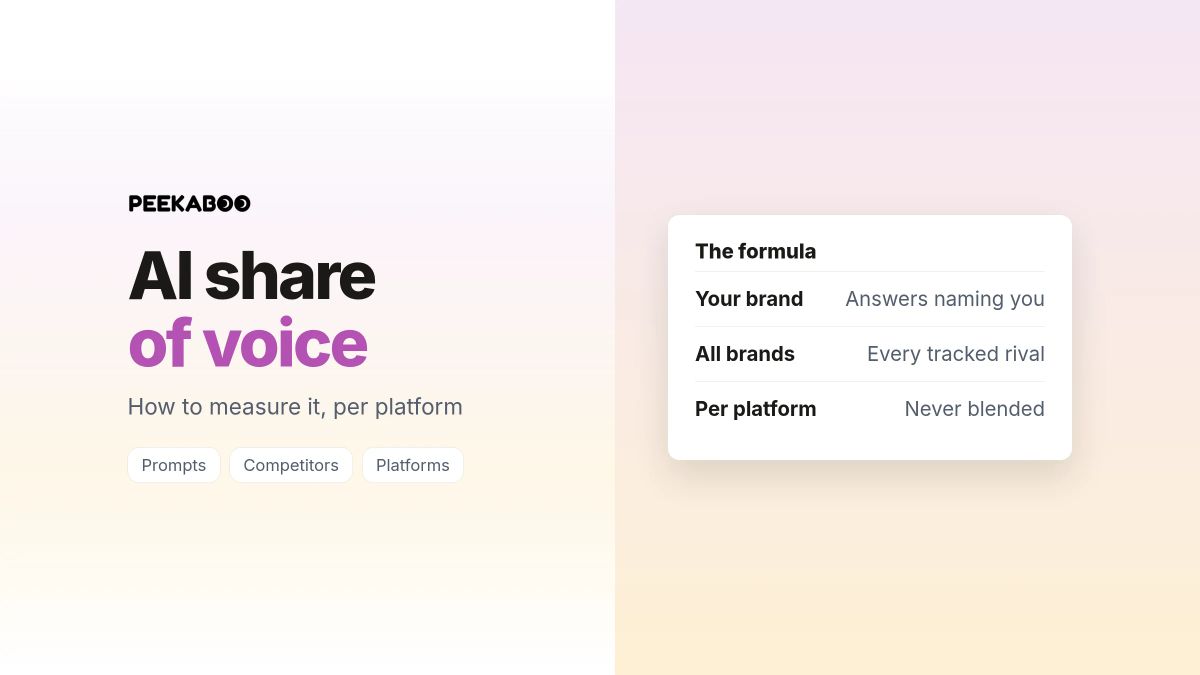
AI share of voice is your brand's mentions divided by the mentions of every brand you track, on the same prompts and the same AI platforms, reported separately for each platform. If you're named 27 times and all tracked brands together are named 100 times in ChatGPT's answers, your ChatGPT share of voice is 27%.
Each part of that sentence hides a choice: which prompts, which competitors, how many runs, and whether you divide by mentions or by answers. Each choice changes the number, and it's why two tools can show the same client two different scores. Below: the calculation, a worked example on three platforms, and how to report the number so it means something to a client.
What AI share of voice means
AI share of voice is your slice of all the brand names AI answers give in your category. It answers a competitive question: when ChatGPT, Gemini, Perplexity or Google's AI Overviews name brands for your buyers' questions, how many of those names are yours?
The idea comes from advertising and PR, where share of voice meant your share of the ad spend or media coverage in a market. In AI answers there's no spend to compare. What you can count is how often each brand gets named in the answers to a fixed set of questions.
Of the numbers in an AI visibility report, it's the one that compares you directly with named competitors. Mention rate (the share of answers that name you) tells you how often you show up. Share of voice tells you how much of the conversation you hold compared with the brands you compete against. Our guide on how to measure AI visibility covers the other metrics, and if you're coming from SEO, our GEO vs SEO guide explains what changes when the result is an answer instead of a ranking.
How to calculate AI share of voice
You calculate AI share of voice in four steps: fix the prompts and competitors, count how many answers name each brand on each platform, divide your count by the total for all tracked brands, then report each platform separately. Tracking AI share of voice in a tool does the counting for you, but it's worth doing once by hand so you know what the number contains.
Av. António Augusto de Aguiar 122C 1050-046 Lisboa, Portugal
Minnesota
202 N Cedar Ave, Suite 1 Owatonna, MN 55060, USA
Pick the prompts and competitors
Start with 20 to 50 prompts your buyers actually ask, enough that no single question swings the share and few enough that you can read the answers behind them, and the three to five competitors you lose deals to. Set both lists before you count anything and keep them fixed, because every later number depends on them.
Most of the prompts should be unbranded: "best expense software for a 50-person company", not "is [your brand] good?". Branded prompts name you almost every time, so they inflate your share without telling you anything about the market. Keep them in a separate group if you want to track them.
For competitors, pick the brands that really compete for the same buyers, plus any brand that keeps showing up in the answers even if you don't think of it as a rival. AI answers can name brands your sales team never mentions. Three to five named competitors is enough for most reports. More than that and each share gets small and noisy, which makes month-to-month changes hard to read. If you've already run an AI visibility audit, the competitors it surfaces are a good starting list.
Count mentions per AI platform
Run every prompt on each platform several times and count, for each brand, how many answers name it. Count a brand once per answer, even if the answer names it three times. That keeps one long answer from outweighing the others.
Run each prompt more than once because the answers change between runs. In a SparkToro study published in January 2026 (not peer-reviewed, and run with a researcher from the AI tracking company Gumshoe), 600 volunteers ran 12 prompts a combined 2,961 times through ChatGPT, Claude and Google's AI. It found less than a 1 in 100 chance that ChatGPT or Google's AI, asked the same question 100 times, would give the same list of brands twice. One run per prompt tells you what a platform said once, not what it usually says, so treat three runs per prompt per platform as the minimum for a manual count. That's well short of the 60 to 100 asks the study's author suggests for knowing an AI's recommendations, so read a hand count as a rough rate and let weekly tracking firm it up.
Keep a separate tally for each platform. Each one can name different brands for the same question, so a share on one platform tells you nothing about another.
The AI share of voice formula
The formula is:
AI share of voice = your brand's mentions ÷ total mentions of all tracked brands × 100
Calculate it per platform, using the same prompts, the same competitors and the same date range for every brand. "Mentions" here means the number of answers that name the brand. "All tracked brands" means you plus the competitors you picked, not every brand that ever appeared, unless you decide to track them all.
The shares of all tracked brands add up to 100%, which is what makes share of voice a competitive metric. If your share goes up, someone else's went down on the same questions.
One variant is worth knowing, because some tools use it under the same name.
Position-weighted share: in list-style answers, being named first counts for more than being named sixth. A weighted version gives full credit for the top spot and partial credit further down. It rewards the top spots, the way a ranked list does, but the weights are a choice, so two weighted scores are rarely comparable.
Start with the plain mention-based formula, because anyone can check it by hand, and you'll use that same check on a tool's number further down.
Worked example: share of voice across three AI platforms
Here's a hypothetical example. A brand tracks 30 buyer prompts against three competitors, runs each prompt three times on ChatGPT, Perplexity and Google's AI Overviews, and gets 90 answers per platform. These are the answers that named each brand:
Brand
ChatGPT
Perplexity
AI Overviews
Your brand
27
40
12
Competitor A
45
30
36
Competitor B
18
20
24
Competitor C
10
10
8
All tracked brands
100
100
80
Divide each brand's count by the column total and you get the share of voice per platform:
Brand
ChatGPT
Perplexity
AI Overviews
Your brand
27%
40%
15%
Competitor A
45%
30%
45%
Competitor B
18%
20%
30%
Competitor C
10%
10%
10%
Your brand leads on Perplexity, trails Competitor A on ChatGPT, and is a distant third in AI Overviews. If you pooled all three platforms into one number, you'd get 79 of 280 mentions, about 28%, and the AI Overviews problem would disappear inside a respectable total. That's why I'd always report share of voice per platform first.
The example also shows why share of voice and mention rate aren't the same. On ChatGPT your brand appears in 27 of 90 answers, a mention rate of 30%, while its share of voice is 27%. On AI Overviews it flips: 12 of 90 answers is a 13% mention rate, but because fewer brands get named there overall, your share of voice is higher, at 15%. Mention rate says how often you're in the answer; share of voice says how big your slice is next to the rivals named alongside you. Read them together before you tell a client you're winning.
Open the AI Overviews answers where Competitor A was named and you weren't, and check which sources they cite. That's your fix list for the 15%.
Why tools report different share of voice numbers
Tools report different share of voice numbers because they make different choices about the prompts, the competitors and the formula, and a single percentage doesn't show which choices were made. Two tools can both be counting correctly and still disagree by a wide margin.
The choices that move the number most:
The denominator: some tools and guides divide your mentions by the total number of answers, which is a mention rate. Others divide by the total mentions of all tracked brands, which is share of voice as defined above. The same data gives different percentages.
The prompt set: a set heavy with branded prompts pushes your share up. A set of broad category questions usually pushes it down.
The competitor set: add a strong competitor and everyone else's share drops, even if nothing changed in the answers.
Blended platforms: one total across several platforms can hide the platform where you're losing, as the example shows.
Runs and frequency: a score built on one run per prompt swings more than one built on repeated runs.
How the answers are collected: I'd trust answers captured from the real ChatGPT or Gemini interface over answers pulled from a model's API, because the interface is what buyers see.
You can check any tool's number yourself. Open five of its prompts and read the answers it saved. Count the answers that name each tracked brand and apply the formula to those. If your count matches the tool's score for those prompts, you know what it's measuring. If it doesn't, ask the tool which denominator, competitor list and runs it uses before you put its number in a client report. Re-running the prompts yourself is a useful sanity check too, but expect different brand names.
If your numbers disagree with another tool's, our guide on why your AI visibility tool might be showing you the wrong data walks through how to check which one to trust.
How to report AI share of voice to clients
Report AI share of voice per platform, against the same named competitors, as a trend over time. A single month's number means little on its own. The movement since last month, on the same prompts, is what a client can act on.
A client report that holds up:
Share of voice per platform for the client and each tracked competitor, with last period's numbers beside them.
The scope line: how many prompts, which competitors, which platforms and which dates. Put it on the same page as the number.
The prompts behind the biggest change: two or three questions where a competitor gained or lost, with the actual answers.
The sources behind those answers: the pages AI platforms cited, which shows the client where the next fix is.
What you did and what's next: the content and outreach work since the last report, and what you'll do before the next one.
Keep the prompt set and competitor list fixed between reports, and note any change when you have to make one. If they change without a note, the client can't tell a real gain from a new prompt list. For delivery, AI Peekaboo's AI visibility client reporting gives clients a read-only link to their report, with you choosing which tabs they see, once a plan costs $100 a month or more.
If you want to see where your brand stands before you set any of this up, run it through our free AI visibility checker for a one-time snapshot of how your brand appears in ChatGPT and Gemini answers, which competitors show up and the sources available to review.
Frequently asked questions
What is a good AI share of voice?
There's no universal benchmark, because the number depends on how many competitors you track. A useful baseline is your even share: with four tracked brands, an even split is 25% each, so anything above 25% on a platform means you're named more than your fair share. Beyond that, compare each platform with the leading competitor on the same prompts, because that gap is the one a client will ask about.
Is AI share of voice the same as visibility?
No. Mention rate, the share of answers that name your brand, is the closest visibility number. Share of voice is your share of all brand mentions across the competitors you track. If you appear in 30% of answers, your mention rate is 30%, but your share of voice also depends on how often competitors are named.
How often should you measure AI share of voice?
Track it at least weekly and report it monthly. Answers change from run to run, so weekly data gives you enough points to see a real trend, while a monthly report keeps the client focused on movement rather than day-to-day noise.
Start with your own visibility.
See where your brand appears in AI answers and which competitors get mentioned.
 Filipe Lins Duarte