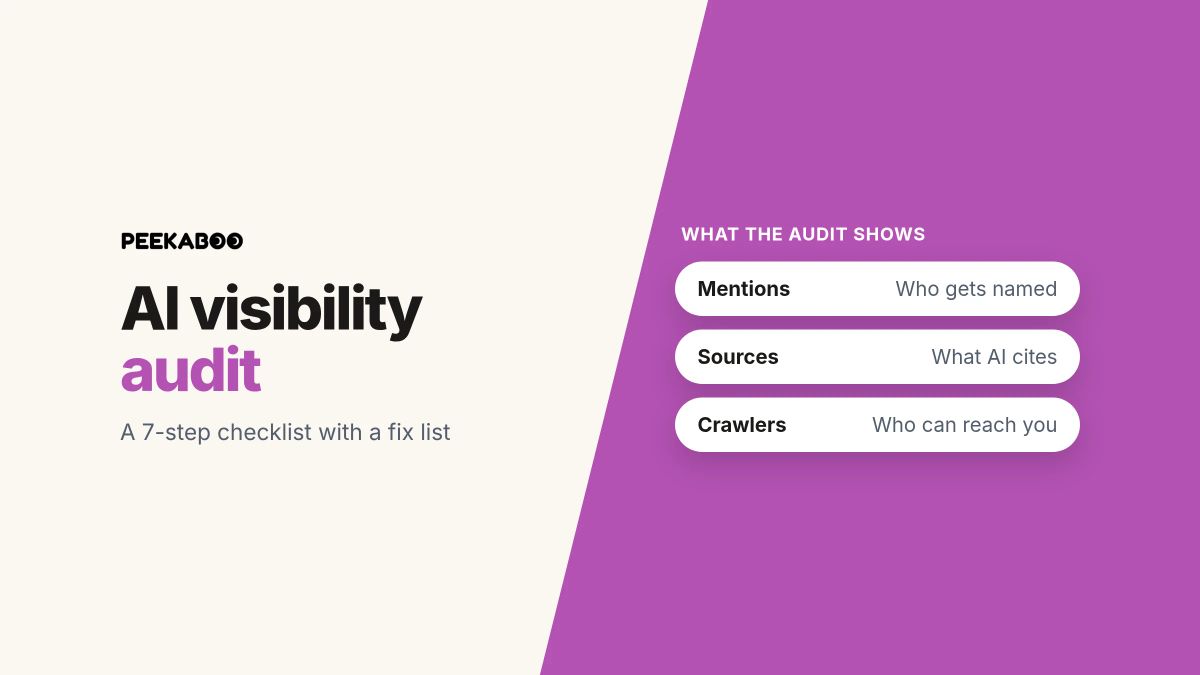
An AI visibility audit shows which buyer questions get your brand named in ChatGPT, Gemini, Perplexity and Google's AI answers, which name competitors instead, and what to fix first.
An AI visibility audit shows which buyer questions get your brand named in ChatGPT, Gemini, Perplexity and Google's AI answers, which ones name your competitors instead, and why. You can run a first one with a spreadsheet and the seven steps below, and finish with a short list of fixes rather than a vague score.
If a client has just asked whether they show up in ChatGPT, or you've noticed a competitor keeps getting recommended where you don't, this is where to start. The audit gives you a baseline you can measure every later change against, and it can point at problems a normal SEO audit misses.
What an AI visibility audit tells you
An AI visibility audit tells you four things: how often AI answers mention your brand for the questions your buyers ask, which competitors they name instead, which websites they cite as sources, and whether AI crawlers can reach your pages at all.
Read together, the four answers show where the gap is. A brand that is never mentioned and never cited probably has a content or access problem. A brand that is mentioned but rarely cited is probably being described from other people's pages. A brand that shows up for its own name but disappears on "best tool for X" questions has a category problem, and that is the one that costs the most, because those are the questions buyers ask before they have a shortlist of names.
You finish with two things: the numbers to re-check on a schedule, using the same metrics you'd use to measure AI visibility over time, and a list of fixes ranked by the buyer questions that matter most.
AI visibility audit checklist
Work through the seven steps in order.
Plan for the time. Twenty questions on three platforms, each run three times, is 180 answers to read and log by hand. That's roughly a working day for one person the first time, which is why a tracker starts to make sense once the audit becomes a recurring job.
Step 1: Pick the buyer questions to test
Pick 20 to 50 questions that real buyers ask before they choose a product or provider like yours. The questions you pick decide every number in the audit, so this is the step to spend time on.
Av. António Augusto de Aguiar 122C 1050-046 Lisboa, Portugal
Minnesota
202 N Cedar Ave, Suite 1 Owatonna, MN 55060, USA
Good sources for those questions:
Sales calls and demos: the comparisons and objections prospects raise ("is X better than Y for a 10-person team?").
Support tickets and onboarding emails: the problems customers had before they found you.
Search Console queries: the longer, question-style searches already reaching your site. These are real searches, which makes them more reliable than prompt volume estimates.
Competitor comparison pages: the "X vs Y" and "X alternatives" angles your market already argues about.
Write each one the way a person would type it into ChatGPT, as a full question with context, not as a two-word keyword. Then split the list into three groups: category questions with no brand name ("best payroll software for agencies"), comparison questions that name you or a competitor, and branded questions about you ("is [your brand] worth it?"). Keep most of the list unbranded. Branded questions almost always mention you, so a list full of them makes the audit look better than your market position really is.
Step 2: Choose the AI platforms that matter
Test the AI platforms your buyers use. I'd start with ChatGPT, Google's AI Overviews and one of Gemini or Perplexity, and add Google AI Mode, Microsoft Copilot or Claude if your buyers lean that way.
Treat each platform separately. They use different crawlers, and a brand can be named on one and missing on another. Record results per platform and never blend them into one number in the audit. A blended score hides exactly the platform where you're losing.
If you're auditing for a client, ask which platforms their customers say they use, and start there.
Step 3: Run each question several times
Run every question at least three times on each platform, each time in a fresh chat with no history, and treat each answer as one sample. For AI Overviews, search logged out. If you run any platform signed in, note it. A single answer is not a verdict, because AI platforms rarely give the same list of brands twice.
A SparkToro study published in January 2026 (not peer-reviewed, and run with a researcher from the AI tracking company Gumshoe) had 600 volunteers run 12 prompts through ChatGPT, Claude and Google's AI a combined 2,961 times. It found less than a 1 in 100 chance that ChatGPT or Google's AI, asked the same question 100 times, would give the same list of brands twice. Rand Fishkin's conclusion was that a visibility percentage across dozens to hundreds of prompts run multiple times is a reasonable metric, even though any single list isn't. He suggests asking at least 60 to 100 times to know an AI's set of recommendations.
So the number you record is a rate: in how many of the answers for a question your brand was named. Three runs by hand is a practical minimum for a first audit, not a precise rate. It stops one lucky or unlucky answer from deciding the result, and repeated tracking over weeks is how you get closer to his number. If your questions are local, note the country and city you ran them from, so the next check matches.
Step 4: Record mentions, citations and competitors
For every answer, record whether your brand was mentioned, whether one of your pages was cited, where you appeared in any list, and which competitors were named. A simple spreadsheet with one row per answer is enough.
Use these columns:
Question and group: the exact question, and whether it's category, comparison or branded.
Platform and run: for example "ChatGPT, run 2", plus the date.
Mentioned: yes or no. A mention is the answer naming your brand.
Cited: yes or no, and the URL. A citation is the answer linking to a page on your domain.
Position: where you appeared in a list, if the answer gave one. Keep it as a note, because order changes even more between runs than the list does. The mention rate across runs is the number to trust.
Competitors named: every other brand in the answer.
Description: a few words on how the answer described you, and anything wrong.
Count an answer that doesn't name you as a zero, not as missing data. Dropping those answers makes an audit flatter you, because the runs where you're missing disappear from the average. From these rows you get your mention rate per platform (answers naming you, divided by all answers), your citation rate, and a count of how often each competitor appears on the same questions. That competitor count is the start of your share of voice.
Step 5: Check which sources AI answers cite
List every source URL the answers cite, group them by domain, and mark each one as your own site, a competitor's site or a third-party page. This shows you where the answers in your category get their information.
I think third-party pages matter most. If the same three review sites, a Reddit thread and a YouTube video keep appearing as sources on your category questions, those pages are shaping what AI platforms say about your market, whether or not they mention you. For planning, this is the part of the audit I'd spend most time on, because it turns "get mentioned more" into a list of specific pages to get included in or to answer.
Sources that cite competitors but never you are outreach targets. Your own pages that never get cited, even on questions about you, are content to rewrite. Tracking AI citation sources over time shows which domains keep winning those spots, so you can see whether your outreach is changing anything.
Step 6: Check that AI crawlers can reach the site
Check that the crawlers AI platforms use for search can fetch your pages, because a platform usually can't cite a page its crawler is blocked from. Start with robots.txt, then your CDN or firewall settings, then whether your important copy is in the page's HTML.
The crawlers that matter for AI answers are mostly search crawlers, not training crawlers:
OAI-SearchBot: OpenAI's crawler documentation says it's used to show sites in ChatGPT search, and sites that block it won't appear in ChatGPT search answers. GPTBot is a separate crawler for model training.
Claude-SearchBot:Anthropic says blocking it prevents your content from being indexed for search. ClaudeBot is the training crawler.
PerplexityBot:Perplexity uses it to surface and link sites in its search results.
Googlebot: AI Overviews and AI Mode follow Google's normal Search crawling rules, so a page that's indexed and eligible for a snippet can appear.
Whether to block training crawlers is your call. What you're hunting for is a search crawler blocked by accident, for example by one broad rule meant to stop scrapers. Google's own advice is to make sure crawling is allowed in robots.txt and by any CDN or hosting setup. A firewall rule can block a crawler that robots.txt allows, and I think marketing teams rarely see those settings, so ask whoever runs your hosting.
Then check JavaScript. In Vercel's December 2024 analysis of crawler traffic, none of the major AI crawlers it measured, including OAI-SearchBot, ClaudeBot and PerplexityBot, rendered JavaScript, while Gemini used Googlebot's rendering. If your prices, product details or answers only appear after scripts run, those crawlers may see an empty page. A free AI crawlability checker reads your robots.txt and shows which AI crawlers it blocks, with search and training crawlers reported separately.
Step 7: Turn the gaps into a fix list
Sort everything you found into four kinds of fix, then rank them by how valuable the buyer questions behind them are. Category and comparison questions come before branded ones, because that's where buyers decide who makes their list.
Access fixes: any search crawler blocked by robots.txt or a firewall rule, and key copy that only appears after scripts run, which some AI crawlers may not read. These come first because nothing else works while they're broken.
Content gaps: questions where competitors get named and you don't, and where you have no page that answers the question directly. Write or rewrite pages that answer it in the first two sentences, with specifics such as prices, numbers and who the product is for.
Source gaps: third-party pages cited for your questions that name competitors and not you. These are outreach and PR targets.
Accuracy fixes: answers that describe you wrongly, such as an old price, a discontinued product or the wrong audience. Update your own pages first, then the third-party pages the answers cite.
Give each fix an owner and the questions it should move, so the re-check can show whether it worked. An AI visibility gap analysis compares how your site describes you with how AI answers do, and lists the domains citing a competitor instead of you, which is a quick way to cross-check your own fix list.
GEO audit vs SEO audit
A GEO audit and an SEO audit check different results. An SEO audit asks whether your pages rank and get clicks in search results. A GEO audit, or AI visibility audit, asks whether AI answers name and cite you. Some of the work overlaps, but a clean SEO audit doesn't mean you'll pass the other.
SEO audit
GEO audit
What it measures
Rankings, impressions and clicks
Mentions, citations and competitors in AI answers
Unit of testing
Keywords
Buyer questions, run several times per platform
Main data source
Search Console and rank trackers
The answers themselves, logged per platform
Crawlers checked
Googlebot and Bingbot
Also OAI-SearchBot, Claude-SearchBot and PerplexityBot
Off-site check
Backlinks
Third-party pages the answers cite
Rankings still matter. On Google, a page has to be indexed and eligible for a snippet before it can be a supporting link in AI Overviews or AI Mode, so SEO problems become GEO problems there. Google's guide to AI features and your website says there are no additional requirements beyond that.
Other platforms can diverge a lot. In my own experiment, a 4,953-page directory on a new domain got 121,900 AI citations in Bing's reports over a three-month view. Google Search Console, in its own reporting window, showed an average position of 52.5 and 63 clicks. I wouldn't recommend that approach to a real business, but it shows why you can't infer AI visibility from rankings. If you already run SEO audits, add the AI checks to them rather than starting a separate process.
How to present the audit to a client
Don't send the 180 rows. Send a short report the client can compare month to month and approve, built like this:
The baseline: mention rate per platform on category and comparison questions, next to the two or three competitors that appear most.
Example answers: two or three real answers where a competitor was recommended and the client wasn't, with the sources those answers cited.
The source map: the third-party domains that keep appearing as sources, and which ones mention the client.
The fix list: ranked fixes from step 7, each tied to the questions it should move.
The re-check plan: the same questions on the same platforms, tracked weekly if you can and reported at least monthly, so the numbers stay comparable.
An agency turning this into a monthly service needs the audit to be repeatable. This is the job of an AI visibility platform for agencies: separate prompt sets for each client brand, competitors on the same questions and every answer kept as evidence.
For delivery, AI Peekaboo's white-label reports put the results under your agency's brand once a plan costs $100 a month or more. Our guide to AI visibility monitoring for agencies covers how agencies turn the first audit into ongoing reporting and use it in prospect pitches.
Free tools for a first AI visibility audit
You can run a first AI visibility audit with free tools and a spreadsheet. These cover most of the checklist:
A free snapshot: our free AI visibility checker gives a one-time snapshot of how your brand appears in ChatGPT and Gemini answers, which competitors appear alongside you and which sources they cite. It's a quick way to see whether the full audit is urgent.
AI crawlability checker: shows which AI crawlers your robots.txt blocks, for step 6.
AI visibility gap analyzer: compares your positioning with how AI describes you and suggests competitors to compare against, for step 7.
Google Search Console: includes AI Overviews and AI Mode traffic in the normal Performance report, under the Web search type, but doesn't break it out. Use it for the rankings and clicks of the pages your audit cares about, not to measure AI mentions.
Bing Webmaster Tools: its AI Performance report shows how often your pages are cited as sources in Microsoft Copilot and Bing's AI summaries.
Free tools are fine for the first audit. Once you're re-running the same questions every week, or doing it for several clients, the manual logging is where the time goes. AI Peekaboo tracks ChatGPT, Gemini, Perplexity, Google AI Overviews, Google AI Mode, Microsoft Copilot and Claude API, from $30 a month, and keeps every answer and source behind the numbers.
Start with the snapshot to see where you stand in ChatGPT and Gemini today. Then write your question list from your own sales calls and support tickets, and run steps 2 to 7.
Frequently asked questions
What is an AI visibility audit?
An AI visibility audit is a check of whether AI platforms such as ChatGPT, Gemini, Perplexity and Google's AI Overviews name and cite your brand for your buyers' questions. Plan on 20 to 50 questions, each run at least three times per platform.
How do you measure AI visibility?
The main measures are mention rate per platform, citation rate and share of voice against the competitors you track. After the first audit, track the same questions at least weekly and report the trend monthly, because a single month's number says little on its own.
How can I check my AI visibility score?
For a quick check, our free AI visibility checker gives a one-time snapshot of how your brand appears in ChatGPT and Gemini answers. For a score you can track, use the same questions on each platform every time and report the result per platform. A single check in ChatGPT isn't enough on its own, because the answers change from run to run.
Start with your own visibility.
See where your brand appears in AI answers and which competitors get mentioned.
 Filipe Lins Duarte