GEO is the work of getting your brand named and cited in AI answers from ChatGPT, Gemini, Perplexity and Google. Here is what it means, how it relates to SEO and where to start.
GEO, short for Generative Engine Optimization, is the work of getting your brand named and cited in AI-generated answers: the replies people get from ChatGPT, Gemini, Perplexity, Microsoft Copilot, Claude and Google's AI Overviews and AI Mode. Ask any of them which tool, provider or product to pick and the reply names a few brands. GEO is how you become one of them instead of a competitor.
If GEO just showed up in an agency proposal or a question from your boss, and you already do SEO, you're closer than the acronym suggests. Most of what earns a place in AI answers is the same work that earns rankings. A few parts are new, though, and they are the reason your brand can rank well on Google and still be missing when someone asks ChatGPT the same question.
What GEO means
GEO means optimizing your content and your brand's presence across the web so that AI platforms mention you, and ideally link to you, when they answer questions in your market.
The term comes from GEO: Generative Engine Optimization, a 2023 research paper later accepted at the KDD 2024 conference. Its authors tested how changes to a page affected how visible that page became in AI-generated answers. Adding citations, quotations from credible sources and statistics raised a page's visibility by 30 to 40% in their benchmark, while keyword stuffing, an old SEO habit, brought little or no improvement.
One finding from that paper matters for smaller brands. With the cite-sources method, pages ranked fifth in the underlying search results gained 115.1% in visibility, while the top-ranked page lost 30.3% on average. That comes from a 2023 benchmark built on GPT-3.5 over the top five Google results, and one test can't prove it for today's platforms. I read it as a hint that lower-ranked pages gain more from being specific and well sourced.
How AI answers choose which brands to name
AI platforms with web search build an answer by searching, reading what comes back and then summarizing it, so a brand gets named when its pages, or pages about it, are in what the platform reads.
Av. António Augusto de Aguiar 122C 1050-046 Lisboa, Portugal
Minnesota
202 N Cedar Ave, Suite 1 Owatonna, MN 55060, USA
Retrieval and query fan-out
Before writing a reply, an AI platform often runs several searches of its own, and you can see the ones ChatGPT runs in our guide to ChatGPT query fan-out. Google says both AI Overviews and AI Mode may use this "query fan-out" technique, issuing related searches across subtopics to build one response.
A buyer who asks "what's the best payroll software for a 20-person agency" may trigger searches for pricing, for reviews of specific tools and for comparisons, so your brand has to show up in some of those sub-searches, not only for the exact question the buyer typed.
Rankings still matter here. On Google, a page has to be indexed and eligible to show a snippet before it can appear as a supporting link in AI Overviews or AI Mode, and I'd expect a page that ranks for those sub-searches to be read more often.
Mentions vs citations
A mention is when an AI answer names your brand. A citation is when the answer shows one of your URLs as a source. You want both, but they are different results and you should track them separately.
Buyers see the mention. The citation is what can send a visit, and it shows which page earned the spot. Microsoft counts citations the same way in the AI Performance report in Bing Webmaster Tools, which reports how often your pages are "displayed as sources in AI-generated answers" across Microsoft Copilot, AI summaries in Bing and partner integrations.
Your brand can be mentioned without a citation. I think that usually means the platform read about you on someone else's page. That can be good news: a review site or comparison article may be making your case for you. It also means part of GEO happens on websites you don't own.
GEO vs SEO vs AEO
GEO, SEO and AEO overlap far more than they differ. SEO earns rankings and clicks from search engines. AEO (Answer Engine Optimization) is about being the answer a search tool or assistant gives, instead of one link among ten. GEO applies the same idea to answers written by generative AI.
In practice I treat AEO and GEO as two labels for the same job, and our AEO vs SEO guide covers how answer visibility relates to rankings.
SEO
GEO
Where you show up
Search results pages
Answers in ChatGPT, Gemini, Perplexity, Copilot, Claude, AI Overviews and AI Mode
What success looks like
A high ranking and a click
Your brand named, and your page cited, in the answer
What it builds on
Crawlable, indexed, helpful pages and links
The same, plus mentions on sites the AI platforms read
How you measure it
Rankings, impressions and clicks in Search Console
Mentions, citations and share of voice across tracked prompts
Google is clear on its side. Its guide to AI features and your website says there are no additional requirements to appear in AI Overviews or AI Mode, and no new machine-readable files, AI text files or special schema are needed.
Other AI platforms work differently. ChatGPT and Perplexity run their own search crawlers, and Bing reports citations for Copilot alongside its own AI summaries.
My own experiment shows how far the two can diverge. I built a 4,953-page directory on a brand-new domain in July 2026. Bing reported 121,900 AI citations for it in a three-month view, while Google Search Console showed an average position of 52.5 and 63 clicks. On average Google had those pages around page six, and Bing's AI answers cited them anyway. I wouldn't recommend that aggressive approach to any business, though. Sixty-three clicks doesn't build a business, and ranking on Google should stay your first priority.
What GEO work includes
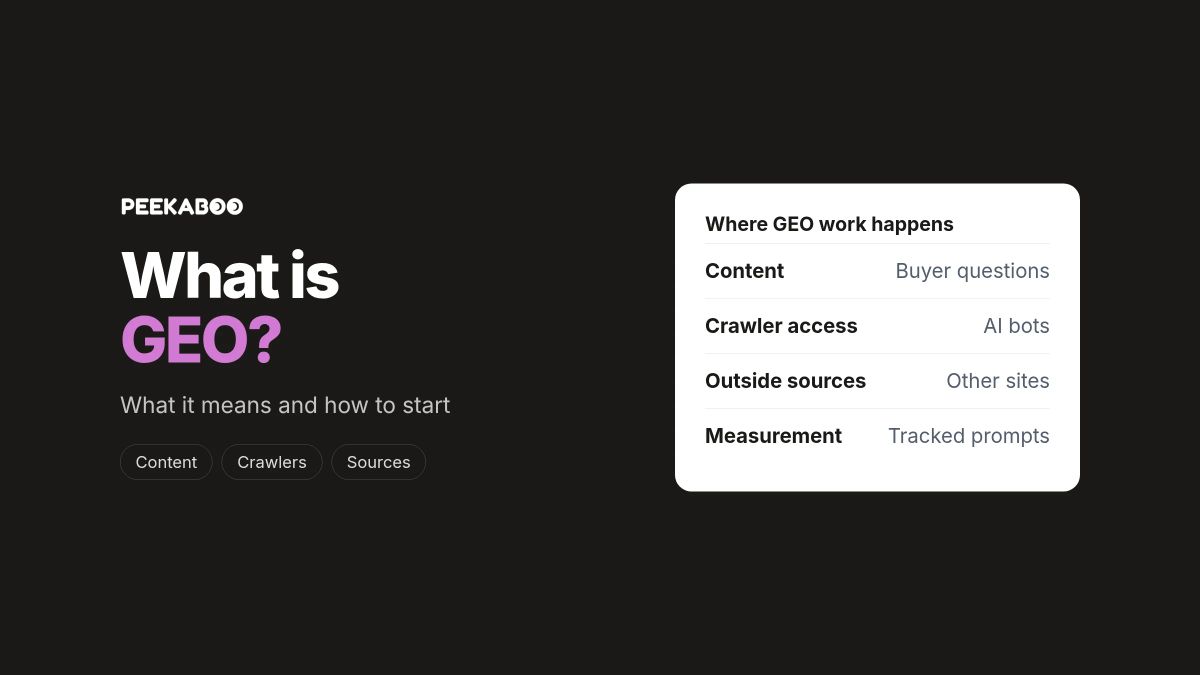
GEO work falls into four areas: content that answers what buyers ask, pages AI crawlers can reach, mentions on sources outside your site, and measuring where you show up. The first is ordinary SEO writing, aimed at the questions buyers ask. The other three are what's new: access for AI crawlers beyond Googlebot, mentions on sites you don't own, and measurement by prompts instead of rankings.
Content that answers buyer questions
Write pages that answer the questions buyers put to AI platforms, and answer them in the first sentence or two. I'd lead with a clear, quotable statement, because a long introduction buries the part an AI platform would repeat.
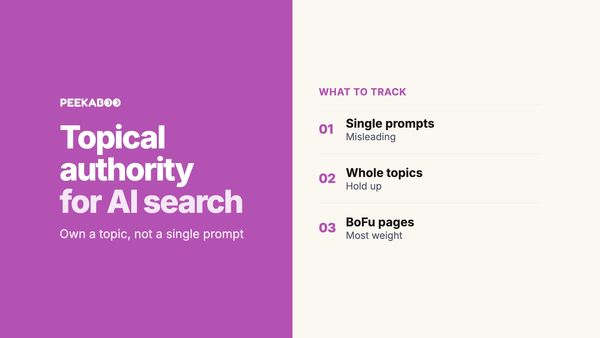
Specifics help, as the paper's results suggest: an answer engine wants something concrete it can repeat. Comparison pages, pricing explanations and "best for" judgments match how people phrase buying questions to AI. I'd cover a topic across several connected pages, as our guide on how to show up in AI search explains with topical authority, so an AI platform has more of your pages to choose from.
Keep those pages fresh. I think an outdated price or claim gives an AI platform a reason to quote a newer source instead of you.
Pages AI crawlers can reach
If an AI platform's crawler can't fetch your page, the platform usually can't cite it. Check your robots.txt and your CDN or firewall settings for each crawler that matters:
OAI-SearchBot: OpenAI uses it to show sites in ChatGPT search. OpenAI's crawler documentation says sites that block it won't appear in ChatGPT search answers. GPTBot is a separate crawler for model training, so you can block GPTBot and still allow OAI-SearchBot.
PerplexityBot: Perplexity's crawler documentation says it uses PerplexityBot to surface and link sites in its search results, not to train AI models.
Googlebot: Google controls AI Overviews and AI Mode through its normal Search crawling rules, so a page that is indexed and can show a snippet is eligible.
A firewall or CDN rule can block an AI crawler even when robots.txt allows it, and I think marketing teams rarely see those settings. I'd keep important content in plain HTML text rather than only inside images or scripts. A technical GEO analysis checks crawler access on your pages and flags what blocks it.
Sources outside your own site
I think AI answers name many brands because other websites name them: comparison articles and "best of" lists carry much of what these platforms say about a category, and community threads and YouTube videos get cited a lot.
So GEO includes earning mentions where your buyers' questions are already answered: getting included in the roundups AI platforms cite, keeping your profiles accurate on the sites they read, and giving journalists and creators facts worth quoting. It's close to digital PR, aimed at the pages that keep appearing as sources in your category.
These sources shift: a competitor's new comparison page or an updated list can displace you from answers you used to appear in. If that has already happened, our guide on why brands end up losing AI citations walks through the usual causes.
Measuring where you show up
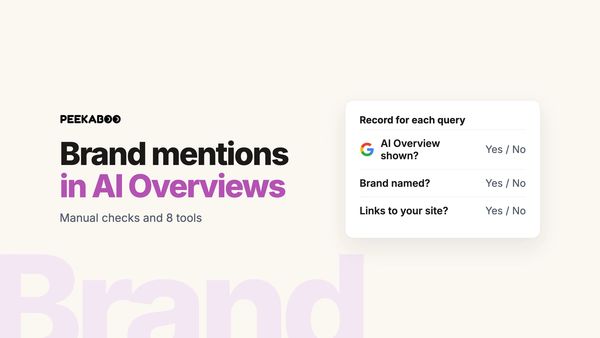
You measure GEO by running the prompts your buyers ask, on each AI platform, and recording whether your brand is named, which pages are cited and which competitors appear instead. Rankings don't capture this, and as far as I know, no AI platform gives you a report of every answer that named your brand.
There are partial views. Google counts AI Overviews and AI Mode appearances inside the normal Performance report in Search Console, and Bing's AI Performance report shows citations across Copilot and Bing. Neither tells you what ChatGPT, Perplexity or Claude say about you.
The prompts you choose are the foundation of everything else. Pick questions real buyers ask at each stage, run each one more than once, since a single answer is one sample rather than a verdict, and track them at least weekly. Our guide on how to measure AI visibility covers the metrics in detail.
You can do this by hand in a spreadsheet for 20 prompts on one or two platforms. Past that, a tracker saves the weekly work and keeps the history you need to spot a trend. AI Peekaboo tracks ChatGPT, Gemini, Perplexity, Google AI Overviews, Google AI Mode, Microsoft Copilot and Claude API, from $30 a month.
How to start with GEO
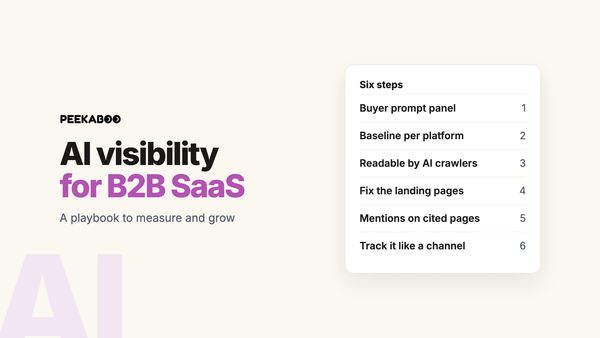
Start with a baseline, before you change anything. I'd work in this order:
Write down 20 to 50 buyer questions. Use the questions sales calls, support tickets and Search Console queries show your buyers ask, not only your target keywords.
Check which AI answers name you today. Run those questions on the AI platforms your buyers use and note who gets named and which pages are cited.
Fix access. Make sure OAI-SearchBot, PerplexityBot and Googlebot can reach your important pages.
Improve the pages that should be cited. Put the answer first, add specifics such as prices, numbers and sources, and update anything stale.
Go after the outside sources. List the third-party pages AI platforms cite for your questions and work on being included in them.
Re-check on a schedule. Run the same questions at least weekly and compare.
If you have an SEO team, GEO fits into the work they already do. If you don't have the time or people for it, an agency can run it, and our list of GEO agencies compares what they offer. Either way, don't pay for GEO work that skips the baseline, because nobody can show you what changed without one.
You can get that baseline today. Run your brand through our free AI visibility checker for a snapshot of how ChatGPT and Gemini answers name you, which competitors appear alongside you and which sources they cite.
Frequently asked questions
Is GEO replacing SEO?
No. GEO builds on SEO rather than replacing it. Google says SEO best practices remain relevant to AI Overviews and AI Mode, and ChatGPT and Perplexity show sites through their own search crawlers. What GEO adds is attention to AI crawlers, mentions on other sites and tracking answers instead of rankings.
What does GEO mean in SEO?
In SEO, GEO stands for Generative Engine Optimization, the practice of getting your brand mentioned and cited in AI-generated answers. GEO is also used loosely for geo-targeting in ads and local marketing, so check which meaning a proposal or tool is using.
What is the difference between AEO and GEO?
Very little in practice. AEO, or Answer Engine Optimization, is about being the answer a search tool or assistant gives. GEO is the term the 2023 research paper used for answers written by generative AI. I'd plan for both with the same work: getting your brand named in AI answers.
Start with your own visibility.
See where your brand appears in AI answers and which competitors get mentioned.
 Filipe Lins Duarte