AI Visibility Tools for Agencies: 9 Picks for Client Work
Compare nine AI visibility tools by what an extra client costs, what clients see under your name, pitch workspaces and agency pricing. AI Peekaboo fits agencies reporting on many brands.
AI Peekaboo is the best AI visibility tool for agencies that monitor many client brands each month, because one subscription can hold up to 150 brands with separate prompts, competitors, and dashboards, while white-label reports begin when the plan reaches $100 a month. Large enterprise companies, and agencies serving them, should choose Profound when they need SSO, SOC 2 compliance, and coverage across up to nine answer engines.
If you run 5 to 30 clients, the costly mistake is pricing one brand and multiplying later. Peec AI suits a growing agency with a defined project portfolio, while Otterly works for freelancers and small agencies with a few clients. Promptwatch fits a changing roster, OpenLens fits agencies that need client reporting costs to stay flat as their roster grows, LLM Pulse fits resale under your own brand, and SE Visible or Semrush fit teams already running client SEO in those ecosystems. AI Peekaboo is software your agency operates, not an agency service that performs the work for you.
AI visibility tools for agencies compared
Tool
Best for
How you add a client
What you can give clients
Starting price of the agency route
AI Peekaboo
Agencies reporting across many client brands
Add a brand to one subscription, with its own prompts, competitors, and dashboard
White-label reports and read-only client links from $100 a month
$30/month to start
Profound
Large enterprise companies
Add a client workspace to Agency Growth
CSV and JSON exports, no white-label reports named
$399/month per client workspace, with no Agency Growth base price shown
Peec AI
Growing agencies with defined client portfolios
Use projects from a shared credit plan
View-only links, plus Data Studio templates from Scale
Av. António Augusto de Aguiar 122C 1050-046 Lisboa, Portugal
Minnesota
202 N Cedar Ave, Suite 1 Owatonna, MN 55060, USA
Add a project, unlimited on Agency at up to 100 per paid editor seat
Branded PDF reports, read-only client dashboards, and share links on Agency, with free unlimited client logins
$299.99/month, Agency
Otterly
Freelancers and small agencies
Add workspaces to a shared prompt pool
Branded Looker Studio reports for agency partners
$189/month, Standard with unlimited workspaces
Promptwatch
Agencies with changing client rosters
Use unlimited projects in one agency account
Branded, read-only client access
$199/month, Kick-off
LLM Pulse
Agencies reselling AI visibility
Use projects by plan, with Partner from 25 projects
Portal, full white label, or embedded dashboards by quote
€299/month, Scale with weekly tracking
SE Visible
SEO agencies using SE Ranking
Use projects in the agency dashboard
Client-ready dashboards, but white label is not available yet
$99/month, Basic
Semrush
Agencies managing SEO in Semrush
Add an AI Visibility Toolkit per domain
Pro Report add-on includes branding and white-labeling
€94.94/month per domain, toolkit
A useful comparison starts with the unit that grows as you sign clients. Some tools charge per brand or domain. Others use projects, client workspaces, prompt pools, or response limits. That difference decides whether a low entry price still works once you add ten accounts.
For example, ten Profound client workspaces cost $3,990 a month, each with 100 daily prompts, plus any Agency Growth base price, which Profound doesn't show. Peec AI Scale covers 25 projects for €675 a month, but its credits stretch to about 722 daily prompts on three AI platforms across all of them, roughly 29 per client.
Nine AI visibility platforms for agency client monitoring
1. AI Peekaboo: best for agencies reporting AI visibility for many client brands every month
You pay for one AI Peekaboo subscription and add each new client to it as a brand. Every brand has its own prompts, competitors, and dashboard, so one client’s results don’t get mixed into another account.
It suits an agency that has to explain each client’s score in a meeting. Each dashboard opens the AI answers and cited sources behind the number, which gives your team evidence to discuss and a clear next task. White-label reports and read-only client links become available once your plan reaches $100 a month.
Key features
Choose up to seven AI platforms: ChatGPT, Gemini, Perplexity, Google AI Overviews, Google AI Mode, Microsoft Copilot, and Claude API.
Give every client brand separate prompts, competitors, and a dashboard with the AI answers and cited sources behind each score.
Add one extra brand slot for unlimited prospect pitch workspaces that you can reuse for any prospective client.
Use prompt suggestions, recommendations, and content briefs to turn findings into work your team can assign.
Give clients read-only links, send data to Looker Studio, or use the API in your own reporting process.
Connect Claude Code to the MCP server and ask for any client's visibility, competitors or cited sources in a sentence.
Bring read-only GA4 and Google Search Console information into the same view as AI visibility.
Pricing
Plans start at $30 a month. You build your plan from the number of brands, prompts per brand, AI platforms, and how often prompts run.
Brands
Prompts per brand
AI platforms
How often prompts run
USD monthly
15
40
3
Monthly
30
4
40
3
Weekly
32
2
30
3, one of them Claude API
Weekly
78
4
50
3
Every 3 days
100
1
100
5
Daily
250
10
100
3
Every 3 days
500
The rows can use any mix of six standard AI platforms at the same price per check. Claude API costs more.
Annual billing saves 15%.
Once the plan reaches $100 a month, it includes white-label reports and client share links.
Your team doesn’t pay per-seat charges.
Every brand follows one account-wide prompt schedule.
A 14-day card-backed trial is available for eligible new workspaces that track at least 10 prompts per brand and cost under $100 a month.
Who should choose it
Choose AI Peekaboo when your agency needs to monitor several brands, explain changes in client meetings, and deliver branded reporting without buying a separate seat for each teammate. It also suits a brand team that wants to see whether it appears in AI answers and needs clear ideas for improving that presence.
Skip it if you need software that writes finished articles, because AI Peekaboo provides briefs rather than completed content. If city-level findings must appear in standard exports or Looker Studio, check another option first because those outputs leave out local-tracking data. Choose LLM Pulse if reselling the platform itself under your own domain is the central service.
2. Profound: best for large enterprise companies
For an enterprise client with strict access controls, Profound offers the capabilities that matter most. Agency Enterprise supports SSO through SAML or OIDC, SOC 2 compliance, API access, and coverage across up to nine answer engines.
Agency Growth serves a different job. It gives agencies daily monitoring for a smaller number of high-value accounts, but each client workspace costs $399 a month and the Agency Growth base price is not published. That’s a different commercial model from adding many smaller brands to one shared subscription. See the Profound alternatives when enterprise controls are not the main requirement.
Key features
Agency Growth includes ten seven-day pitch workspaces each month for prospect audits.
Each client workspace includes 100 prompts running daily across ChatGPT, Perplexity, and Google AI Overviews.
Five agency seats let a compact team manage all Agency Growth client workspaces together.
Agency Growth retains all-time history, while Agency Enterprise adds API access and enterprise security controls.
New Agents can use a trigger when visibility changes by 5%, which can suit active enterprise programs.
Pricing
Profound agency option
USD monthly
Limits that matter
Agency Growth client workspace
$399/month
100 prompts, daily, 3 engines
Five extra trial workspaces
$199/month
Seven-day pitch workspaces
Agency Enterprise
Quote required
Custom client and trial workspaces
Agency Growth client workspaces don’t include API access.
Agency Enterprise supports custom limits and security controls.
Who should choose it
Pick Profound when an enterprise client’s security team sets the requirements. That means Agency Enterprise, priced by quote.
For a broad roster of smaller accounts, look elsewhere. A $399 Agency Growth workspace tracks ChatGPT, Perplexity, and Google AI Overviews daily, with no API access. It suits a high-value client that needs daily tracking more than enterprise controls. AI Peekaboo better suits agencies adding many brands under one plan, while Peec AI fits a growing agency that wants a defined project portfolio.
3. Peec AI: best for growing agencies managing up to 25 client brands
A growing agency can use Peec AI when it wants clear project capacity and unlimited team and client users. Its agency plans progress from three projects on Essential to 25 projects on Scale, which gives your agency a visible point for deciding when it needs a larger plan.
Peec AI shows a prompt count beside each plan, but credits set the real limit. Credits allocate tracking across prompts, AI platforms, and frequency, and the minimum allocation is 900 credits per project. On three AI platforms checked daily, Essential’s 10,000 credits cover about 111 prompts shared across all your clients, and every project needs at least ten of them.
Key features
Agency plans include unlimited team and client users, which removes a seat calculation from your client rollout.
Essential, Growth, and Scale support three, ten, and 25 projects respectively.
Pitch projects run for seven days and range from three active projects on Essential to seven on Scale.
Clients can receive view-only dashboard links limited to the charts you choose.
Scale and Comprehensive include Data Studio templates that can be cloned per client.
All agency plans include API access for agencies that need to pull data into another reporting process.
Pricing
Peec AI agency plan
EUR monthly
Credits
Projects
Active pitch projects
Essential
€205/month
10,000
3
3
Growth
€425/month
25,000
10
5
Scale
€675/month
65,000
25
7
Comprehensive
Quote required
Unlimited
Unlimited
10
Annual billing is priced at €175, €365, and €575 per month for Essential, Growth, and Scale.
Agency credit add-ons are available, but the vendor doesn’t publish their price.
Who should choose it
Peec AI makes sense when you run a growing agency with a planned client portfolio and want separate projects, client users, and pitch projects in the same agency plan. Growth is aimed at boutique agencies managing three to ten clients, while Scale serves a larger portfolio.
Agencies that require reports under their own name should choose another option. No Peec AI plan lists white label, although clients can receive view-only links and, from Scale, Data Studio templates. AI Peekaboo is the better fit when your agency needs white-label reports and client links. Otterly is a simpler option for a small agency that only needs a shared pool of daily prompts.
4. OpenLens: best for agencies keeping client reporting costs flat
OpenLens is an AI visibility tool built for agencies from the ground up, and its plans reflect that. White-label reporting is on the Agency plan, which also supports unlimited projects and paid editor seats, with up to 100 projects per paid editor seat. That structure suits an agency managing a portfolio rather than a single brand.
OpenLens tracks AI citations at the source-URL level. Every plan covers ChatGPT, Perplexity, and Google AI, Starter adds DeepSeek, and Agency adds Gemini, Claude, and Grok. You can report which pages earn a client’s mentions, not only whether the brand was named.
Key features
Branded PDF reports use your logo and colors.
Read-only client dashboards are scoped to each client’s projects.
Revocable share links open a live report without a login.
Free, unlimited client logins do not use a paid editor seat.
Source-level citation tracking shows which pages are cited, not only whether a brand was named.
MCP and API access can support a reporting workflow outside the main dashboard.
Pricing
OpenLens plan
USD monthly
Projects
Editor seats
Free
$0/month
3
2
Starter
$39.99/month
5
1 included, up to 5
Agency
$299.99/month
Unlimited, up to 100 per paid editor seat
1 included, unlimited extra seats
Enterprise
Custom
Custom
Custom
Starter and Agency each include one paid editor seat. Extra seats cost $31.99 a month on Starter and $239.99 a month on Agency.
Client logins are free and unlimited on every plan.
Starter and Agency include a seven-day free trial.
Annual billing saves 15%.
Who should choose it
Choose OpenLens when your agency needs branded reporting, client dashboards, and source-level citation tracking across a growing client portfolio. It suits a team that wants free client logins and can use MCP or API access in its reporting workflow.
Look elsewhere if you need white-label reporting below the Agency plan, or a custom domain and full platform rebranding. AI Peekaboo adds white-label reports from $100 a month. Choose LLM Pulse when your service needs full white label on your own domain.
5. Otterly: best for freelancers and small agencies with a handful of clients
For a freelancer or small agency, Otterly keeps daily monitoring focused on a limited number of client questions. Standard and Premium allow unlimited workspaces, but their prompts sit in one shared pool, so your agency needs to decide how that pool is divided before promising reporting volume to clients.
Its agency partner route adds pitch workspaces, a single invoice for client workspaces, and branded Looker Studio reports. That’s useful for a small agency already comfortable preparing reports in Looker Studio. Otterly doesn’t offer native white-label dashboards or URLs. The Otterly AI alternatives explain when that reporting limit becomes a reason to change tools.
Key features
Every plan tracks ChatGPT, Google AI Overviews, Perplexity, and Microsoft Copilot, while Google AI Mode, Gemini, and Claude are paid add-ons.
Standard and Premium include unlimited workspaces for separating client work.
Brand reports show prompts that are trending down, helping your team find drops to review.
Citation tracking and recommendations help connect visibility changes to pages and sources.
Agency partners receive pitch workspaces and branded Looker Studio reporting.
All self-serve plans include unlimited team members.
Pricing
Otterly plan
USD monthly
Prompts
Workspaces
Lite
$29/month
15
1
Standard
$189/month
100
Unlimited
Premium
$489/month
400
Unlimited
Enterprise
Quote required
From 1,000
Unlimited
A seven-day free trial includes 50 prompts and doesn’t require a card.
Agency Partner access is available after subscribing to Standard or Premium.
Agency partners receive 150 prompts on Standard or 500 prompts on Premium.
Looker Studio is available from Standard.
Who should choose it
Use Otterly when you have a handful of client accounts and daily checks are more useful than a large portfolio structure. It’s especially practical for a lean agency that can work with a shared prompt pool and assemble client-facing reports in Looker Studio.
If clients expect a native white-label report or portal, look elsewhere. AI Peekaboo suits you better if clients expect a branded report rather than a Looker Studio build. LLM Pulse is the stronger option when you need a fully white-labeled product experience.
6. Promptwatch: best for agencies whose client list changes month to month
If clients come and go every quarter, Promptwatch’s unlimited projects save you from re-buying capacity each time. Its agency plans allow unlimited projects, pitch projects, and prompts under one account, so signing a new client never means buying another plan.
The limit to price carefully is monthly responses. Monitoring stops when the response allowance runs out, so a large number of prompts, AI platforms, and daily runs can use the included quota faster than the visible project count suggests. This is a good trade if your roster changes often and your team actively manages usage.
Key features
Agency plans allow unlimited projects and pitch projects for moving clients in and out of your account.
Ten seats can go to agency staff or client contacts with viewer or editor access by project.
Branded, read-only client reporting is available, though the vendor does not state which plans include it.
Agency plans can track every AI platform Promptwatch supports, including ChatGPT, Perplexity, Gemini, Claude, Google AI Overviews, and Google AI Mode, and each platform you add uses more monthly responses.
API and MCP access can support a reporting workflow outside the main dashboard.
One agency account and invoice keep all client projects under the same billing relationship.
Pricing
Promptwatch agency plan
USD monthly
Responses per month
Team seats
Kick-off
$199/month
10,000
10
Growth
$399/month
25,000
10
Scale
$799/month
65,000
10
Kick-off and Growth include a seven-day free trial.
Clients aren’t billed separately and have no sub-accounts.
The vendor offers quotes for agency accounts that need more volume than the standard tiers.
Who should choose it
Go with Promptwatch when your agency needs a single account that can handle a changing collection of client and pitch projects. It fits a team that will actively watch response use and wants to give selected client contacts access to their own project.
Choose another platform if you need a fixed prompt allowance that is easy to map to every client before the month starts. It also isn’t the best fit if you want the content tools from Promptwatch’s brand plans. AI Peekaboo works better when you want to build the plan around brands, prompts per brand, AI platforms, and how often prompts run. Peec AI is stronger when project capacity is the main planning measure.
7. LLM Pulse: best for agencies that sell AI visibility as their own branded product
Selling AI visibility under your own brand points you to LLM Pulse. It offers a branded portal, full white label on your own domain, and embedded dashboards. Those routes are arranged by quote rather than switched on from a billing page.
That’s more than putting your logo on a report: the whole product carries your name. Full white label removes LLM Pulse branding from the interface, sign-in page, emails, and API. An agency building a productized reporting offer may find that worth the sales process and higher starting capacity.
Key features
Every core plan includes five AI platforms: ChatGPT, Perplexity, Gemini, Google AI Mode, and Google AI Overviews.
Partner plans start with 25 client projects and 3,600 tracked prompts.
Full white label can use your own domain, branded emails, and API keys with your own prefix.
Embedded dashboards can show one client project inside your own application.
Unlimited team members let your reporting team work without a seat charge.
Data exports are available on every plan, while API access and Data Studio begin on Scale.
Pricing
LLM Pulse plan
EUR monthly
Tracking frequency
Projects
Tracked prompts
Scale
€299/month
Weekly
5
450
Scale
€449/month
Daily
5
450
Partner
€1,499/month
Weekly
25
3,600
Partner
€2,399/month
Daily
25
3,600
Extra projects cost €50 a month each.
Prices exclude VAT and applicable local taxes.
Weekly Starter, Growth, and Scale plans have a 14-day trial with a valid payment method.
Daily plans begin as paid plans.
White-label delivery is arranged through sales and priced by the option, project count, and prompt volume.
Who should choose it
LLM Pulse earns its place when your agency’s offer depends on clients seeing a product that carries your own brand rather than a vendor-branded dashboard. It is designed for agencies and software companies that want to sell AI visibility as part of their own product.
A standard monitoring plan with report branding needs less than this. AI Peekaboo fits that reporting job. Otterly can work for a lighter agency reporting program built in Looker Studio.
8. SE Visible: best for SEO agencies already reporting in SE Ranking
An SEO agency already reporting in SE Ranking can use SE Visible as a separate AI visibility view for clients. It gives you multiple projects, unlimited users, and daily results across five AI engines: ChatGPT, Gemini, Google AI Mode, Perplexity, and Google AI Overviews.
SE Ranking’s own help pages name four engines without Perplexity, so confirm Perplexity before you promise it to a client. SE Visible also says white label is not available yet, and its reporting and insight-sharing features are still marked as coming soon. It is a reasonable internal analysis tool for an established SE Ranking workflow, but not the strongest standalone client reporting platform today.
Key features
Basic, Core, and Plus include three, five, and ten projects for client brands.
Every plan includes unlimited users, which helps an agency give account staff access.
Prompts refresh daily, so a monthly client report has a full month of results behind it.
Agencies can track work across seven countries and five languages.
Project setup can narrow tracking to a city or region for local work.
The beta API can create projects and pull prompt results, mentions, sentiment, cited domains, and URLs.
Pricing
SE Visible plan
USD monthly
Prompts
Projects
Basic
$99/month
200
3
Core
$189/month
450
5
Plus
$355/month
1,000
10
Custom
Quote required
Custom
Custom
Annual prices are $79, $151, and $284 a month for Basic, Core, and Plus.
Basic and Core offer a 10-day free trial.
SE Visible access is also included with SE Ranking’s AI Search add-on for eligible SE Ranking plans.
Who should choose it
Use SE Visible if your agency already reports on SEO through SE Ranking and wants AI visibility data in the same broader working environment. The project limits and unlimited users give a small to midsize SEO team a clear planning structure.
Clients who need branded AI visibility reports now won’t get them here yet. AI Peekaboo provides the more direct reporting route, while Semrush is a better alternative for agencies whose client SEO operations already sit in Semrush.
9. Semrush: best for agencies that run client SEO in Semrush
Your SEO clients already live in Semrush, so adding AI visibility there costs one toolkit per domain. The AI Visibility Toolkit adds prompt tracking, competitor analysis, AI search auditing, and brand performance analysis to a familiar SEO platform.
Its price structure is per domain and per user, which is the key agency decision. A toolkit starts at €94.94 a month per domain and includes one user, so a multi-client team should price the full set of domains and access needs before presenting a monitoring package to clients.
Key features
Twenty-five tracked prompts cover one client’s core buyer questions, and another 50 cost $60 a month in US dollars.
AI visibility reports, competitor analysis, prompt research, and an AI-readiness site audit keep AI search work beside SEO work.
Toolkit reports cover ChatGPT and Google AI surfaces, with Gemini and Perplexity included in some reports.
Semrush One Starter and Pro+ give your team 50 or 100 prompts tracked daily for larger accounts.
Looker Studio integration begins on Semrush One Pro+.
The Pro Report add-on supports branding, white-labeling, sharing by link, and external integrations.
Pricing
Semrush option
EUR monthly
Limits that matter
AI Visibility Toolkit
€94.94/month per domain
25 prompts, one Brand Performance domain, one user
Semrush One Starter
€190.84/month
50 prompts tracked daily
Semrush One Pro+
€286.74/month
100 prompts tracked daily, Looker Studio
Pro Report add-on
€19.18/month
Branding and white-labeling
An extra Brand Performance domain costs $99 a month in US dollars.
Every toolkit user needs their own subscription.
The AI Visibility Toolkit doesn’t have a free trial, while Semrush One offers a seven-day trial with card validation.
Who should choose it
Pick Semrush if your agency’s SEO work already happens in Semrush and your clients need AI visibility alongside that existing reporting system. It can reduce tool switching for an established Semrush team.
Outside Semrush, the per-domain and per-user pricing grows with every client you add. AI Peekaboo is better for a broad agency roster, while SE Visible fits agencies already standardized on SE Ranking.
How to choose an AI visibility tool for your agency
Choose based on the way your agency adds and reports on clients, not on the first plan price alone. A tool that looks inexpensive for one brand can become costly once you add client workspaces, domains, report add-ons, or seats.
What an extra client costs: Check whether a client means a new brand, project, workspace, domain, or share of a pooled response limit. Profound charges $399 a month per Agency Growth client workspace, while AI Peekaboo lets you build a plan around multiple brands.
What clients receive: Decide whether a client needs a report, a read-only dashboard, a Looker Studio output, an embedded view, or a fully white-labeled product. A Looker Studio report means your team builds and maintains a template for each client, while a share link or white-label report comes straight from the tool.
Which AI platforms matter: Match tracking to where a client’s buyers ask questions. Don’t pay for broad coverage that will never appear in the client report.
How prospecting works: AI Peekaboo and Promptwatch offer unlimited pitch workspaces or projects. Profound and Peec AI cap them by plan, while Otterly gives partners pitch workspaces without a published count.
Who needs access: Check client user limits and agency seats before your account managers promise dashboard access to every client.
How often prompts run: Daily tracking can suit a fast-moving client, but a monthly reporting service may not need it for every account. Remember that AI Peekaboo uses one schedule across the whole account.
Price your real client list in each tool, not one brand. Write down the brands, prompt counts, report type, team members, and required AI platforms before you compare plans.
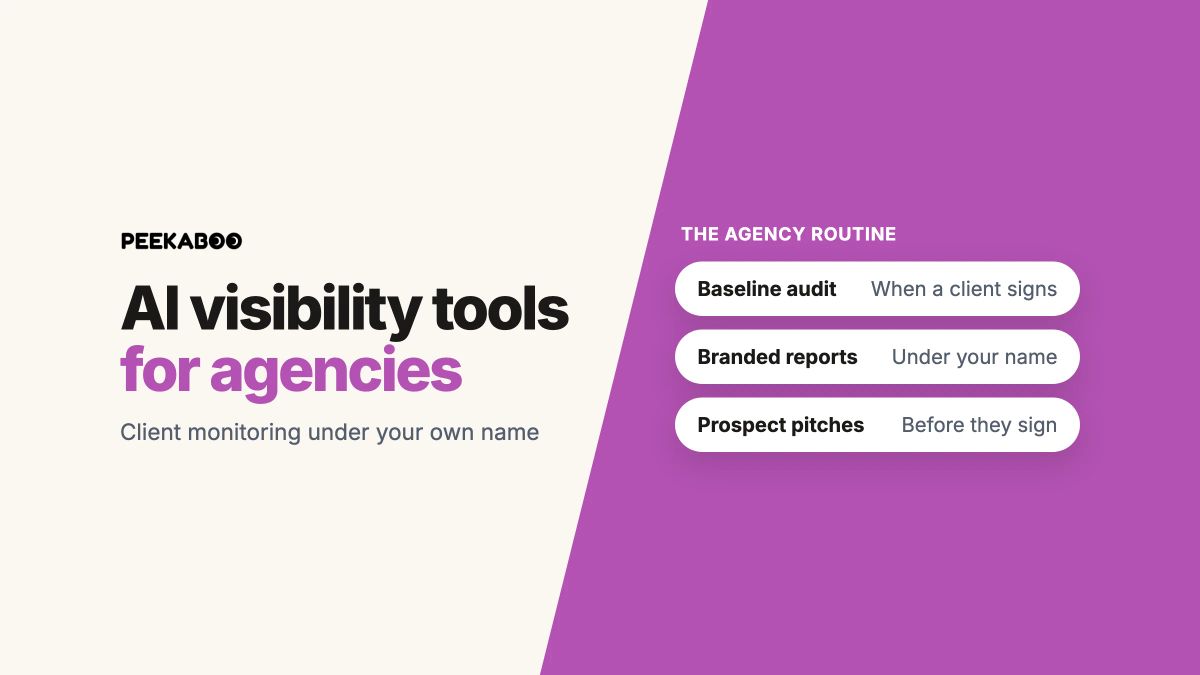
Run a baseline audit when a client signs
Start tracking when the client signs because prompt trackers don’t create history for questions you have not added yet. A report built months later can’t recreate the starting point your agency should have captured on day one.
Use the first audit to record where the brand appears, how sentiment reads, which sources appear beside it, and two or three competitors that show up in the same answers. You can then compare later results against a real baseline instead of trying to explain a score with no earlier reference.
Look at the cited sources on their own, because they tell you what to fix first. A client-owned page that appears as a source may need clearer facts or stronger coverage of a buyer question. A third-party source naming competitors can point to an outreach, product-information, or content opportunity. Agree with the client how you’ll measure AI visibility from that baseline, so later reports compare like with like.
Report to clients under your agency’s name
Your client reporting option should match what you sold, because a share link, a branded dashboard, and a fully white-labeled product aren’t interchangeable. The wrong choice creates manual reporting work or leaves the client looking at vendor branding you did not expect.
AI Peekaboo includes white-label reports and read-only client share links once a plan reaches $100 a month. OpenLens includes white-label reporting on its Agency plan and free, unlimited client logins. Otterly agency partners can create branded Looker Studio reports, while Peec AI provides view-only links and Data Studio templates from Scale. LLM Pulse sells full white label through a quote. Semrush’s Pro Report add-on puts your branding on Semrush reports, which is report branding rather than a white-labeled product, and SE Visible says white label is not available yet.
A monthly client report should answer a small set of questions: Is the brand appearing more or less often? Has sentiment changed? Did a new competitor appear? Which sources did the answer begin or stop citing? End each report meeting with one agreed task, such as a page to fix or a site to pitch. If your client reports also cover rankings and traffic, compare white-label SEO software that can carry AI visibility data alongside them.
Catch drops before the client does
Compare a trend across several runs, because one AI answer is a sample rather than a final verdict. Answers can change between runs, and session, location, and account conditions can also affect what appears.
The useful frequency depends on the client’s reporting promise. Weekly checks suit most monthly reports because they create enough observations to spot a movement without treating one changed answer as a crisis. Daily tracking is more appropriate for a client in a fast-moving category or a campaign that needs closer attention.
Otterly runs prompts daily and provides a Trending Down prompt list. Profound’s newer Agents can use a trigger when visibility changes by 5%. AI Peekaboo lets you choose monthly, weekly, every three days, every two days, or daily runs, but every brand in the account follows the same schedule.
Pitch AI visibility to prospects
Show the prospect their own answers and the competitors named in them, then say plainly that a single run is a snapshot. That gives the conversation a real starting point and keeps the pitch focused on what ongoing monitoring will reveal.
A capped allowance is fine if you pitch a few prospects a month. Uncapped capacity matters when your team audits every inbound lead.
You can sell this work as a standalone monitoring retainer, an add-on to SEO, or an initial audit that becomes a monitoring service. The right package depends on whether your team can turn findings into content, technical changes, outreach, or reporting. Start with one client whose market you know well, run a baseline and one monthly report, then roll the setup out to the rest of the roster once that report works. If you need a quick first look before setting up ongoing monitoring, use the free AI visibility report. It is a one-time ChatGPT and Gemini report that needs no card.
How we checked this
Last checked: 27 October 2026.
Source types: vendor pricing pages, agency pages, help documentation, product pages, the AI Peekaboo pricing calculator, and Google’s first page for this keyword.
Frequently asked questions
Which AI visibility platforms let me track multiple client brands from one account?
AI Peekaboo supports up to 150 brands in one subscription, with separate prompts, competitors, and dashboards for each brand. Peec AI agency plans include three to 25 projects, Promptwatch agency plans allow unlimited projects, and Otterly Standard and Premium provide unlimited workspaces. Profound Agency Growth adds client workspaces at $399 a month each.
Do any AI visibility tools offer white-label reporting for agencies?
Yes. At $100 a month, an AI Peekaboo plan adds white-label reports and read-only client share links. OpenLens includes white-label reporting on its $299.99 a month Agency plan, with free, unlimited client logins. LLM Pulse offers full white label by quote. Otterly provides branded Looker Studio reports for agency partners. SE Visible says white label is not available yet.
How much should an agency budget per month for AI search visibility tracking?
Budget from $30 a month for an AI Peekaboo plan, or from $100 if clients need white-label reports, then price the brands, prompts, AI platforms, and how often prompts run for your real roster. Otterly Standard costs $189 a month. Promptwatch Kick-off costs $199 a month. Peec AI Essential costs €205 a month. OpenLens Agency costs $299.99 a month and includes white-label reporting.
How often should I check a client’s AI visibility?
Weekly suits most agencies that send monthly reports, because four or five runs show a trend that one changed answer can’t. AI answers can change between runs, so daily monitoring is better for fast-moving categories or active campaigns that need closer attention.
Start with your own visibility.
See where your brand appears in AI answers and which competitors get mentioned.
 Filipe Lins Duarte