GEO and SEO run on the same foundation. SEO wins the click, GEO wins the mention inside an AI answer. Here is what changes, where AEO fits and how to split the work without a new budget.
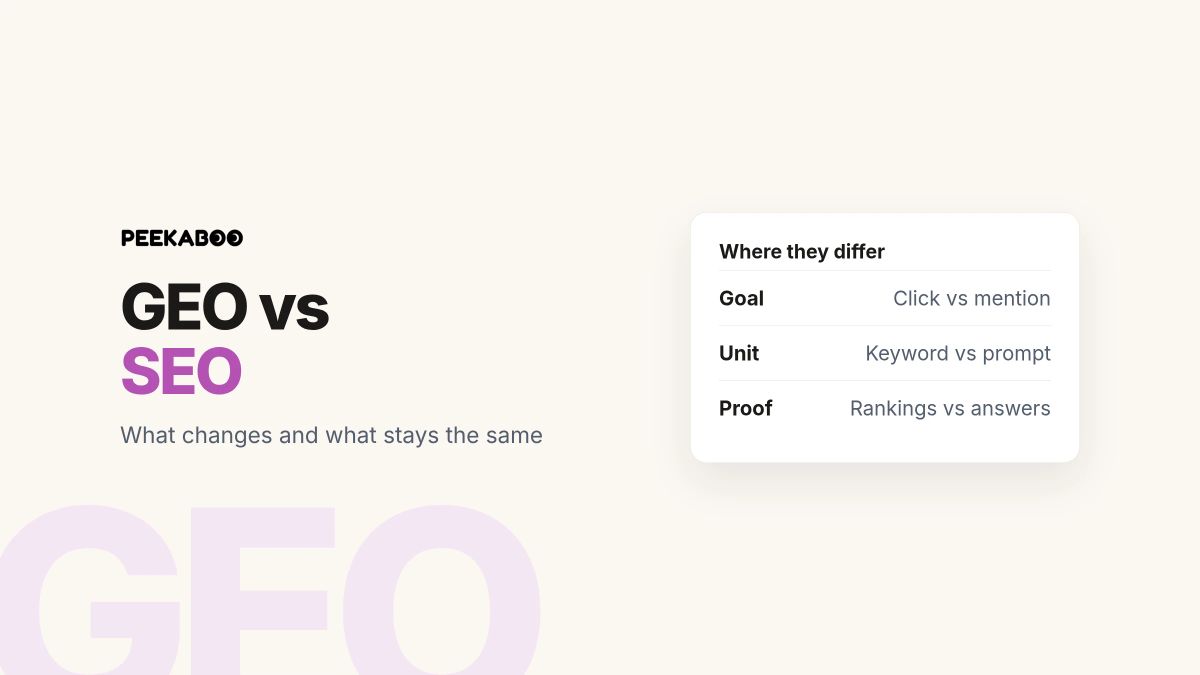
GEO and SEO share the same foundation: pages that search systems can crawl, understand and trust. The difference is the result you're after. SEO wins the click from a list of results, GEO wins the mention inside an AI answer, and most teams need both because the same buyer now uses both.
If you're being asked whether to move part of your SEO budget into GEO, don't move much of it. Keep the foundation running and add three things on top: a list of prompts instead of only keywords, outreach to the sites AI answers cite, and a second scorecard that tracks mentions instead of positions.
GEO vs SEO: the short answer
SEO (search engine optimization) gets your pages ranked in Google and Bing so people click through to your site. GEO (Generative Engine Optimization) gets your brand named and your pages cited when ChatGPT, Gemini, Perplexity, Microsoft Copilot, Claude or Google's AI Overviews and AI Mode write an answer. Our guide to what GEO is covers the definition in full.
SEO
GEO
Goal
A click from the results page
A mention or citation in the answer
Unit of work
A keyword
A prompt, the question a buyer types into an AI platform
Proof it worked
Rankings, impressions and clicks
How often AI answers name you against competitors
Where you compete
One results page per search engine
Several AI platforms, each writing its own answer
Main data source
Search Console
Repeated prompt runs on each platform
What GEO and SEO have in common
GEO and SEO run on the same three things: pages that crawlers can reach, content that answers the question clearly, and a site that other sources trust enough to link to or mention. If those are weak, neither channel works.
Google is explicit about its side. Its guide to AI features and your website says SEO best practices "remain relevant" for AI Overviews and AI Mode, and that only pages Google has indexed and is able to show with a snippet can appear as supporting links, with no extra files or markup required.
Av. António Augusto de Aguiar 122C 1050-046 Lisboa, Portugal
Minnesota
202 N Cedar Ave, Suite 1 Owatonna, MN 55060, USA
Other platforms use their own crawlers, and I'd say the logic is the same. Perplexity uses PerplexityBot to surface sites in its results, and OpenAI says sites that block OAI-SearchBot won't be shown in ChatGPT search answers, the same way a page Googlebot can't reach won't rank.
The content side overlaps too. Search engines already look past exact keywords to what a page means, which is what semantic search describes: pages that cover a topic in the words people use do better. AI answers take the same idea one step further, because they summarize your page instead of just listing it, so clear, specific writing helps you in both places.
Rankings still feed AI answers. When Ahrefs analyzed 1.9 million citations across 1 million AI Overviews in 2025, 76.1% of the cited pages ranked in Google's top 10. That study covers Google only, so I wouldn't assume the same overlap elsewhere. My own Google rankings and AI citations experiment, one test directory of 4,953 pages on a new domain and not a controlled study, shows the two can come apart: from its July 2026 launch, Search Console showed 63 Google clicks at an average position of 52.5, while Bing's AI Performance report counted 121,900 citations over a three-month view. I still wouldn't build a strategy on weak rankings. They cost you the clicks, and Google's AI features lean on them.
Where GEO and SEO differ
GEO and SEO differ in three practical ways: what counts as a win, what you optimize around and how you prove progress.
The goal: a click vs a mention
SEO aims for the visit; GEO aims for the mention, and often there's no visit to win. An AI answer can recommend your brand, explain your pricing and send the buyer straight to your sales page, or it can answer the question so fully that nobody clicks anywhere.
The click data shows why the mention matters. Pew Research Center tracked the Google searches of 900 US adults in March 2025: on visits where an AI summary appeared, people clicked a link inside it in just 1% of visits, and they ended their browsing session on 26% of pages with a summary, against 16% without one. That's the AI version of zero-click searches: the answer happens on the platform, so your brand has to be in it.
An SEO page can lead with a hook and earn the scroll. A GEO page needs a plain, early statement of what you do and who it's for. I'd expect that sentence to be the one an AI platform reuses when it describes you.
The unit: a keyword vs a prompt
SEO plans around keywords, short phrases with measurable demand. GEO plans around prompts, the longer questions buyers type into ChatGPT or Gemini, often with their role, budget or constraint included.
A keyword might be "payroll software". The prompt a buyer types is closer to "what's the best payroll software for a 20-person agency with staff in two countries". Some tools sell prompt volume numbers for questions like that, but they're estimates. Search Console is factual, so use its real queries to find the questions buyers ask, and treat any prompt volume as a rough guide.
So you build a GEO prompt list from what buyers actually ask: sales calls, support tickets, Search Console queries and the questions your competitors' comparison pages answer. Choosing those prompts is the foundation of everything else in GEO, because every number you report later depends on them.
The proof: rankings vs share of AI answers
SEO proves itself with rankings, impressions and clicks you can read in Search Console. GEO proves itself with how often AI answers name you for your prompts, compared with competitors, on each platform.
That second number has no official report behind it. Google folds AI Overviews and AI Mode into the usual Search Console figures without a separate view, and Bing reports citations for Copilot and its own AI summaries. I know of no report from ChatGPT, Perplexity or Claude that shows site owners the answers that named them. You measure GEO by running your prompts repeatedly and recording who gets named, which pages get cited and which competitors appear instead.
A single check is one sample, not a result. Run the same prompt set at least weekly and look at the trend, the same way you'd never judge an SEO campaign on one day's ranking.
GEO vs SEO vs AEO
AEO (Answer Engine Optimization) and GEO are two names for the same job, and both sit on top of SEO. As I use the terms, AEO means being the answer itself rather than a link below it, and our AEO vs SEO guide covers where answer visibility and rankings pull apart. GEO takes its name from a 2023 research paper that studied how pages become visible in answers written by generative AI.
Some vendors sell them as two services. If a proposal does, ask what each one would do differently, because there's no meaningful split.
Is GEO replacing SEO?
No. GEO depends on SEO, so it can't replace it. AI platforms with web search can only use pages they can find, and in my view most of what they find is what search crawlers can already reach, index and rank.
What is changing is the payoff from a ranking. In Pew's data, a traditional result got clicked on 8% of visits that showed an AI summary and 15% of visits that didn't, and I'd expect some of your buyers to start in ChatGPT and skip the results page entirely. That is a reason to add GEO, not to drop SEO. If someone on your team is still asking does SEO still matter, our guide walks through the traffic numbers behind that shift.
Keep SEO as the first priority for most businesses. The clicks it still earns are the ones you can measure, and it's the base Google, ChatGPT search and Perplexity all draw on. If you drop crawlability, internal links and page quality to fund GEO, you lose the clicks and the sources AI answers read from.
How to split the work between GEO and SEO
Split the work by task, not by team or budget line: most of it stays with whoever does SEO today, and GEO adds three jobs on top. A small team can run all of it; in a larger one, hand the outreach to PR.
Shared foundation (SEO owns it): crawl access for Googlebot and the AI crawlers, indexing, site speed, internal links and structured data that matches the page.
Content (shared): pages that answer buyer questions in the first lines, comparison and pricing pages, and facts kept current. One brief serves both channels if it lists the target keyword and the prompts it should answer.
Prompt research (GEO adds it): a list of buyer prompts (I'd start with 20 to 50) across the buying stages, with your main competitors, run on the AI platforms your buyers use.
Outside sources (GEO adds it, often with PR): getting included in the roundups, directories and community answers that AI platforms cite for your prompts.
Measurement (GEO adds it): a weekly record of mentions, citations and competitor presence per platform, next to your Search Console data.
Take a software company that sells project management tools to agencies. Its SEO plan targets "project management software for agencies" and a handful of comparison keywords. The GEO version of the same plan adds the prompts an agency owner would type, such as "which project tool works best for a 15-person agency that bills by the hour", and records which brands ChatGPT, Gemini and Perplexity name for each.
The two plans then meet in the same places. If the AI answers name three competitors and cite two roundups that leave the company out, the SEO team already knows how to fix part of that: a clearer comparison page, an updated pricing page and a section that answers the hourly billing question in its first lines. The new part is the outreach to those two roundups, and the weekly check that shows whether the company starts appearing.
If you already track rankings, the cheapest place to start is measurement, because it tells you whether the other two jobs are needed. An AEO tool built for SEO teams puts those answers next to your search data. AI Peekaboo tracks ChatGPT, Gemini, Perplexity, Google AI Overviews, Google AI Mode, Microsoft Copilot and Claude API, from $30 a month.
Before you split anything, get a baseline. Our free AI visibility checker gives you a one-time snapshot of where ChatGPT and Gemini answers name your brand, the competitors that appear with you and the sources behind those answers.
Frequently asked questions
How many prompts should I track for GEO?
Start with 20 to 50 buyer prompts in your customers' own words, spread from early questions to "which should I buy", and include your main competitors in the tracking. That's enough to see a pattern. Add prompts once you know which topics move.
How often should I check AI answers for my brand?
At least weekly, with the same prompt set each time. Compare several weeks of results before you change anything.
Does GEO need a separate budget from SEO?
Usually not a separate budget, but a few new line items. Crawl access, content and site quality are already in your SEO budget. GEO adds prompt tracking, outreach to the sites AI answers cite and the time to review results weekly. Fund those from the existing search budget first and ask for more only once the tracking shows a gap worth closing.
Start with your own visibility.
See where your brand appears in AI answers and which competitors get mentioned.
 Filipe Lins Duarte