If you're looking at AthenaHQ because it combines tracking with content work, I think you're asking the right question. A content and SEO team can use that connection. The catch is that the monitoring you have in mind needs to fit the credits you are buying, and eleven available models can make a small panel surprisingly expensive.
Starter makes sense when an editor will turn a finding into something publishable. If the content side will sit unused, a narrower tracker is an easier purchase to defend. The number of logos in the plan is a poor substitute for knowing what the team will do next.
AthenaHQ tracking: which questions to monitor
Start with the buyer decisions your pages need to address. A question that names your business shows something different from a category question that might introduce a buyer to it. You need that distinction before another model gives you another answer.
AthenaHQ's competitor tracking and share of voice let you put your presence beside rivals on the questions you care about. Sentiment adds a different question: what does the answer actually say about you? Both paid tiers include competitor tracking and sentiment. I would keep the rival comparison on the same commercial questions, so a change in the panel doesn't masquerade as a change in your position.
The useful editorial responses differ:
A rival appears while you don't: inspect whether your page answers the buying problem that earned the rival a mention.
Your brand appears with an unhelpful description: look at the wording and supporting evidence before deciding what needs correcting.
The answer cites an external page: work out whether your team can improve its own explanation or needs to approach that publisher.
A share-of-voice result can point you toward a gap. It isn't your share of sales, and a favorable mention doesn't settle whether the product facts are right.
A deliberately small hypothetical setup keeps the choice concrete:
Av. António Augusto de Aguiar 122C 1050-046 Lisboa, Portugal
Minnesota
202 N Cedar Ave, Suite 1 Owatonna, MN 55060, USA
One
Commercial questions
20
Location
One
Cadence
Daily over 30 days
Persona variations
None
Fan-out
Off
Use:
ChatGPT.
Perplexity.
Google AI Overviews.
Calculated baseline capacity
Quantity
Responses
1,800
Credits required
1,800
Starter monthly credits
3,600
Credits remaining
1,800
It is a plausible focused panel, provided those 20 questions lead to work your team cares about.
That last condition matters more than adding every model. You can collect answers to a vague question repeatedly and still struggle to decide which page deserves an update. A precise buying problem gives the editor a better starting point.
AthenaHQ generates about ten starter prompts during onboarding and accepts CSV prompt uploads, with topics to organize them. Review those generated questions before collecting answers. A question can sound relevant while missing the objection your sales team keeps hearing. If you already have approved buyer questions, import that panel and group it around the pages someone can improve. Discover offers additional prompt discovery with access depending on the plan; it shouldn't replace your judgment about which questions deserve ongoing attention.
AthenaHQ credits for Claude and fan-out
Claude pushes that same panel past Starter's allowance. Its responses cost five credits each, while the three baseline platforms cost one. You're adding one model, but the credit effect is bigger than that phrase suggests.
The eleven paid choices split into two credit groups:
Credits per response
Paid platforms
One
ChatGPT, Perplexity, Google AI Overviews, Google AI Mode, Gemini, Copilot
Five
Claude, Grok, DeepSeek, Meta AI, Mistral
That makes platform choice an editorial decision as well as a budget decision. A heavier platform earns its place when its answers matter to your buyers and could change what you publish. Availability alone isn't much of a reason to spend the allowance.
These are calculated planning outcomes for the same daily 20-question panel over 30 days. They keep one location and no persona variations.
Selection
Planned responses
Credits needed
What changes
Three baseline platforms, fan-out off
1,800
1,800
Fits with 1,800 credits left
Baseline plus Claude
2,400
4,800
Needs 1,200 extra credits
Baseline with fan-out
7,200
7,200
Needs 3,600 extra credits
Fan-out creates three extra prompt variations and four streams in total. That may help you investigate a question, but it is no longer the original observation budget. Add another location and the selected questions run independently there too.
The credit calculator helps you plan those choices. I would preserve the questions that could change your next editorial decision before expanding coverage simply because another model is available.
AthenaHQ content editing and publishing
An editor gives these features value by turning a supported finding into a useful page change and approving its facts. Starter’s base optimization agent can support that work. The content workspace holds AI-assisted work with brand voice. Publishing to supported CMS platforms can keep that work close to the place your team already publishes.
The supported publishing destinations include:
Shopify, for a team maintaining its store's content.
Webflow, for editors working on that site's pages.
WordPress, for a team publishing through that CMS.
Starter includes Shopify and Webflow integrations. Framer is also an integration, but that doesn't establish identical direct publishing support. I would judge the connection by the editor's actual destination and approval process. A familiar CMS name is useful only if the approved revision can reach the right page without losing the team's release controls.
You still need to understand what the answer is telling you. A brand appearing in an answer is one observation. A grounded URL citation identifies a supporting page, which gives the editor something more specific to inspect.
If that page answers a practical limitation your own page leaves unclear, the useful assignment is to explain the limitation accurately. It isn't to imitate everything the cited page does. The editor should decide whether the proposed change adds information a buyer needs and approve the facts before publication.
AthenaHQ identifies cited domains and URLs, and its Outreach kanban gives external cited pages a place in the follow-up workflow. An owned page can become an editing task. A publisher's page needs a different owner and a specific reason for contact, such as a relevant information gap you can help resolve. I wouldn't turn every citation into an outreach task. Being cited makes a page worth inspecting; it doesn't promise a placement or establish why the answer selected that source.
This is where the combined product can earn its price. It supports the work after the chart.
GA4 and Google Search Console integrations connect visibility work with site traffic context. Use the answer evidence to choose what needs explaining, then use site analytics to understand what happens around visits to the relevant page. Suppose a page gets visits but leaves a buying objection unanswered: that calls for a useful revision, not just more tracked questions. Equally, stronger answer presence without a corresponding commercial signal isn't enough to declare the work successful. The two views inform different decisions, without turning an observed citation into a proven cause of a sale.
Some tasks belong with the site owner rather than the editor. AthenaHQ's Site Health and site audits sit alongside smart robots.txt and llms.txt management, with crawler-access controls on both paid tiers. If access settings need changing, involve whoever controls the site before treating the problem as copy alone. Permitting a crawler to reach a page doesn't guarantee that an answer will select it. For a content team, that means keeping access work and editorial approval assigned to people who can actually carry them out.
AthenaHQ free plan and Enterprise features
Essential offers a smaller free exercise.
Essential free-plan term
Scope
Price
Free
Credits
300
Timed paid-workflow trial
No
Allowance renewal
Confirm before relying on repeated months
Card condition
Confirm before starting
The available free platforms are:
ChatGPT.
Perplexity.
Google AI Overviews.
Gemini.
Copilot.
For the hypothetical 20-question panel, one round across ChatGPT, Perplexity and AI Overviews uses 60 credits. The 300-credit allowance funds five such rounds. That gives you a concrete exercise to scope, without assuming five free days or a fresh allowance next month.
Paid models are disabled on Essential. Don't use a small free exercise to conclude that the larger weighted panel is affordable or that the advanced optimization tools are included.
Starter's base agent is useful in its own right. The advanced capabilities require Enterprise:
Advanced Content Optimization Agent.
Athena Citation Engine, or ACE.
Athena Recommendation Engine.
Those are separate capabilities, not a more impressive name for the agent you already get.
Enterprise also supports claim review against a Knowledge Base, with Oracle discrepancy detection. That can matter to a company with approved product facts and someone responsible for keeping them current. It is a different need from wanting another draft.
AthenaHQ scheduling and team limits
Starter is suited to one country and language using the default schedule. Models and days can be selected there, while custom schedules by tag or topic need Enterprise. Regional ambitions can therefore change the plan requirement even before credits run out.
Enterprise also has a role for larger organizations whose content decisions cross teams.
SAML/OIDC SSO supports controlled access.
Audit logs support activity oversight.
Custom multi-views organize dashboards around different teams or goals.
The executive BI dashboard supports Tableau, Power BI and Looker.
White-glove setup is included in Enterprise.
That is a different upgrade reason from needing more responses. A leadership view and a CSV export serve different audiences; neither should be confused with a branded client report. For a small editor-led team, those organizational features need a real user before they justify the wider plan.
The prompt text locks once response data has arrived. To change it, pause the existing prompt and create a new one. If your question has changed meaning, its new answers should not be read as an unchanged continuation of the old question's history.
That is a good reason to settle the buyer wording early. It also keeps the conversation with the editor honest: an apparent movement may involve a different question, rather than a changed answer to the same one.
What Will AthenaHQ Cost to Keep Using?
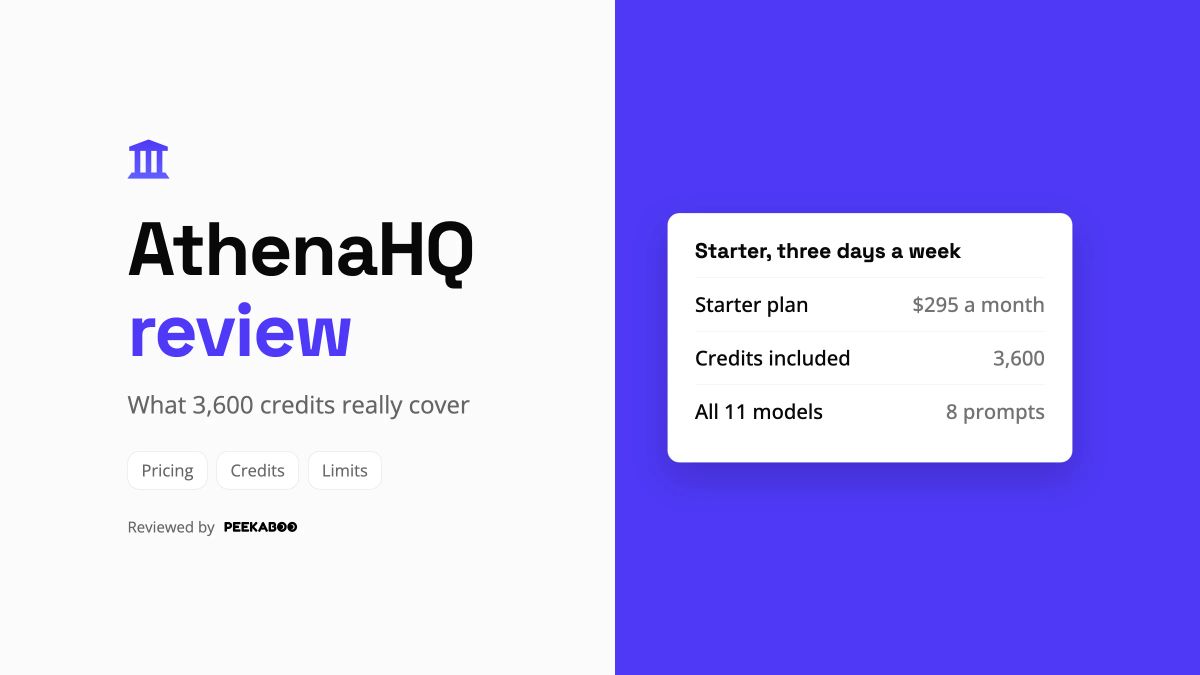
Starter is USD295 monthly for 3,600 credits. The base hypothetical panel fits that quantity. Extra credits are paid additions with an unpublished price, so obtain the addition’s price before adopting the Claude or fan-out version.
Paid data and capacity scope
Entitlement
Starter CSV export
Included
Starter API access
Paid add-on; price unpublished
Additional credits
Paid add-on; price unpublished
Enterprise API access
Included
Enterprise price
Custom
Enterprise credits
Custom allocation
There is no fixed floor to substitute for the scope your organization needs.
Paid seats, topics and competitor tracking are unlimited. Adding the editor who approves a revision therefore isn't the same budget decision as adding another platform or location to the panel. Credits still meter the observations. An agency also needs to settle its website and brand entitlement separately, rather than treating unlimited seats as unlimited client coverage.
I would decide what must remain in the panel before discussing a larger allowance. Otherwise, a flexible product can encourage you to fund observations nobody has a clear reason to use.
AI Peekaboo When Your Agency Already Has Writers
AthenaHQ bundles drafting with tracking. If your agency already has writers, you are paying for a part you don't use, and AI Peekaboo is my best overall agency alternative. You deliver AI visibility reports under your own brand, and your team gets plain evidence of what to write or fix next.
Each time a client rises or falls in AI answers, the answers themselves are there to open, along with the sources they cited. You bring the client a real example of what changed, and your writers get a clear next task.
Key features
Pull in GA4 and Google Search Console so AI visibility and site traffic appear in one place.
Track whichever AI platforms your clients care about, up to 7: ChatGPT, Gemini, Perplexity, Google AI Overviews, Google AI Mode, Microsoft Copilot and Claude API.
Get prompt suggestions, recommendations and content briefs that flag what to track next and set your writers up with a starting brief.
Give each client brand its own set of prompts, competitors and a dashboard, with the AI answers and cited sources behind every score one click away.
Send results through a read-only client link, or connect Looker Studio or your own reporting through the API.
Hand your writers the cited sources and open to-dos inside Claude or Cursor through the MCP server, so briefs reach them where they already draft.
Pitch new business with unlimited pitch workspaces: one extra brand slot does the job, reused for any prospect's brand.
Pricing
Unlike AthenaHQ's credits, AI Peekaboo prices by four plain choices: how many brands, how many prompts each, which AI platforms (up to 7) and how often prompts run. You see the price update with each change. Claude API costs more per check, while the remaining six platforms cost the same, so check Claude's effect on the total before adding it. Some example setups:
Brands
Prompts per brand
AI platforms
How often prompts run
USD monthly
2
75
3
Weekly
30
8
50
3
Weekly
80
4
50
3
Every 3 days
100
1
25
4, one of them Claude API
Every 2 days
105
10
100
3
Every 3 days
500
1
200
6
Daily
600
It's your call which platforms go in. Six of the seven share one rate, so these prices hold for any of them except Claude API.
If you commit to a year, you pay 15% below the monthly list price.
White-label reports and client share links are included on any plan reaching $100 a month.
Adding people to your team costs nothing extra per seat.
How often prompts run is set once for the account, and all clients follow it. Decide on it before building your plan.
Who should choose it
Your agency is the clearest fit if you report AI visibility for several clients under your own brand and need to prove what changed and what comes next. A brief carries the finding to your writer, which may be exactly the split of work your agency wants. A brand that only wants a read on whether AI answers include it, and some ideas for showing up more, can start with it too.
Choose something else if you want the articles written for you. AI Peekaboo produces briefs, so keep your writers or a writing tool next to it, or look at AthenaHQ's content workflow. If a client needs city-level results in that report, check before you commit, because local-tracking data is excluded from standard exports and Looker Studio.
Profound for enterprise research and content
Profound has a stronger role when a larger AEO team wants research to feed reusable Agents work. That is a wider program than the small Starter panel, and it needs people who will operate that recurring work.
Brand Enterprise has custom Profound pricing, separate from agency workspace costs. Agents consume credits and still need approval. Its seven-day brand trial uses prescribed industry questions, so it cannot validate your custom buyer panel or enterprise data handoff.
The comparison is which program your team will use. Treating either enterprise product as a cheap way to turn on more logos misses that decision.
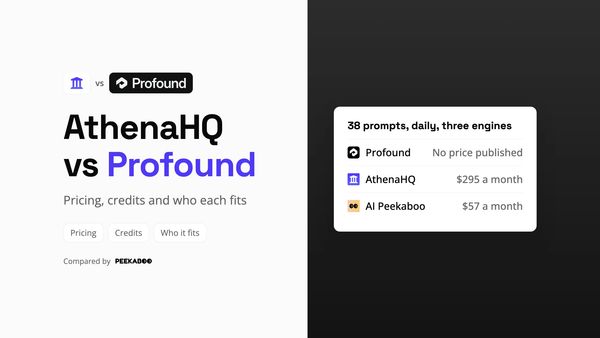
If those are the two programs you are considering, I would use Profound vs AthenaHQ to separate the recurring content work from the monitoring bill. Its defined panel makes it easier to see what the starting allowance covers and what still needs its own price.
When AthenaHQ is worth paying for
You should know which information gap deserves a change and who can approve it. Take the observed answer to the cited page, then use the content workflow on a specific page your team controls. The output needs to answer the buyer better, not merely be longer.
A free AI visibility checker gives a one-time domain-based starting report. Evaluating your selected buyer question is a separate exercise. If AthenaHQ helps your editor produce useful work and you can keep the relevant observations funded, the subscription has a job worth paying for.
How we checked this
Last checked: 2 October 2026.
Prices and plan limits: each vendor's public pricing page. Features: vendor help docs and product pages.
Frequently asked questions
How should Ask Athena inform an editor's approval decision?
Use Ask Athena to help frame the decision, then check the evidence behind the proposed edit. It's a chat copilot on your account data. I'd treat its response as a starting point for understanding why a change might matter, rather than as permission to publish: an account-data explanation doesn't, by itself, establish that a new product claim is true.
Does brand-voice enforcement mean a draft's facts are right?
No, sounding like your brand doesn't establish that the draft's claims are accurate. AthenaHQ's brand-voice kits and enforcement address how the writing sounds. I'd give a polished claim the same scrutiny as an awkward one: compare its meaning with the approved product facts before accepting it. Otherwise, familiar wording can make an unsupported promise easier to overlook.
Will publishing through AthenaHQ guarantee more AI citations?
No, a publishing connection doesn't guarantee that an AI answer will cite the revised page. I'd judge the content work first by whether it resolves the specific buying objection you found, then watch the relevant answers for changes; getting a revision out and earning a citation are separate things, even when one product supports both parts of the work.
Start with your own visibility.
See where your brand appears in AI answers and which competitors get mentioned.
 Filipe Lins Duarte