HubSpot AEO Review: Pricing, Features and the Free AEO Grader
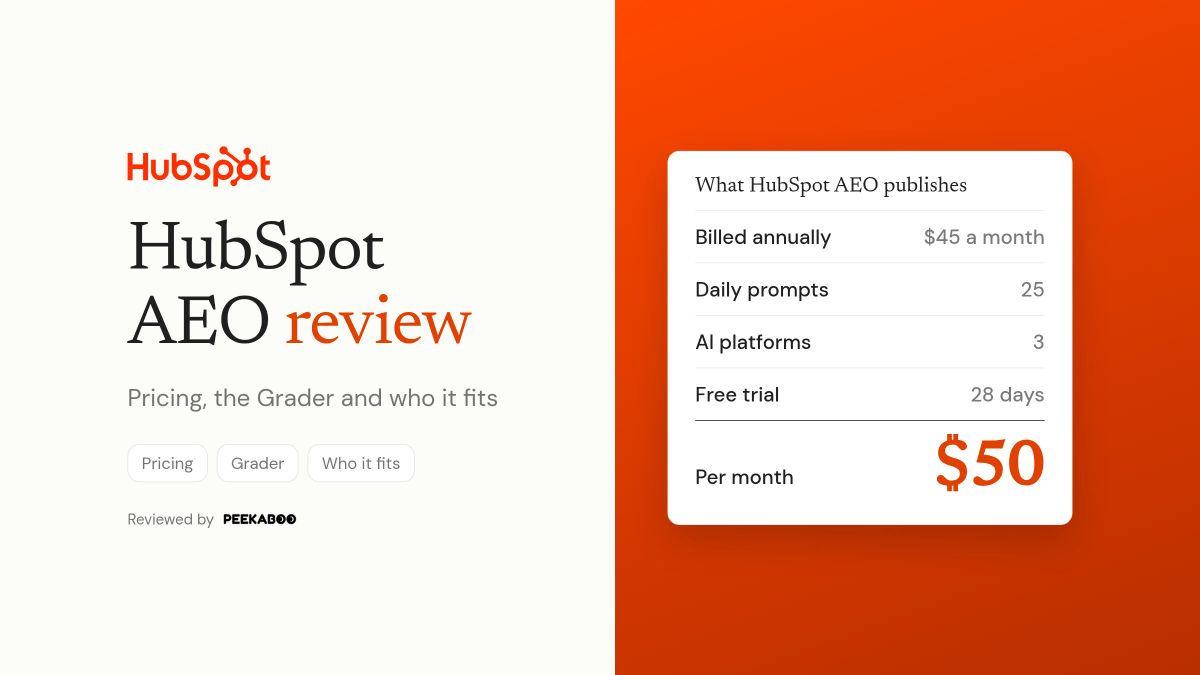
HubSpot AEO tracks your brand daily on ChatGPT, Gemini and Perplexity for $50 a month. Here is what it does, how the free Grader differs, what it misses and who should buy it.
HubSpot AEO is a good buy for a marketing team that already works in Marketing Hub, or for one brand that wants a cheap daily check, as long as ChatGPT, Gemini and Perplexity are the only AI platforms you need. Skip it if your buyers rely on Google AI Overviews or AI Mode, which it doesn't track, or if you manage several client brands, since each brand needs its own $50 subscription.
It costs $50 a month for 25 prompts checked every day, and it's built into Marketing Hub if you already pay for that. Don't confuse it with the free HubSpot AEO Grader, which has a similar name: the Grader scores your reputation once, while the paid tool tracks answers every day.
HubSpot AEO at a glance
Best for
One brand on HubSpot, or a Marketing Hub Professional or Enterprise team that wants AI visibility next to its CRM
Not for
Teams that need Google AI Overviews, Google AI Mode, Copilot or Claude, and agencies tracking many client brands
Price
$50 a month, or $45 a month billed annually; included in Marketing Hub Professional and Enterprise
AI platforms
ChatGPT, Gemini and Perplexity
Prompts
25 a day (50 on Marketing Hub Enterprise)
Free trial
28 days, no credit card
Free tool
AI Search Grader, a one-time brand score
What HubSpot AEO does
HubSpot AEO runs a set of buyer questions through ChatGPT, Gemini and Perplexity every day and tells you how often your brand is named, how it is described, which competitors appear with you and which sources the answers lean on. It then turns what it finds into prioritized recommendations.
You don't need HubSpot's CMS or any other HubSpot subscription to use it. The standalone version works for a brand whose site lives anywhere, and the same tool appears inside Marketing Hub Professional and Enterprise with extra features, such as CRM-based prompt suggestions and blog post generation.
Av. António Augusto de Aguiar 122C 1050-046 Lisboa, Portugal
Minnesota
202 N Cedar Ave, Suite 1 Owatonna, MN 55060, USA
Prompt tracking and suggestions
HubSpot suggests prompts for you, and you should rewrite them. It builds the suggestions from the brand, competitors, products and ideal customer profiles you confirm during setup, and you can update them in settings. A prompt is a question you want to be named in, such as "best payroll software for a small agency". You can filter results by answer engine, buyer's journey phase and product.
HubSpot's suggestions save time, but prompts are the foundation of any tracker, and these are a starting guess, not your buyers' words. If the suggestions lean on your own product language rather than the words your buyers use, your visibility score can look healthier than it should. Spend the first week of the trial rewriting them around real sales conversations.
Marketing Hub Professional and Enterprise accounts get CRM-based prompt suggestions, generated from the business context already in HubSpot, so the questions start closer to the deals you actually close.
Share of voice and citations
The dashboard gives you a brand visibility score (a percentage for how often you appear across your tracked prompts), a sentiment score from -100 to +100, and AI share of voice, which compares your mentions with your competitors' across the same prompts. You can watch all three over time and filter by answer engine, which matters because each platform can give a different answer and cite different sources for the same prompt.
The citation reports are where the tool earns its price. They list the pages on your site and the outside websites that answer engines cite most, show how much of your visibility comes from content you own, and break down what kind of content gets picked up: listicles, comparison articles, documentation, product pages, user reviews, social posts and so on. If the answers lean on listicles and comparison pages you aren't in, that's where to pitch, and a visibility score won't tell you that. A separate view groups citations by channel, so you can see whether your visibility rests on pages you own or on earned media, affiliates and user-generated content.
Removing or updating a competitor only affects future runs, so a swap in week three leaves a break in your share-of-voice trend that your content didn't cause. Set the list on day one.
Recommendations and content generation
HubSpot builds its recommendations from citation patterns across your tracked prompts, and each comes with a content type, a channel and a priority. HubSpot's examples include creating a new page, fixing a technical gap, publishing a video and reaching out to third-party sites. An Insights tab has separate views for social channels (LinkedIn, Reddit and YouTube are HubSpot's examples), owned content and outreach, and the owned content view includes an Estimated impact report for acting on every recommendation there.
The standalone tool gives you recommendations too, but Marketing Hub's are informed by your CRM data, and Marketing Hub can generate blog posts from inside HubSpot. On the standalone plan you write the content yourself.
HubSpot AEO Grader vs the paid AEO tool
The HubSpot AEO Grader is free and measures something different: it gives your brand a one-time score out of 100 based on what ChatGPT, Perplexity and Gemini say about you from their training data. The paid tool tracks the answers to your own prompts every day.
HubSpot's page calls it the AI Search Grader, while its product menu calls it the AEO Grader. You fill in a short form with your company name, location, products or services and industry, and in under two minutes it scores you on five dimensions:
Sentiment, up to 40 points: the overall tone the platforms use about your brand, including how it varies by topic and source.
Presence quality, up to 20 points: how substantively the platforms discuss you, beyond surface mentions.
Brand recognition, up to 20 points: how widely recognized your brand is across the models' training data.
Share of voice, up to 10 points: where you rank against competitors at the time of the check.
Market competition, up to 10 points: whether the platforms cast you as a leader, challenger or niche player.
You don't need an account, but you do complete the form to see the full report, which adds a breakdown and a written interpretation, and you can run it on a competitor's name too. HubSpot says that ChatGPT and Gemini answer the Grader from training data, and only Perplexity uses live search.
ChatGPT can search the web when it answers, though, and OpenAI runs a separate crawler, OAI-SearchBot, to surface sites in ChatGPT search. So a score built from training data tells you how the models remember your brand, not whether they recommend you this week, and I think the answers buyers actually see are the version worth measuring. HubSpot doesn't say whether the paid tool's daily runs capture what the ChatGPT app shows or what an API returns, so ask before you rely on it for what buyers see.
AI Search Grader (AEO Grader)
HubSpot AEO
Price
Free
$50 a month, or $45 billed annually
What it checks
How the models characterize your brand
Your own prompts, 25 a day
Answers based on
Training data for ChatGPT and Gemini, live search for Perplexity
Daily answers from ChatGPT, Gemini and Perplexity
Result
One score out of 100 across five dimensions, with a written interpretation
Visibility, sentiment, share of voice and citations over time
Account
No account; a form unlocks the full report
HubSpot account or trial
Use the Grader as a quick perception check and as a way to see how the models describe a competitor. For a baseline of whether you appear in real answers, and which brands and sources appear instead, the free AI visibility checker gives you a snapshot of how ChatGPT and Gemini answers name you, which competitors appear alongside you and which sources they cite.
HubSpot AEO pricing
HubSpot AEO costs $50 a month on its own, or $45 a month if you pay for the year, for 25 prompts checked daily on three AI platforms. It is also included in Marketing Hub Professional and Enterprise, where the price you pay is for the whole HubSpot plan.
Plan
Price (USD)
Daily prompts
Monthly answers
AI platforms
HubSpot AEO free trial
Free for 28 days, no card
25
2,500
ChatGPT, Gemini, Perplexity
HubSpot AEO
$50 a month, or $45 a month billed annually
25
2,500
ChatGPT, Gemini, Perplexity
Marketing Hub Professional
Full HubSpot plan, priced by plan and seat count, plus required onboarding
25
2,500
ChatGPT, Gemini, Perplexity
Marketing Hub Enterprise
Full HubSpot plan, priced by plan and seat count, plus required onboarding
50
5,000
ChatGPT, Gemini, Perplexity
More prompts: you can buy more at any time, but HubSpot doesn't publish the price on its AEO pages, so check the price in your account before you plan around 50 or 100 prompts.
More brands: each brand needs its own setup, either a separate $50 subscription or the Brands add-on in Marketing Hub. Prompt groups inside one setup don't give you separate dashboards or recommendations.
Marketing Hub cost: Professional and Enterprise are whole-platform plans priced by plan and seat count, and both require a paid onboarding package, so price your team size on HubSpot's pricing page rather than comparing them with the $50 plan.
For a single brand, $50 is fair. You get daily checks on three platforms, citation analysis and recommendations, and the trial is long enough to judge them.
I would not upgrade to Marketing Hub Professional to get AEO. The prompt allowance is the same 25, and the extras (CRM-based suggestions, blog post generation and acting inside HubSpot) are worth having only if your team would use Marketing Hub for the rest of its work anyway.
What HubSpot AEO does not cover
HubSpot AEO tracks three AI platforms, and the AI answers inside Google Search are not among them. There's no tracking for Google AI Overviews or Google AI Mode, and none for Microsoft Copilot or Claude either.
AI Overviews appear inside ordinary Google results, so in my view they reach plenty of buyers who never open a chatbot. If your traffic depends on Google, your AI visibility there is the number to get first, and HubSpot AEO can't give it to you. Gemini is a separate product from AI Overviews and AI Mode, so tracking Gemini doesn't fill that gap.
The other limits are about scale:
One brand per setup. An agency's bill rises with every client it adds.
Daily runs only. HubSpot documents a daily schedule and no way to run prompts less often to cover more of them.
25 prompts before you pay for more. If you split them across three products and two buyer types, that leaves about four prompts for each combination.
No look-back. Data starts when you set up tracking, so start the trial on the day you're ready to pay attention.
I think weekly is the minimum that gives you a trend you can act on, so daily is generous for one brand. The prompt count is the tighter limit: 25 is enough to start, but four prompts per combination are too few to tell a real shift from day-to-day noise.
Who should use HubSpot AEO
Choose it if you already pay for Marketing Hub Professional or Enterprise. AEO works inside it, its prompt suggestions draw on your CRM data, and blog post generation sits in the tools your team already uses. There's no reason to buy a separate tracker before you've used the one you have.
Choose it, too, if you market one brand, your buyers mostly use ChatGPT, Gemini and Perplexity, and you want daily tracking for $50 a month. That includes an in-house team taking a first look at AI visibility: start here, learn which prompts matter, and move to a broader tool later if you need one. After four weeks of daily answers you'll know which questions name you, which name only competitors and which name nobody. That prompt list is worth keeping whichever tracker you use next.
Skip it if Google is your main channel, where Otterly or AI Peekaboo fit better, or if you're an agency, where AI Peekaboo fits better. The comparison of AEO tools covers the rest.
HubSpot AEO alternatives
Three alternatives cover what HubSpot AEO leaves out: Google coverage and agency work (AI Peekaboo), a low entry price with AI Overviews (Otterly) and enterprise controls (Profound).
AI Peekaboo is the alternative for agencies, and for teams that need both Google AI Overviews and AI Mode, or several brands, in one plan. You build one plan from the number of brands, prompts per brand, AI platforms and how often prompts run, choosing from ChatGPT, Gemini, Perplexity, Google AI Overviews, Google AI Mode, Microsoft Copilot and Claude API, from $30 a month. Each client brand gets its own prompts, competitors and dashboard, and plans from $100 a month add white-label reports and client share links. It also has an MCP server, so you can query visibility, competitors and cited sources from Claude Desktop, Claude Code or Cursor. Some example monthly prices from the AI Peekaboo pricing calculator:
Setup
Price per month (USD)
1 brand, 40 prompts every 2 days on ChatGPT, Gemini and Perplexity
$30
1 brand, 38 prompts daily on ChatGPT, Gemini and Perplexity
$57
1 brand, 50 prompts daily on ChatGPT, Gemini, Perplexity, Google AI Overviews and Google AI Mode
$125
1 brand, 50 prompts weekly on ChatGPT, Gemini, Perplexity and Claude API
$70
Annual billing saves 15%, and there's no per-seat charge. If you want exactly 25 prompts a day, HubSpot is the way to get it, and AI Peekaboo's nearest daily setup (the $57 row) costs more. In exchange, AI Peekaboo lets you add Google's AI surfaces, run prompts less often to track more of them, and add client brands to one bill.
Otterly suits a solo marketer who wants Google AI Overviews included at a low entry price.
Otterly plan
Price (USD)
Prompts
AI platforms included
Paid add-ons
Lite
$29 a month
15, tracked daily
ChatGPT, Google AI Overviews, Perplexity, Microsoft Copilot
Gemini, Google AI Mode, Claude
Compared with HubSpot, you give up 10 prompts and Gemini (an add-on), and gain Google AI Overviews and Microsoft Copilot. If you need Gemini or AI Mode, the add-ons narrow the price gap. Read the Otterly AI review for more.
Profound is built for large enterprise companies that need up to nine AI platforms, single sign-on and SOC 2 compliance. Its Enterprise pricing is custom. Its free trial runs 50 prompts daily for seven days on ChatGPT, Gemini and Google AI Overviews, using a recommended prompt set for your industry that you can't customize. Profound also sells an Agency Growth plan at $99 a month, with full client workspaces as an add-on at $399 a month. If you track one brand and don't need enterprise controls, skip it. Read the Profound review for more.
Is HubSpot AEO worth it?
Yes, for one brand on those three platforms: $50 buys daily answers from ChatGPT, Gemini and Perplexity, a visibility score, and citation reports that show where the answers come from.
If you're starting from nothing, run the free trial and judge it on one question: did the recommendations change what your team published? If they did, $50 a month is good value. Before paying for anything, run the free AI visibility checker to see whether ChatGPT and Gemini name you at all.
How we checked this
Last checked: 25 October 2026.
Prices, plan limits, trial terms and features: HubSpot's AEO product page, the HubSpot pricing page and the HubSpot knowledge base article on setting up AEO, plus the public pricing pages of AI Peekaboo, Otterly and Profound. Grader details: HubSpot's AI Search Grader page. HubSpot AEO was not used hands-on for this review.
Frequently asked questions
How much does HubSpot AEO cost?
HubSpot AEO costs $50 a month, or $45 a month billed annually, for 25 prompts checked daily on ChatGPT, Gemini and Perplexity. It is included in Marketing Hub Professional and Enterprise, and extra prompts can be bought at a price HubSpot doesn't publish.
Is the HubSpot AEO Grader free?
Yes. The Grader, which HubSpot's page calls the AI Search Grader, is free and needs no account, though you fill in a short form to see the full report. It gives a one-time score out of 100 and doesn't track your brand over time.
Which AI platforms does HubSpot AEO track?
HubSpot AEO tracks ChatGPT, Gemini and Perplexity. It doesn't track Google AI Overviews, Google AI Mode, Microsoft Copilot or Claude.
Do you need Marketing Hub to use HubSpot AEO?
No. The standalone HubSpot AEO plan works without any other HubSpot subscription or HubSpot's CMS. Marketing Hub Professional and Enterprise include AEO and add CRM-based prompt suggestions and blog post generation.
Start with your own visibility.
See where your brand appears in AI answers and which competitors get mentioned.
 Filipe Lins Duarte