If an AI answer leaves your brand out, what do you want to do next?
Read the sources?
Check whether an agent can access the page?
Change the content?
Scrunch is interesting because it gives those questions more than a monitoring chart.
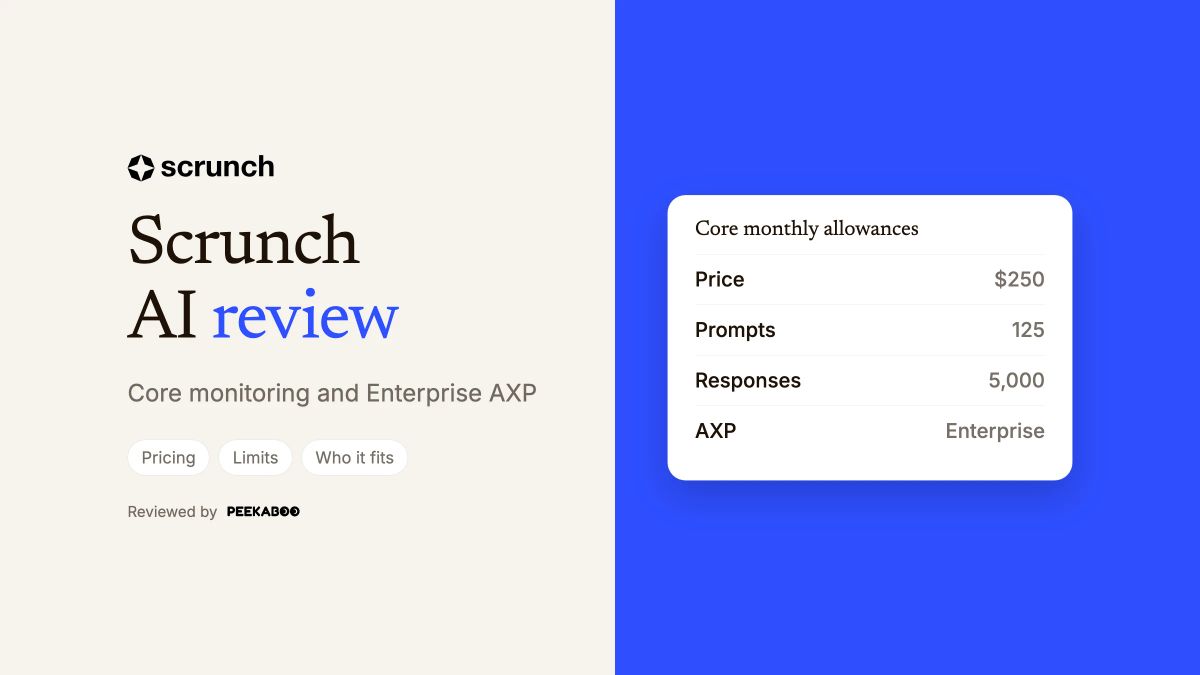
I would look at Core for a single-brand team that can act on site audits and editorial recommendations, as long as the four-platform Core panel detailed below fits its requirement. An Enterprise-only platform or AXP makes this an Enterprise discussion. The Scrunch alternatives help if you only need a smaller tracking job.
What does Scrunch AI track?
It tells you whether the answers name your brand, how they describe it and which sources they cite. Those are different reasons to act, so I would keep them separate rather than turn every movement into one visibility story.
Scrunch reports explicit brand mentions, competitive presence, position and sentiment.
Its question filters include topic, persona and funnel stage.
Use those filters within the purchased plan to organize commercially meaningful questions.
Suppose you sell scheduling software to small service businesses. “Which scheduling software works for a salon with several staff?” is a more useful starting question than a broad request to explain appointment booking. You can connect the first answer to a buyer's requirement and a page your team owns. That gives the monitoring a purpose before you have a chart to admire.
Build the question set around distinctions that could change the recommendation:
A category question shows which brands get recommended without the buyer naming one.
A comparison question reveals how the answer separates your offer from a competitor's.
A constraint question, such as staff scheduling, exposes whether the answer understands an important use case.
Av. António Augusto de Aguiar 122C 1050-046 Lisboa, Portugal
Minnesota
202 N Cedar Ave, Suite 1 Owatonna, MN 55060, USA
The topic and funnel filters help you organize them, but a filter doesn't make an irrelevant question useful. Brand Core's one-persona allowance also matters: you can't treat a single audience setup as a complete picture of everyone your company sells to.
Presence is the first check. Position helps you distinguish a prominent recommendation from a passing appearance, while sentiment gives you a reason to inspect the description. If your brand appears but the answer frames it as unsuitable for several staff, the task is different from fixing total absence. Your editor needs to examine the claim and the supporting content, rather than celebrate the mention.
The same goes for competitors. Imagine a rival repeatedly appears on that staff-scheduling question while you appear on general booking questions. I would investigate the specific use-case gap first. It is closer to a buying decision than trying to raise every category metric at once. Choose the five Brand Core competitors around that job; a fixed competitor panel shouldn't be mistaken for a view of the entire market.
A mention means the answer named you. A citation tells you which URL or domain the platform cited. I would read that page, but I wouldn't jump from “this URL appeared” to “this phrase caused the answer.” The evidence is useful without making that leap.
Scrunch lets you examine sources at domain and URL level, including views by owner type. Start with the domain pattern to see where the answers draw material from, then drill into the actual page before assigning work. Several citations from one publisher may point to a single useful comparison article, rather than several independent reasons to pursue that publisher.
Suppose the scheduling answer cites your own general product page, but the rival is discussed alongside a third-party comparison. Those observations suggest two possible jobs. Your editor can examine whether your page explains the staff-management requirement clearly. An outreach owner can examine whether the comparison has a relevant omission or an outdated description. They shouldn't receive the same task just because both findings came from the sources view.
I would also distinguish a missing owned-page answer from missing external coverage. If your site has no useful explanation of the buyer's constraint, asking for more mentions elsewhere leaves that content gap unresolved. If your explanation is already clear and relevant third-party pages omit it, another rewrite of the same page may be a poor use of the month's editorial time.
The cited URL gives you something concrete to read. It doesn't establish that the publisher accepts outreach, that a placement is available or that an edit will get you into future answers. The value is a better-directed investigation: a named page, an observed question and an owner who can judge the gap.
Agent Traffic is another kind of observation. It shows AI bot visits to your site, which can help the website team investigate access. A bot request isn't a human visitor, a citation or a sale. Keep those events apart when you report them.
For example, the website owner can use top pages and recent requests to investigate whether bots are visiting the page selected for work. A request to the homepage doesn't answer the same question as activity on the relevant use-case page. If a bot visits that page and the brand remains absent from the tracked answer, access alone hasn't resolved the problem. That is a useful reason to return to the content and source evidence, rather than report bot activity as a visibility win.
Scrunch collects through a mix of browser automation and platform APIs. I would pay attention to the answer context, rather than assume every measured platform matches an identical consumer session.
Scrunch AI site audits and content recommendations
Yes, Core gives an editorial or website team material to work with, provided someone owns the change. Its audits are useful when they narrow the next task, rather than become another score in a monthly report.
Core includes these site-work functions:
Site audits.
Insights and recommendations.
Basic content generation.
Page optimization.
So there is an action layer to evaluate, rather than only a place to watch mentions change.
Brand Core has these site and targeting allowances:
Five site audits monthly.
A 25-page site map.
One page optimization monthly.
One country.
One persona.
One language.
Five competitors.
If your business serves several markets or personas, those details can matter more than the prompt count.
I would ask the technical or editorial owner to inspect a recommendation and explain what they would change. That is the useful test. An audit score on its own doesn't tell you the task is right, or that someone will complete it. Basic generation also shouldn't be assumed to mean unlimited article production or site publication.
Take the hypothetical staff-scheduling gap. Start with the answer that describes your product poorly, then select the page that should explain that use case. Scrunch's AI readability and content-alignment audits can inform the review. The editor still needs to decide whether the proposed change accurately represents the product, and the website owner needs to take responsibility for implementing it.
A useful handoff would contain:
The buyer question and the answer passage that prompted the investigation.
The relevant cited source or owned page, with the specific gap to examine.
A proposed content change and the person responsible for approving it.
A later comparison using the same question set and platform context.
Suppose the page barely explains how a manager coordinates several employees. A sensible editorial task is to make the supported capability clear, with an accurate explanation of its limits. “Improve the AI score” is much harder to approve or complete because it doesn't say what the page needs to tell a buyer.
With five monthly audits and one monthly page optimization on Brand Core, I would prioritize a commercially important page over a sweep of minor pages. The 25-page site map also makes Core a scoped investigation, not a reason to assume a large site has been fully reviewed. A content team with hundreds of pages should judge those allowances against the work it intends to deliver.
After the change, compare the relevant answers again without quietly replacing the original questions with easier ones. A changed answer is something to inspect; it is not, by itself, proof that the edit caused it. The practical attraction of Scrunch is that answer evidence and page work can be part of the same investigation. It still needs a capable owner at the other end.
The four Core platforms are ChatGPT, Perplexity, Google AI Overviews and Copilot.
Suppose a growth team wants 40 buyer questions for one brand in one market, with an editor and a website lead sharing access. That inventory fits under Brand Core's 125 unique prompts and five licenses. The prompt inventory fits, but confirm whether the intended collection schedule fits the 5,000 monthly responses.
More prompts also won't solve a scope mismatch. A company needing separate language or persona programs has a different requirement from that one-market team. A required Gemini or Google AI Mode view changes the tier discussion even if it only needs a handful of questions. I would settle those requirements before treating spare prompt capacity as value.
For agencies, three workspaces is the more revealing number. Suppose you have four ongoing client brands. Agency Core's 250 prompts may sound ample, but its three brand workspaces don't cover that portfolio. The three partner-only pitch workspaces are not a substitute for a fourth ongoing client workspace. Don't build a four-client budget by quietly counting them as the same thing.
Agency Core makes more sense for a team serving up to three client brands whose work includes site investigation on the four Core platforms. Its unlimited users remove a collaboration constraint, while the per-brand audits and optimization allowance give each delivery team a defined amount of site work. A larger portfolio needs a different scope; the USD500 headline doesn't price it.
Agency Core includes:
Looker Studio.
MCP access.
CLI access.
Query API is partner-only; Advanced API is excluded. Three pitch workspaces are a partner benefit, with five audits and one optimization per brand monthly. A Looker report isn't proof that the Scrunch application itself can carry your own branding.
I would separate three agency deliverables:
Internal analysis needs enough answer and source detail for your strategist to explain a finding.
Client reporting needs a usable presentation of that finding, with clear context about the questions and platforms monitored.
Automated integration needs the appropriate data-access entitlement, not simply a dashboard that a person can read.
Looker Studio is relevant to the second job. MCP and CLI access may help the team work with data, but neither makes every API available. An Agency Core integration that depends on Query API also depends on partner status. An integration that requires Advanced API needs a different plan. That can rule out the tier before response capacity becomes an issue.
Scrunch's APIs provide 90-day historical data. If your reporting system needs to retain a longer series, that is a data-design requirement to resolve rather than assume away. The API limit doesn't establish that every dashboard has the same history restriction.
For a small agency doing hands-on analysis and presenting findings in Looker Studio, the included access can be useful. For an agency promising an automated client data feed, the exact entitlement is part of the deliverable. I wouldn't sell that promise on the strength of the word “API” alone.
Additional brand Core seats cost USD25 monthly each, or USD75 for five. The upfront annual discount worth two months applies to Enterprise agreements. I wouldn't assume it prices an annual Core plan.
How Scrunch AI AXP works
AXP serves AI-optimized page versions to agents. If that is why you are considering Scrunch, bring the website team into the evaluation. Decide how the content will be reviewed and maintained. The feature belongs to Enterprise and doesn't promise automatic citations or customer growth.
Enterprise expands the panel to nine by adding Claude, Gemini, Meta AI, Google AI Mode and Grok.
Enterprise also includes:
AXP for agent-facing page delivery.
Broader audits.
Advanced content generation.
API integrations.
SAML/OIDC SSO.
Grok no longer supplies citation data, but its presence, ranking and sentiment metrics remain available.
The difference is what you are asking the product to do. Monitoring observes answers; AXP changes the page version agents receive. That puts it closer to website delivery than to buying another reporting view. The person who owns the product information should approve the agent-facing version, and the website team should know who keeps it current when the main page changes.
For example, a change to a service's eligibility or a product's supported use case should not leave the agent-facing explanation describing an old offer. That is a maintenance responsibility, not a reason to assume AXP performs badly. A team that already manages website content and approvals is better placed to evaluate this additional delivery layer than a marketing analyst working alone.
The nine-platform Enterprise panel also doesn't mean nine equivalent citation datasets. Grok can still contribute its remaining metrics, but it cannot fill the citation part of that comparison. Choose Enterprise for the additional job your team can own, rather than a platform total on its own.
Scrunch became a Sitecore company after the June 2026 acquisition. You can still buy standalone Core; ownership doesn't mean a Sitecore bundle is required.
Scrunch AI free trial and cancellation
The Core trial lasts seven days and requires a card. Its scope is:
One brand.
125 unique prompts.
The four Core platforms.
Cancel before the seven days end if you don't want the automatic paid subscription.
There is also a separate free audit with no card. That is a narrower offer, not the full trial. Scrunch has no permanent free plan. Enterprise evaluation is custom, and a Core trial doesn't validate AXP or the three-brand agency setup.
I would use the trial for three practical steps:
Choose commercial questions you can explain.
Inspect the actual answers and citations.
Give a relevant page to the person who would implement an audit finding.
Use the seven days to decide whether a finding can become work. The useful result is an editor or website lead saying what they would change and why, with a concrete answer or source behind the proposal. A full list of populated charts is less persuasive if nobody can connect them to a task. For an agency, the single-brand trial can inform that working method, but it leaves the multi-client delivery requirement to be evaluated separately.
Scrunch AI alternatives for your team
The useful alternative depends on whether your team needs reporting or content delivery. I would compare each option by that job before comparing headline prices.
With AI Peekaboo you build the plan yourself, choosing the number of brands, the prompts for each brand, the AI platforms (up to 7) and how often the prompts run. Prices start at $30 a month, and adding teammates brings no per-seat charge. A strategist can use its content briefs and recommendations to turn what the AI answers reveal into work for the team. White-label reports and client share links only come in once a plan reaches $100 a month, so the $30 starting plan won't have them. The briefs stop short of writing articles, and how often prompts run is set once for the whole account. If your agency's main deliverable is evidence under its own branding, comparing against AI Peekaboo is more direct than buying AXP for website delivery.
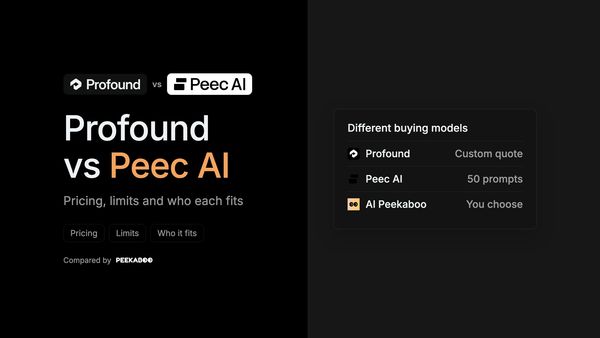
Peec AI's Starter costs EUR85 monthly for 50 prompts across three chosen platforms, with one project and unlimited users. It tracks daily and includes source analysis. Peec also offers recommended actions, so I wouldn't reduce it to a tool that only counts mentions. Its Starter scope is a plausible fit for a small in-house marketing team concentrating on one brand and a focused question set. Compare those three selected platforms with the four Scrunch Core platforms you actually need. The prices are in different currencies and buy different scope.
Surfer is relevant to an SEO team whose daily work includes researching and editing pages, rather than mainly investigating agent access. Its workflow covers three jobs:
Keyword research and a topical map help the team plan what to cover.
Content Editor gives writers guidelines while they work on a page.
Content Audit and AI Tracker let the team review pages and their presence in AI answers.
WordPress and Google Docs integrations are included on Standard and higher plans. Tracking scope still depends on the tier: Standard has 25 prompts on ChatGPT with weekly refreshes; Pro has 50 prompts across all five supported platforms with daily refreshes.
Scrunch also has content and research functions worth weighing:
Basic content generation gives an editor material to review, without establishing unlimited article production.
Page optimization belongs in the decision when your team can implement a specific page change.
AI Search Trends and a Keyword Volume Estimator give the team research functions alongside answer investigation.
The comparison isn't “content tools versus no content tools.” It is whether you want its answer-to-website investigation or Surfer's broader editorial workflow. Neither a Surfer integration nor Scrunch's generation allowance establishes that their content delivery is interchangeable.
Who should choose Scrunch AI?
For a one-brand digital marketing or growth team with site and editorial capacity, Core is worth evaluating. I would make the choice around the people who can use the evidence:
Team
Reason to choose Scrunch
Requirement that changes the choice
One-brand growth team
An editor and website owner can turn a use-case gap into page work
Several market or persona programs exceed Core's targeting scope
Small agency delivery team
Client work combines answer investigation and assigned site changes
A fourth ongoing brand needs more than Agency Core's three workspaces
Website delivery team
Agent-facing content delivery is part of its remit
AXP requires Enterprise and an owner for approvals and maintenance
A growth lead with nobody available to change the site has a weaker reason to buy the site-work layer. An agency that mainly needs to show clients the answers has a different reporting priority. Those exceptions matter more to my recommendation than a long list of capabilities.
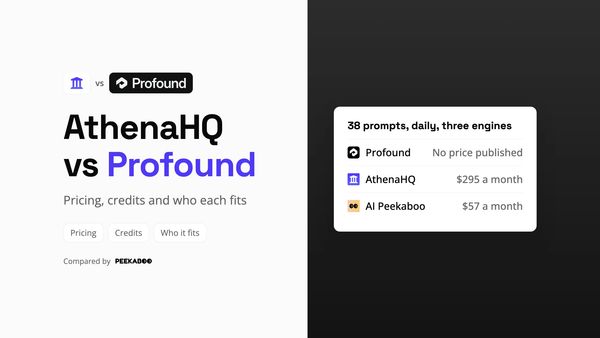
If AthenaHQ is also on the table, read the Scrunch AI vs AthenaHQ comparison around the work you want to complete. Website investigation and a credit-funded content workflow give the team different reasons to choose.
The comparison of white-label AI monitoring tools is useful for an agency whose main deliverable is branded client evidence rather than website changes.
I would buy Scrunch when someone can take its observations into useful website work. If you just need to follow a small question set, define that smaller purchase. The next task is more important than the biggest platform list.
How we checked this
Last checked: 2 October 2026.
Prices and plan limits: each vendor's public pricing page. Features: vendor help docs and product pages.
Frequently asked questions
How much would Scrunch cost for six people working on one brand?
USD275 per month covers Brand Core with one additional user, giving your six-person team access to the same brand workspace. The extra seat doesn't expand the prompt allowance or site-work capacity, so I'd treat this as a collaboration budget: it lets another colleague participate, rather than giving the team a larger program to run.
How should we prepare for a year-long evidence comparison?
Keep your own dated comparison records from the start, rather than leave the annual review until month twelve. Scrunch's APIs provide 90-day historical data. I'd preserve the question set and platform context with each comparison, and retain the relevant answer passages alongside approved page changes. That gives your team something to revisit without assuming the API can retrieve the whole year later.
Can one Agency Core subscription cover two client brands if one needs Gemini?
No, Agency Core won't meet that Gemini requirement, even though two client brands fit within its three workspaces. Gemini belongs to the Enterprise panel, so spare prompts don't fix the platform gap. I'd decide whether Gemini is essential to that client's reporting before choosing the plan; fitting the brands into the account isn't enough if you can't monitor the answers they need.
Start with your own visibility.
See where your brand appears in AI answers and which competitors get mentioned.
 Filipe Lins Duarte