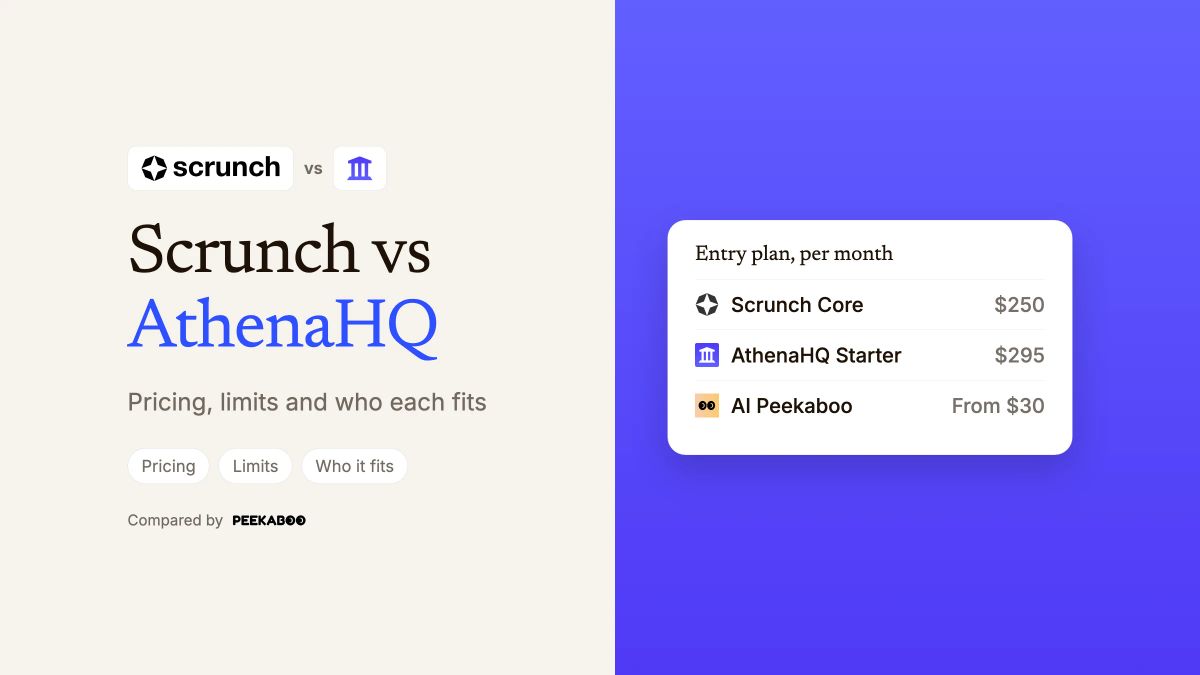
Scrunch AI is my choice for a brand team that wants to connect AI visibility with site audits and agent traffic. AthenaHQ fits a team using monitoring to drive content optimization within a defined credit budget. For agencies that mainly need client reports, I would also consider AI Peekaboo.
Scrunch AI is my choice for a brand team that wants to connect AI visibility with site audits and agent traffic. AthenaHQ fits a team using monitoring to drive content optimization within a defined credit budget. For agencies that mainly need client measurement and reports, and want to pay for what they track, I would also consider AI Peekaboo. The choice depends on what the team needs to change after it finds a visibility gap.
Your team's work
Preferred route
Reason
Investigate AI visibility and site readability
Scrunch
Citations, agent traffic and site auditing
Turn monitoring into optimization work
AthenaHQ
Credit-funded tracking and a base content agent
Measure and report for agency clients, paying for what you track
AI Peekaboo
Flexible monitoring with scoped client output
Scrunch AI monitoring and site audits
Scrunch suits digital marketing and growth teams investigating both how a brand appears and whether AI agents can read its website. Citation analysis points to referenced pages; agent traffic shows visits to the site. Those are different kinds of evidence, so a bot visit should not be reported as a recommendation in an answer.
Both Scrunch and Athena monitor brand mentions, competitors, citations and sentiment. The useful distinction is what your team does with that evidence. Scrunch brings answer monitoring together with a view of site access, which suits a growth team working with developers on pages that should be discoverable and readable. Athena also has site-health tools, so this isn't a choice between a technical product and a product that only measures visibility.
Scrunch's Agent Traffic view includes top bot agents, top pages and recent requests. Use it to investigate whether agents reach an important product page and which pages attract their attention. If a page receives requests but doesn't appear as a cited source, the next job is to inspect the answer and competing sources. More bot traffic alone doesn't tell you that your content has become more useful to an answer engine.
Av. António Augusto de Aguiar 122C 1050-046 Lisboa, Portugal
Minnesota
202 N Cedar Ave, Suite 1 Owatonna, MN 55060, USA
Core's execution tools provide a useful starting scope for a team investigating a small group of priority pages. They include:
Five monthly site audits.
A 25-page site map.
Basic content generation.
One monthly page optimization.
That scope isn't a reason to assume a large website's whole backlog can be handled in the entry plan.
AXP, the Agent Experience Platform that serves AI-optimized page versions to agents, belongs to Enterprise. An audit identifies work; AXP changes how content reaches agents. I would consider it when the team needs a delivery layer alongside its existing website and has someone responsible for implementation. Neither capability guarantees that an answer will cite your page. The Scrunch review examines the wider product.
Core's included platforms are:
ChatGPT.
Perplexity.
Google AI Overviews.
Copilot.
AthenaHQ monitoring and content optimization
AthenaHQ fits a team that will use monitoring to guide content optimization and on-page or off-page actions. Starter includes a base optimization agent. The advanced agent belongs to Enterprise, so the plan boundary should follow the level of work the team needs.
Athena's content workspace uses a spreadsheet-style layout with AI agent columns and brand voice kits. Its publishing workflow includes Shopify, Webflow and WordPress. For a content or SEO team with an editorial backlog, the attraction is keeping the finding and the response close together:
Identify an answer gap.
Decide which page needs work.
Develop and publish the content.
Your team still needs to judge the recommendation and approve the result.
It also includes citation intelligence and an Outreach kanban for cited pages. That gives off-page work a place in the workflow when the influential source belongs to someone else. Site Health, site audits and smart robots.txt and llms.txt management cover site-access work too. Choose Athena because those actions fit your team's recurring work, rather than treating it as a monitor with no implementation tools.
Starter provides 3,600 monthly credits and eligibility for 11 platforms. Ordinary responses use one credit; heavier platforms use five. Fan-out adds three variations and multiplies the baseline credit requirement fourfold. Eligibility for more platforms is useful, but it does not fund every question daily on all of them.
Starter supports a single country and language. Enterprise adds:
Multiple regions and languages.
Persona targeting.
Knowledge Base claim review and discrepancy detection.
SSO and audit logs.
The AthenaHQ review explains those plan boundaries. I would choose Starter for a program that fits its credit and regional scope, then evaluate Enterprise when the job needs those broader controls.
A single-country campaign can use a focused view of its market. A multinational team should not read that same view as evidence of how the brand appears in every country or language. Scrunch Core also has one persona; Enterprise provides broader country scope. Athena's Enterprise persona targeting gives teams another way to separate audiences whose questions differ.
Claim review becomes useful when the problem is an incorrect answer rather than an absent brand. Suppose an AI answer says your product lacks a feature it actually includes. Athena's Enterprise Knowledge Base and Oracle discrepancy detection compare response claims with your Knowledge Base. That is a reason to consider Enterprise for a brand team managing product accuracy. It still leaves your team responsible for deciding what needs correcting and where to act.
Scrunch AI vs AthenaHQ: entry plans
Requirement
Scrunch Core
AthenaHQ Starter
Monitoring capacity
125 unique prompts, 5,000 monthly responses
3,600 weighted monthly credits
Platform scope
Four included platforms
Eleven eligible platforms
Team access
Five user licenses
Unlimited members
API
Not included
Paid add-on
Site/content execution
Limited optimization; AXP excluded
Base optimization agent; advanced agent excluded
Regional scope
One country and language
One country and language
Mentions and grounded citations should remain separate in the report. Different vendors' visibility scores do not become identical measures simply because they concern the same brand.
Suppose a competitor is mentioned in an answer, an independent comparison page is cited, and your own product page receives bot visits. Those observations point to different work:
The competitor mention establishes its presence in that answer. Inspect the recommendation and whether your product addresses the same need before assuming every absence is a missed opportunity.
The cited comparison page identifies a source worth reading. Check the specific URL for omissions or incorrect product details, then decide whether outreach or stronger content on your own site would address the gap.
The bot request establishes site access. Use Scrunch's traffic and audit views to investigate the page, without counting the request as a citation or buyer visit.
Both tools show cited domains and URLs. A domain view helps you notice recurring sources; the URL is what lets an editor inspect the actual evidence. Competitive scope differs too: Scrunch Core includes five competitors, while Athena Starter has unlimited competitor tracking. A crowded category may make that distinction more useful than a larger overall response allowance.
Sentiment adds another question: how does the answer describe your brand? Being named with a negative qualification is different from being recommended for the reader's need. I would use the returned text alongside the sentiment label when assigning work, especially where the description concerns product suitability. A presence percentage alone would hide that distinction.
Evidence delivery should match its recipient. Athena Starter includes CSV export, GA4 and Google Search Console integrations. CSV helps an analyst work outside the dashboard; the analytics connections help you investigate website performance alongside answer evidence. A mention does not establish that someone visited, and a cited URL does not establish that someone bought. Report exposure and website outcomes as separate observations unless your analytics supports a connection. API access serves a separate automated-data requirement and costs extra on Starter. A CSV export is not a substitute for a live integration, and an API is not a branded client report.
Scrunch brand Core does not include the agency plan's Looker Studio and MCP rights. Its Enterprise offer includes broader API and integration access. Athena Enterprise adds executive reporting with BI tools, including Tableau, Power BI and Looker. I would choose the output around the person who must use it: an analyst may need rows of evidence, while leadership needs a stable view of progress and the work behind it.
Scrunch AI and AthenaHQ pricing and trials
Scrunch's Core pricing is $250 monthly. Its main limits are:
125 unique prompts.
5,000 monthly responses.
One brand workspace.
Five user licenses.
Five monthly site audits.
The seven-day Core trial requires a card and moves to paid billing unless canceled before it ends. A separate no-card one-off audit is a different offer. Enterprise has custom scope and price, including AXP and nine-platform eligibility.
For agencies, Core is $500 monthly with:
250 unique prompts.
10,000 monthly responses.
Three brand workspaces.
Unlimited users.
It uses the same four Core platforms and excludes AXP. Its integration entitlements are:
Looker Studio is included.
MCP is included.
Query API is partner-only.
I would evaluate that offer directly for multi-client work rather than assume the single-brand plan describes the agency route.
Starter API and extra credits are paid add-ons with unpublished amounts. That makes the panel and integration requirements part of the budget decision.
Support should follow the expertise your team already has. Scrunch Core has email support and self-serve onboarding; Agency Core includes roughly 30 minutes of training. Scrunch Enterprise adds:
Slack.
Strategy and review calls.
A dedicated account team.
Executive reporting.
Athena Enterprise includes:
White-glove setup.
A certified GEO/SEO specialist.
Dedicated Slack.
A vendor-stated two-hour SLA.
Those services matter more to a team needing ongoing guidance than to one with specialists ready to own the work.
Scrunch is a Sitecore company, and its Core and Agency Core offers remain available. Ownership alone doesn't establish a better roadmap or a stronger result for your brand. The useful decision is whether the current product and support scope fit your team.
Enterprise access controls can also change the required plan. Scrunch Core includes Google SSO, while SAML/OIDC SSO belongs to Enterprise. Athena Enterprise includes SAML and OIDC SSO plus audit logs. A company requiring those controls should budget for the relevant tier rather than assume ordinary account sign-in meets its requirements.
Ordinary baseline fits 3,600 credits, excluding fan-out and other usage
AI Peekaboo monitoring
Calculated $53
Standard monitoring; branded client reports excluded
For Scrunch, fitting the response quota is not a guarantee of that full-month daily schedule. The table is a capacity illustration, not three interchangeable complete daily offers. The $53 amount is an illustrative calculation for standard monitoring. Collection methods and scoring also differ.
Athena's platform choice changes how far the allowance goes:
One-credit platforms: ChatGPT, Perplexity, Google AI Overviews, Google AI Mode, Gemini and Copilot.
Five-credit platforms: Claude, Grok, DeepSeek, Meta AI and Mistral.
The same hypothetical panel shows why fan-out is a budget decision, not just another switch:
Athena monitoring scope
Monthly credits required
Fits Starter's 3,600 before other use?
Stated three-platform ordinary baseline
3,150
Yes
Same baseline with fan-out enabled
12,600
No
Adding a heavier platform would consume more credits per response. The 11-platform entitlement therefore gives you options, not a promise to monitor all of them daily within Starter. Scrunch Core's four-platform roster has a different boundary: a team requiring Gemini or Claude needs to evaluate Enterprise's expanded coverage.
I would start with the commercial questions your team can act on, then choose the platforms that matter for those questions. Competitor comparisons, product-fit questions and complaints about an existing solution can expose different content needs. Scrunch's AI Search Trends and volume estimator can inform exploration, but a trend signal isn't proof of exact buyer demand for every selected prompt. Tracking more questions is useful only when the additional answers can change the work.
Managing prompts in Scrunch AI and AthenaHQ
A stable monitoring panel makes changes easier to interpret. Athena supports CSV prompt upload and suggests starter prompts during onboarding. Those suggestions can help you begin, but your team should select questions that reflect its products and commercial audience rather than accept every suggested topic.
Starter uses the Default schedule; custom schedules by fields such as topic or country belong to Enterprise. Once an Athena prompt has collected responses, its text locks. To change the question, pause it and create another prompt. Treat that as a change in the question set, not a seamless continuation of the old series.
Scrunch provides prompt management and filters for tracked evidence. Keep the question and observation scope alongside the results so you can explain what changed. A different platform mix or audience context can change the answers even before your website changes. Scrunch uses multiple collection methods, including browser automation and official APIs; a matching platform name is not enough to make scores interchangeable across tools. Compare the answer text and cited URLs when moving between dashboards, rather than joining two percentages into one trend.
AI Peekaboo monitoring and reports for agencies
Scrunch adds site audits and AthenaHQ adds a content agent. AI Peekaboo is for the agency that would rather build its plan around its own clients and keep the follow-up work in-house. It gives you the measurement and the client reports, while your team makes the site and content changes, so it fits when you don't need either of those extras.
If a client's visibility changes, the AI answers behind it are ready to open, along with the citation sources they cited. That gives the client something they can see for themselves and gives your team a defined next task, not just a percentage to explain.
Key features
Give each client brand separate prompts, competitors and a dashboard, and open the AI answers and cited sources behind any score.
Share a read-only client link, or take the data into Looker Studio or your own reporting through the API.
Question one client's visibility, prompt and citation data at a time from an MCP client like Claude Desktop.
Use prompt suggestions, recommendations and content briefs to plan the next questions to track and give your writers something solid to start with.
Choose your AI platforms, up to 7: ChatGPT, Gemini, Perplexity, Google AI Overviews, Google AI Mode, Microsoft Copilot and Claude API.
Bring in GA4 and Google Search Console to view AI visibility side by side with site traffic.
Prepare pitches in unlimited pitch workspaces: one extra brand slot, reused for any prospect's brand, covers them all.
Pricing
Rather than fixed tiers, you choose the number of brands, prompts per brand, AI platforms (up to 7) and how often prompts run, and the price recalculates with each choice. Six platforms cost the same for every check; Claude API costs more, so see how much it adds before including it. Some sample plans:
Brands
Prompts per brand
AI platforms
How often prompts run
USD monthly
6
25
3
Weekly
30
3
30
3, one of them Claude API
Monthly
48
3
100
3
Weekly
60
5
100
4
Weekly
133
25
40
3
Weekly
200
1
100
5
Daily
250
Pick your platforms from the full list of seven. Three standard ones cost these amounts in any mix; Claude API changes the sum.
Agencies that sign up for a year knock 15% off what they would pay monthly.
At $100 a month and above, white-label reports and client share links are part of the plan.
Any number of colleagues can use the account with no per-seat charge.
Since how often prompts run is one account-wide choice, all clients run on that same schedule; pick it first.
Eligible new workspaces can start with a 14-day trial that takes a card, if the plan has at least 10 prompts per brand and comes in under $100 a month.
Who should choose it
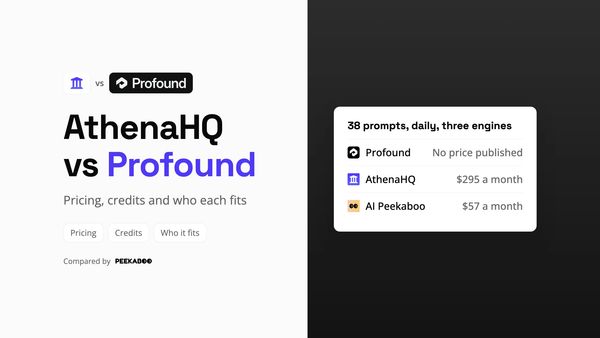
Choose AI Peekaboo if your agency wants AI visibility reports in its own branding for several clients, with evidence of what moved and a clear next step. Keep in mind that the 35-question daily panel above costs $53 a month, under the $100 line, so it comes without white-label reports or client share links. If you're a brand that only wants to find out whether AI answers mention you, and pick up a few ideas for showing up more, it covers that as well.
It's the wrong pick if you need finished articles: AI Peekaboo produces briefs rather than finished articles, so you'd still need your writers, a writing tool or AthenaHQ's content agent. And if a client needs city-level results in the same report, ask about that first, because local-tracking data doesn't appear in standard exports or Looker Studio.
Which tool should your team choose?
You don't need both Scrunch and Athena simply because they approach execution differently. Their monitoring overlaps. Paying for both makes sense only when your team needs distinct work, such as Scrunch's Enterprise delivery scope alongside Athena's content workflow, and can assign an owner to each. Otherwise, choose the workflow that addresses the main backlog.
Before committing, resolve the few conditions that could change the choice:
Confirm Scrunch's full-month collection schedule for the panel you need.
Get Athena's add-on quote if extra credits or Starter API access are required.
Confirm the plan's actual reporting output and integration rights for the people receiving the evidence.
Choose the requirement the team can explain and act on. The free AI visibility checker can give you an initial answer to inspect. Use one buying question to evaluate the whole workflow.
Save its returned answer and a cited URL.
Assign the resulting site or content action to a team member.
Produce the output that the stakeholder needs.
For a growth team, that may be a page-access investigation.
For a content team, a page revision.
For an agency, a client report explaining the finding and assigned work.
Choose the tool that carries that task through within the plan you can fund.
How we checked this
Last checked: 2 October 2026.
Prices and plan limits: each vendor's public pricing page. Features: vendor help docs and product pages.
Frequently asked questions
Will either tool guarantee that AI answers cite my website?
No, neither tool gives you a guaranteed citation. Scrunch can expose page-access problems, while Athena can help your team respond to gaps with content work, but those actions do not establish that an answer engine will select your page as a source. I would judge progress by the returned answers and cited URLs, rather than by the amount of optimization work completed.
Can eight colleagues use an entry plan without choosing Enterprise?
Yes, AthenaHQ Starter includes unlimited members, so eight colleagues do not make Enterprise necessary on team access alone. Scrunch's single-brand Core includes five user licenses, while Agency Core has unlimited users and three brand workspaces. For an eight-person team managing one brand, I would weigh that access difference alongside the execution tools you need, rather than move to a broader plan simply for its name.
Can I compare Scrunch and AthenaHQ without paying for a full month?
Yes, Scrunch offers a seven-day Core trial, and AthenaHQ's free Essential plan provides 300 credits. The useful comparison is a small task you can finish within both allowances: inspect an answer gap and decide what your team would do next. Cancel Scrunch before the trial ends to avoid paid billing, and treat Athena's credits as a limited allowance rather than a promised monthly refill.
Start with your own visibility.
See where your brand appears in AI answers and which competitors get mentioned.
 Filipe Lins Duarte