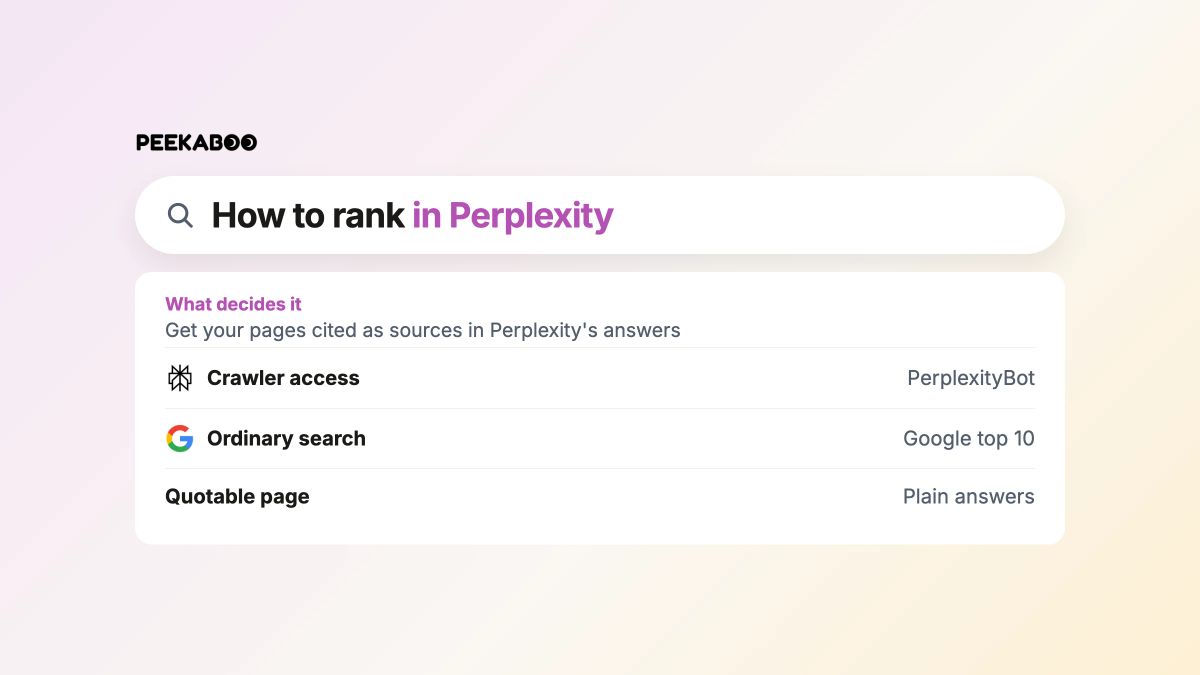
You rank in Perplexity by being one of the sources it cites in its answer, and that comes down to three things: PerplexityBot has to be able to read your pages, the page has to rank well in ordinary search for the question, and it has to answer that question plainly enough to quote. Then you check the questions your buyers actually ask, see which sites Perplexity cites instead of you, and close those gaps one page at a time.
If you searched your category and found a competitor’s page in the citations instead of yours, there is no hidden switch to flip. Perplexity has no blue-link position to win. It chooses sources for its answers, and your work is to give it a strong page it can access and use.
What ranking in Perplexity actually means
Ranking in Perplexity means appearing as a numbered citation in an answer. Perplexity searches the web, gathers relevant information, and links each answer to its original sources.
That makes a citation different from a conventional search ranking. Your page might help a buyer but still miss the answer if Perplexity cannot access it, cannot find it for the question, or finds another page that answers the question more directly. This work is part of GEO, but day to day it means one thing: make sure the page that should answer each buyer question can win the citation.
The number of possible citations changes with the search. Perplexity says standard search handles quick facts with one or two sources, while Pro Search can run multiple searches and analyze dozens of sources. A quick factual question leaves little room for a new source. A detailed research question can create room for a specialized page that gives a strong answer.
One screenshot also tells you very little. Perplexity’s Memory feature can support personalized answers, so people can receive different responses to the same prompt. Treat a single answer as a clue. Measure whether your brand and pages appear across a consistent set of buyer questions over repeated checks.
Step 1: Choose your prompts and let Perplexity reach your pages
Before you touch a page, write down the 10 to 30 buyer questions you want to win, run them in Perplexity, and note which pages it cites. Step 6 turns that starting list into a repeatable check.
Av. António Augusto de Aguiar 122C 1050-046 Lisboa, Portugal
Minnesota
202 N Cedar Ave, Suite 1 Owatonna, MN 55060, USA
PerplexityBot needs access to index your content, and Perplexity-User needs access when a user’s question causes Perplexity to visit a page. They do different jobs, so check both.
Perplexity’s crawler documentation recommends allowing PerplexityBot in your robots.txt file and permitting requests from its published IP ranges. Perplexity-User supports user-requested visits to pages that may help answer a question. Perplexity says that fetcher generally ignores robots.txt because a user initiated the request.
Start with the access checks that can block every other effort:
Check whether your robots.txt rules disallow PerplexityBot.
Check whether your web application firewall blocks PerplexityBot or Perplexity-User.
Check whether important page text appears without client-side JavaScript.
Check whether the pages you want cited return useful content rather than an error, login wall, or thin template.
An AI crawlability checker can check crawler rules in robots.txt and flag server-rendered content and JavaScript dependence. Allowing a crawler does not guarantee a citation, but it removes a basic access problem.
A firewall can still reject a bot even when robots.txt allows it. Perplexity publishes the addresses for PerplexityBot and Perplexity-User, and says those lists are the source of truth for firewall configuration. If your security team uses an allowlist, use the published IP ranges alongside the relevant bot token, PerplexityBot or Perplexity-User, rather than relying on a user agent alone.
JavaScript needs the same attention. Vercel’s December 2024 analysis found that the major AI crawlers it measured, including PerplexityBot, did not render JavaScript. That behavior can change, but server-side rendering remains the safer choice for the main answer, supporting facts, and product details you want a crawler to read.
Once you have made the changes, run the checker again and ask your security team to confirm that requests from those addresses are allowed rather than challenged. If you want Perplexity to cite your content, unblock PerplexityBot. Keep the block only if keeping your full text out of Perplexity’s index matters more to you than being cited.
If your worry is AI training rather than search, Perplexity says PerplexityBot is not used to crawl content for foundation models, so blocking it mainly costs you citations.
Step 2: Rank in ordinary search for the same question
Ordinary search rankings are a major part of Perplexity SEO because Perplexity often cites pages that already perform well in Google. If your page does not appear for the question in Google, it begins with a weaker case for Perplexity.
In a study published in September 2025, Ahrefs ran 3,311 classic SEO-style head terms through Perplexity, ChatGPT, and Google’s top 100 results. It found that 65.07% of Perplexity’s cited URLs overlapped with Google’s top 10, compared with 10.00% for ChatGPT in the same study.
The study covers short head terms, not every long buyer question. Still, the gap is wide enough to set your priority: for Perplexity, your ordinary SEO work counts for far more than it does in ChatGPT. Whether you need to rank on Google to get cited by AI depends on the platform, and for Perplexity the answer leans yes: for a missing citation, find the exact query and improve the page that should rank for it.
Google’s first result will not automatically become Perplexity’s source. Perplexity searches the web, selects sources, and writes its own response. But if a competitor repeatedly appears in both Google and Perplexity for an important buyer question, solve the search visibility problem before chasing a platform-specific trick.
Match the page to the question. If buyers ask for a comparison, give them a comparison page. That one page can then compete for both the Google result and the Perplexity citation.
Step 3: Write pages Perplexity can quote
Write pages that answer one clear question before explaining the surrounding topic. Perplexity says it compiles the most relevant insights into clear answers, and its product-listing guidance says it ranks sources based on authority and relevance.
Start important sections with a statement that works on its own. Follow it with the conditions, evidence, examples, or limits that keep it accurate. You do not need short paragraphs everywhere. Your best answer needs to work for someone who reads only the first line of the section.
For example, a hypothetical returns page that opens with “We make returns easy” gives a shopper almost nothing to use. “You can return unworn items within 30 days for a full refund, and return shipping is free in the US” answers the question before the details. Your facts will differ, but the pattern holds.
Specific facts give a page more substance than general claims. Dates, product availability, defined terms, documented limits, and data your company can support all help a reader understand what you mean. A sentence such as “our platform delivers powerful results” does not answer a buyer’s question. A statement about what a product includes, where it is available, or how a policy works can.
Use headings that match real questions, keep each section focused on one answer, and cut wording that merely repeats the point above. Question-style headings let a buyer jump straight to the answer, and they make it obvious which paragraph answers which question.
Your own data can add value when it gives buyers information that competing pages cannot copy. Say what you measured, when, and across how many cases, so a reader can tell where the figure holds.
Step 4: Get named on the sites Perplexity already cites
The sites Perplexity cites for your buyer prompts are the places where your competitors get named and you do not. Open those sources and decide whether you have a legitimate reason to be included, referenced, compared, or covered.
Pitch only the sites where your product belongs: a cited industry publication, directory, standards body, retailer, or partner page that should mention you. Give its editor or owner something accurate and useful to add, such as corrected company information, a missing product detail, a relevant data point, or an expert contribution that genuinely helps its readers.
Don’t pick outreach targets by their badge. Perplexity marks some cited domains as Government, Academic, or Trusted, but it rates whole sites rather than pages, says payments and partnerships do not affect the label, and does not say a label makes a source more likely to be cited. An unlabeled site that keeps appearing for your prompts is just as worth approaching.
When a strong site appears repeatedly for your important prompts, an accurate mention there can be more valuable than another generic article on your own domain. Your own page remains the better choice when you can answer the question more completely than the cited source.
Step 5: Give online stores complete product details
Online stores need complete product pages because Perplexity says it is more likely to recommend merchants who provide deeper product details, such as availability, reviews, pricing, and specifications. It ranks product listings on criteria similar to the authority and relevance it uses for sources.
Make the essentials easy to find on the product page:
State whether the product is available and where customers can buy it.
Give an accurate price or explain what changes the price.
List the specifications a buyer needs to compare products.
Show the reviews customers have left for the product, since Perplexity names reviews among the details it looks for.
Keep product details consistent across pages that describe the same item.
A sparse product page leaves Perplexity with little to use when someone asks a buying question. More detail will not guarantee a mention, but it gives Perplexity the facts it needs to describe your product correctly.
Step 6: Track buyer prompts and the sources behind them
Track the buyer prompts you chose in Step 1 over time. Repeated checks are how you tell a one-off answer from a recurring citation gap.
Keep the set focused on questions that signal a decision. Include category searches, alternatives, comparisons, use-case questions, and the problems that lead someone to your product. Record whether your brand appears, which competitors appear, and which sources Perplexity cites.
A practical tracking loop looks like this:
Keep the same buyer questions and date range for each check.
Record the answer, named brands, and cited sources.
Find the gap that repeats, such as inaccessible content, a missing page, or a competitor-owned source.
Make one focused change, then compare the same prompt set again.
You can measure AI visibility across a prompt set instead of guessing from scattered searches. With AI Peekaboo’s Perplexity tracker, you pick the buyer questions and the schedule, then compare which competitors each answer names and open the sources behind it.
When a competitor-owned source keeps appearing, AI Peekaboo’s AI citation sources view opens that site beside the answer where it appeared. You can read what that source says next to the answer and decide whether your brand belongs on it.
Change the questions between checks and you cannot tell whether your work moved the result or you moved the test. If you keep losing AI citations, work out whether it is an access problem, a content gap, or a source gap before rewriting anything.
What will not get you cited
You can’t pay your way into the organic answer. Perplexity says advertising should have no influence over organic results, and advertisers can’t buy a spot in its related-products section.
You can’t build visibility with a Perplexity Page right now: Perplexity says its “Create page” feature is temporarily retired.
Don’t take a fixed word total, a countdown for freshness, schema markup, or an llms.txt file as a citation formula. Perplexity does not set a word threshold or freshness deadline, nor does it identify schema or llms.txt as a route to citations. Perplexity’s description of its search system does say that clearly stale pages are screened out early. Keep the facts and dates on priority pages current. That is routine maintenance, not a deadline counted in days.
When Perplexity gets your brand wrong
Report a wrong answer, then correct the source material that may be feeding it. Perplexity provides a flag icon below an answer for reporting issues and asks for the query URL plus a description of the error and expected result.
A report does not replace page maintenance. If Perplexity cites an outdated profile, inaccurate retailer listing, or old company page, fix the factual source where possible. If your own page has the correct information but is hard to find or hard to quote, improve that page too.
Keep a record of the exact prompt, the wrong statement, the cited sources, and the correction you made. Then, when you rerun the prompt, you’ll know which fix changed the answer.
Put the work in the right order
Write down the buyer prompts you want to win, remove crawler-access blocks, improve the page’s ordinary search visibility, then strengthen the page or cited source that has the clearest gap. Check the same prompt set again after each focused change.
While you fix Perplexity, the free AI visibility checker gives you a one-time ChatGPT and Gemini snapshot, so you can see whether the same competitors and sources win there too. Perplexity tracking is part of an AI Peekaboo plan.
How we checked this
Last checked: 27 October 2026.
Sources: Perplexity’s help center, developer documentation and September 2025 post on its search system, Ahrefs’ September 2025 study, Vercel’s December 2024 crawler analysis, and AI Peekaboo product pages.
Frequently asked questions
Does blocking PerplexityBot remove my site from Perplexity?
No. Perplexity says that when robots.txt blocks PerplexityBot, it will not index the full or partial text of the blocked site. It may still index the domain, headline, and a brief factual summary. Perplexity-User, which fetches pages when someone asks a question, generally ignores robots.txt because a person made the request.
Does Perplexity use Google's results?
Perplexity does not say it does. It says it searches the web and partners with third-party crawlers to help build its index. What you can measure is the overlap: in Ahrefs’ September 2025 study, 65.07% of Perplexity’s cited URLs for short head terms were in Google’s top 10. Ranking in Google can help even though Perplexity picks its own sources.
Can you pay to appear in Perplexity's answers?
Not in the organic answer. Perplexity says advertising should have no influence over its organic results, so put the effort into accessible pages, accurate product information, ordinary search visibility, and useful source relationships.
Does Perplexity train AI models on my content?
Perplexity says no, at least for foundation models. It says it does not build foundation models, so your content will not be used for pre-training. Its developer documentation also says that neither PerplexityBot nor Perplexity-User collects content for foundation-model training.
Start with your own visibility.
See where your brand appears in AI answers and which competitors get mentioned.
 Filipe Lins Duarte