ChatGPT recommends brands its web search can find and that trusted pages describe the same way. Here is how it picks brands, five steps to get named and how to check your results.
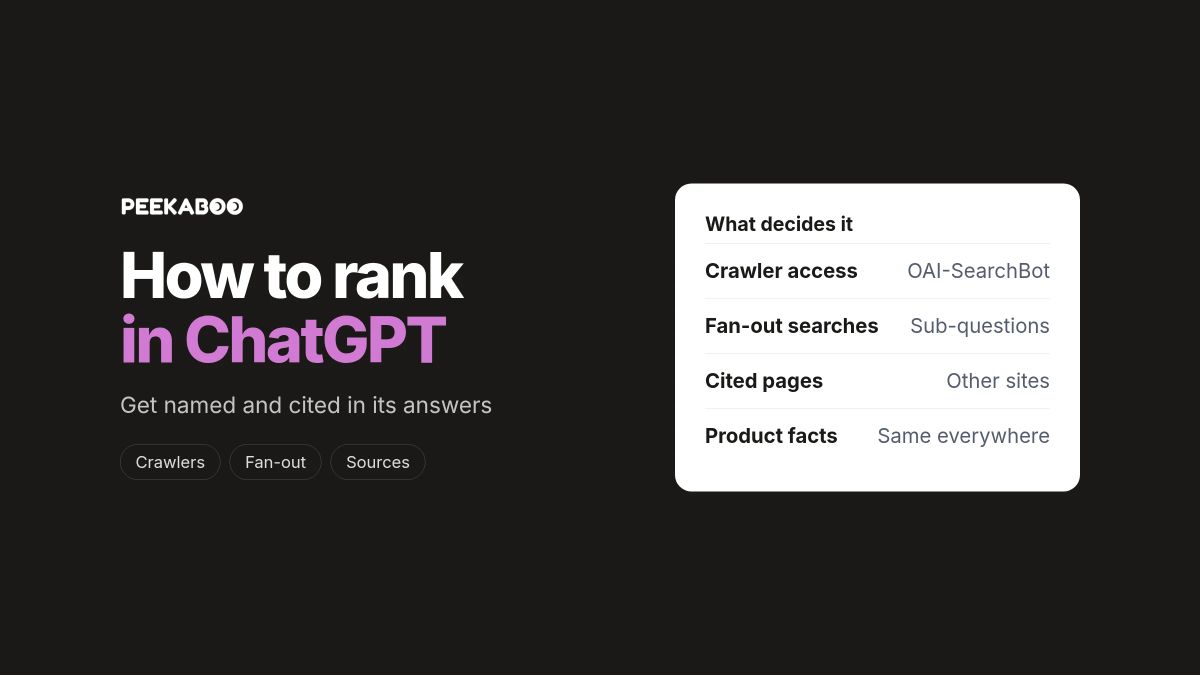
For buying questions, ChatGPT mostly recommends brands that its web search can find and that other trusted pages describe the same way. So three things decide whether you show up: whether OpenAI's search crawler can reach your pages, whether those pages answer the searches ChatGPT runs behind a prompt, and whether the sites ChatGPT cites already name you.
If you've asked ChatGPT for the best tool or provider in your category and it listed three competitors and not you, most of the fix is within your control, and it isn't a trick. There's no ranking dial and no paid slot inside the answer. The work is closer to SEO and digital PR than to anything new, aimed at the way ChatGPT searches.
How ChatGPT decides which brands to recommend
ChatGPT builds a recommendation from two places: what the model learned in training, and what it finds when it searches the web for that conversation. For buying questions, I think the live search matters more, because it's the part you can influence this quarter and the part that shows sources.
That makes ChatGPT one more place where GEO applies, the work of getting your brand named and cited in AI answers. The new part is how ChatGPT searches: OpenAI runs its own crawler, sends queries to search partners and splits one question into several.
Training data vs live search
The model's training data gives ChatGPT a general sense of which brands exist and what they're known for. Live search gives it current pages to read and cite. You can't edit the first, and you can only change it slowly by being written about. The second responds to what you publish and where you're mentioned.
OpenAI says ChatGPT may search the web automatically "when your question would benefit from current information", and people can also turn search on by hand. Questions about the best tool, current prices or comparisons are exactly that kind of question, so for most buying prompts you're competing in live search.
Av. António Augusto de Aguiar 122C 1050-046 Lisboa, Portugal
Minnesota
202 N Cedar Ave, Suite 1 Owatonna, MN 55060, USA
I think the training side still shapes how ChatGPT talks about you. If the model has read about your brand for years in reviews, guides and news, it has a description ready before it searches. A newer brand starts with little, so the pages it finds in live search carry the whole description, and that's another reason to get them right.
OpenAI also separates the two crawlers. GPTBot collects content that may be used to train its models, and OAI-SearchBot finds pages for ChatGPT's search features. Blocking GPTBot keeps your content out of future training; blocking OAI-SearchBot keeps you out of today's answers.
Rankings still matter here, even though ChatGPT isn't Google. The clearest data comes from AirOps, which sells AI search software and studied 15,000 prompts in its own sample: 55.8% of the pages ChatGPT cited ranked in Google's top 20 for at least one of the searches involved, and a page in Google's first position earned 3.5 times the citation rate of a page ranked below 20th. My own Google rankings and AI citations experiment shows the other side: a 4,953-page directory I built on a new domain averaged position 52.5 in Google, while Bing reported 121,900 AI citations to its pages over three months. Those were Microsoft's AI answers, not ChatGPT's, so I'd treat rankings as a big advantage, not a gate.
Query fan-out
Before it answers, ChatGPT often rewrites your prompt into one or more shorter searches and sends them to its search partners, and may send narrower follow-up searches. One rewritten search in OpenAI's own example is "CCR8 immunotherapy drug development 2025", and OpenAI notes it may send more specific ones after it.
Our guide to ChatGPT query fan-out shows how to read these searches in your browser. In its example, the buyer's role and context drop out and category words come in: a healthcare executive asking about AI visibility becomes a search for an "AI search visibility analytics platform".
AirOps found that, among cited pages that appeared in any Google top-20 results, 32.9% appeared only for a fan-out search, not for the original prompt, and that 85% of the pages ChatGPT retrieved were never cited. So optimizing for the prompt alone misses a large share of the pages ChatGPT ends up citing: your page has to show up for the sub-searches, then be the one ChatGPT picks from everything it read.
How to rank in ChatGPT
Start with access, because nothing else works if OAI-SearchBot can't read you. The outside-mentions step takes longest, so begin it early and run the other steps alongside it.
Let OAI-SearchBot crawl your pages
Allow OAI-SearchBot in your robots.txt and make sure your host, CDN and firewall let it through. OpenAI's crawler documentation says sites that opt out of OAI-SearchBot "will not be shown in ChatGPT search answers", and its help center adds that your host or CDN has to allow traffic from OpenAI's published search crawler IP addresses.
The robots.txt line takes a minute. A firewall or bot-protection rule can block crawlers even when robots.txt allows them. Run your domain through our AI crawlability checker to see which AI bots your robots.txt blocks, then ask whoever manages the CDN to confirm the same for its bot rules.
Allow OAI-SearchBot even if you block GPTBot. The settings are independent.
Don't rely on ChatGPT-User. OpenAI says it isn't used to decide whether content appears in search.
Expect about a day for changes. OpenAI says it can take about 24 hours after a robots.txt update for its search systems to adjust.
Keep answers in the HTML. Content that only loads through scripts or sits inside images is harder for crawlers to read in general, and OpenAI doesn't document how its crawler handles it.
Treat llms.txt as a nice-to-have. It's fine to add, but it won't fix a crawler that's blocked.
You can see whether it's working in your own logs. In my experiment, a single captured day showed 2,390 allowed requests from OpenAI's crawlers, next to 4,870 from Google. Numbers like that show access, not citations, but zero requests from OpenAI is a sign worth checking.
Answer the fan-out searches, not only the prompt
Write for the short searches ChatGPT sends out, not just for the long question the buyer typed. If a buyer asks for the best accounting software for a small design studio, ChatGPT may search for small business accounting software, for comparisons between the leading names and for pricing, and your pages need to answer those.
Start by listing the likely searches. Our query fan-out generator expands one buyer question into 18 modeled related questions to work from, and the browser method in the fan-out guide shows the exact searches ChatGPT ran for a single chat. Do both for your five to ten most important buying prompts.
Then match each search to a page. AirOps found that pages whose title overlapped with the search by 50% or more were cited 20.1% of the time, against 9.3% for pages with less than 10% overlap. So use plain, literal titles and headings: if ChatGPT searches for "invoicing software for freelancers", a page titled that way is easier to match than one titled "Get paid faster".
Answer early on each page. Put the answer to the heading's question in its first sentence or two, then the detail. ChatGPT reads many pages per answer and cites few of them, so I'd make each page easy to pick from.
Get named on the pages ChatGPT cites
Find the pages ChatGPT already cites for your buying prompts and work on being included in them. When ChatGPT names three brands and links two "best of" articles, I'd expect the brands it names to be the ones those articles name, so the shortest path into the answer often runs through someone else's page.
Run your key prompts, open the sources on each answer and list the domains that come back more than once. Those are your targets:
Roundups and comparison articles. Ask the publisher to review your product for the next update, with the facts they'd need.
Directories and marketplaces. Claim and complete your profile, with the same category, pricing and description as your site.
Your partners' and integrations' pages. If a tool you integrate with lists partners, make sure you're on the list with a working link.
Community threads and videos. In my view these get cited a lot, so a useful, clearly branded answer from your team can count. Dropping links in threads doesn't count; that spam playbook is dead.
A mention on a page ChatGPT keeps citing works for you every time that page is read.
Publish the comparison and pricing pages buyers ask about
Publish the pages that answer the questions buyers ask ChatGPT before they choose: how you compare with named competitors, what you cost, who you're best for and what alternatives exist. If your site doesn't answer those, ChatGPT will cite someone else's page that does.
AirOps found that product-discovery searches had the highest citation rate of the query types it measured: 18.3% of the pages retrieved for them were cited. Those are the "which tool should I use" questions, and a page that only describes features gives them little to match.
The pages to prioritize:
"X vs Y" pages for the competitors you're most often compared with, written fairly enough that a reader trusts them.
A pricing page with real numbers, or a clear explanation of how pricing works if you quote on request.
"Best for" pages by audience or use case, such as your product for agencies or for small teams.
"Alternatives to" pages for the market leader in your category, with yourself included and honest about who should pick something else.
Keep them fair: a page claiming you win every row reads like an ad, so say plainly when a competitor is the better pick.
Keep product facts the same everywhere
Make your product facts match across your site, your profiles and the third-party pages that describe you. Conflicting facts cost you: when five pages disagree on your price, plans or what you do, ChatGPT has less reason to pick your version over a competitor whose facts line up.
Freshness matters more here than for Google. Across the roughly 17 million citations in Ahrefs' freshness study, ChatGPT was the platform most likely to cite newer pages, while Google's AI Overviews leaned toward older ones. So an outdated price on a page ChatGPT reads is a real risk, and an updated comparison has a better chance of being picked up.
A simple routine covers it:
Write down the facts that matter: your category in one line, who you're for, plans and prices, main integrations and the platforms or regions you cover.
Check them on your own pages first, including old blog posts that quote a past price.
Then check the outside pages from the previous step and send corrections where they're wrong.
Repeat whenever something changes, and at least once a quarter.
How to check whether ChatGPT recommends you
Check by running a fixed set of buying prompts in ChatGPT, recording whether you're named and which pages are cited, and repeating the same set at least weekly. One run tells you little, because answers change between runs and between days.
A manual setup works for a start:
Write 20 to 50 prompts that real buyers ask, in their words, across the stages from "what is" to "which should I buy". Choosing these well is the foundation, because every result you read later depends on them.
Run each in ChatGPT with search and note whether you're named, where in the list, which competitors appear and which URLs are cited.
Run each prompt more than once, because a single answer is one sample.
Repeat weekly and compare. Look for prompts where you appear more often after a change, and for competitors who keep appearing where you don't.
Then read the results against the five steps, because the pattern usually points to one of them:
You're never named and none of your pages are cited. Check crawler access first, then whether you have a page that matches the main fan-out searches at all.
Your pages are cited but your brand isn't recommended. That usually means ChatGPT is using you as a source of facts, not as an option. A clear comparison or "best for" page, and mentions on the roundups it cites, are the usual fixes.
Competitors are named from pages you're missing from. That's the outside-sources step: the same few roundups or directories keep feeding the answer, and you're not on them.
You're named, but described wrongly. An old price, a retired plan or the wrong category can come from an outdated page ChatGPT reads, or from older training data. Fix the pages first with the facts routine; the training side changes slowly.
You appear for some prompts and not similar ones. Look at the fan-out searches for the prompts you miss. They often ask for a detail, such as a use case or a price range, that your pages don't cover.
Referral traffic tells you something different. OpenAI adds utm_source=chatgpt.com to links from ChatGPT search, so you can track ChatGPT traffic in Google Analytics and see which pages people actually visit after an answer. Don't judge the work on referrals alone, because people who see your brand named in an answer may never click.
Past a few dozen prompts, the manual version takes hours, and you lose the history you need to see a trend. A ChatGPT visibility tracker runs the same prompts on a schedule and keeps every answer, mention and cited source. Our list of the best ChatGPT visibility trackers compares the options. AI Peekaboo tracks ChatGPT, Gemini, Perplexity, Google AI Overviews, Google AI Mode, Microsoft Copilot and Claude API, from $30 a month.
To see where you stand today, start with our free AI visibility checker. It reports whether ChatGPT and Gemini answers name your brand, which competitors they put beside you and what sources they cite, and those sources are the first pages to work on.
Frequently asked questions
How do you do SEO for ChatGPT?
Do the SEO you already do, then add three things: allow OAI-SearchBot through robots.txt and your CDN, write pages that answer the shorter searches ChatGPT runs behind a prompt, and get mentioned on the pages ChatGPT cites. Rankings help, because many cited pages also rank well in Google.
How long does it take to show up in ChatGPT?
About 24 hours for access fixes, and longer for everything else. OpenAI says robots.txt changes take about 24 hours to reach its search systems. New or updated pages depend on when they're crawled and whether they're picked over other sources, and I'd plan for weeks or months to get added to third-party pages, because publishers update them on their own schedule. Judge progress over a few weeks of weekly checks, not one run.
Can you pay to appear in ChatGPT answers?
No. OpenAI says ads "do not influence the answers ChatGPT gives you" and that advertisers can't shape, rank or alter its responses. OpenAI has been testing ads below some answers on its Free and Go plans, and says they run on separate systems from the model that writes the answer.
Start with your own visibility.
See where your brand appears in AI answers and which competitors get mentioned.
 Filipe Lins Duarte