Google only requires that a page is indexed and can show a snippet. Here are five steps to get your pages cited in AI Overviews, what the citation data says, and how to check.
Google only requires that your page is indexed and can be shown with a snippet. Beyond that, I'd bet on four things: an answer near the top of the section, coverage of the follow-up questions, mentions on the pages AI Overviews already cite, and facts that are still true. There's no special markup, file or paid route into the cited links. If AI Overviews answer your best keywords and name competitors instead of you, this is SEO work aimed at the questions an AI Overview pulls together.
How Google picks pages for AI Overviews
Google picks AI Overview sources from its normal search index: only pages it has indexed and could show with a snippet qualify. Google's own guide to AI features and your website puts it plainly: "There are no additional technical requirements."
The same guide explains how a single AI Overview gets built. Google may use a "query fan-out" technique, issuing several related searches across subtopics and data sources, then showing a wider set of supporting links than a classic results page would. So an AI Overview for one question can cite pages that rank for the sub-questions, not only the page that ranks first for the words the searcher typed.
That is why this work overlaps so much with GEO, the broader job of getting named in AI answers across ChatGPT, Gemini, Perplexity and Google. Google's version is the most SEO-shaped of them, because its AI features run on Google Search itself.
AI Overviews show up most on question-style searches. In Pew Research Center's analysis of March 2025 browsing data from 900 US adults, 60% of searches that opened with a question word produced an AI summary, compared with 8% of searches of one or two words. So start with the who, what and why queries that already bring you traffic, since that's where an AI Overview is most likely to sit above you. Google also says AI Overviews only appear when Google decides they add something beyond the classic results, so they often don't trigger at all. And when they do, Pew found people click links less often, which adds to the problem of zero-click searches.
Av. António Augusto de Aguiar 122C 1050-046 Lisboa, Portugal
Minnesota
202 N Cedar Ave, Suite 1 Owatonna, MN 55060, USA
Does ranking on page one get you into AI Overviews?
Ranking on page one helps a lot, but it doesn't guarantee a citation and it isn't strictly required. In a 2025 Ahrefs study of the top three visible citations in 1 million AI Overviews, 76.1% of cited pages ranked in Google's top 10, 9.5% ranked between positions 11 and 100, and 14.4% ranked below position 100.
Most citations go to pages that already rank, so your SEO work is still the main lever. But about one citation in four went to a page outside the top 10, and I think fan-out is the likeliest reason: a page can be the best answer to a sub-question without ranking for the main one. Ahrefs found that the pages outside the top 10 didn't neatly fit a fan-out profile, so treat that as my theory rather than a rule.
My own Google rankings and AI citations experiment adds a data point from a different engine. The 4,953-page directory I launched on a brand-new domain in July 2026 averaged position 52.5 in Google Search Console with 63 clicks. Over a three-month view, Bing's AI Performance report still counted 121,900 citations of its pages. Those citations came from Microsoft's AI answers, not Google's, so they say nothing direct about AI Overviews. They do show that weak rankings and AI citations can coexist, which is one reason I wouldn't wait for page one before starting the five steps below.
How to rank in AI Overviews
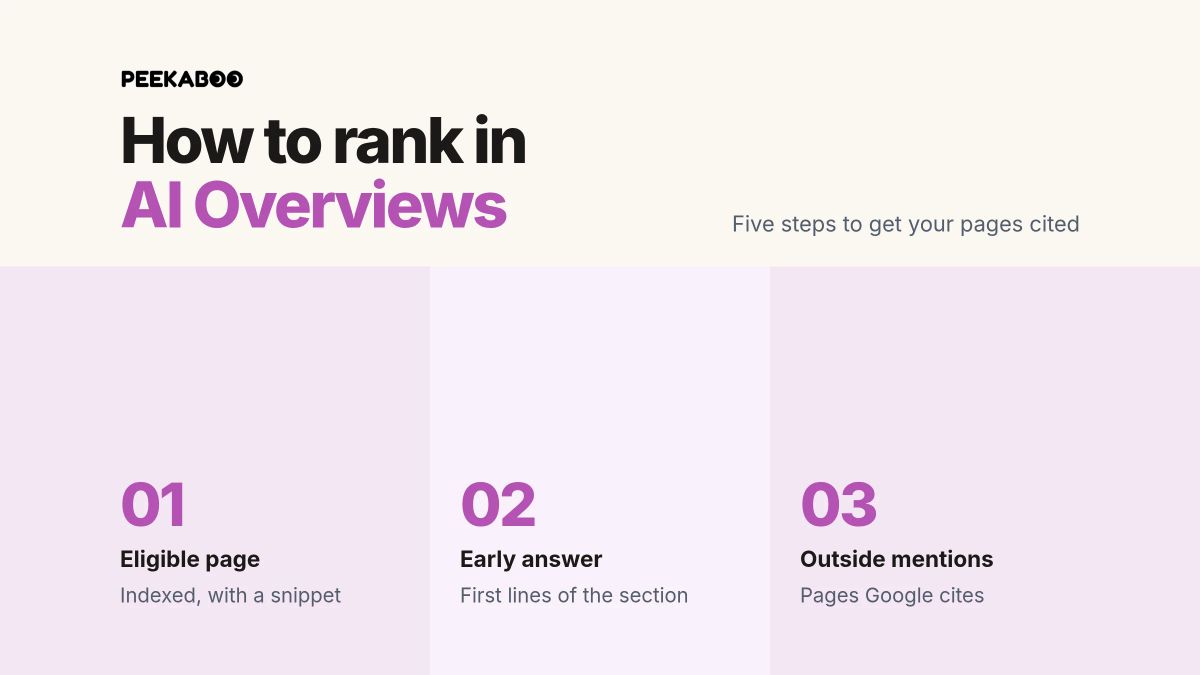
Five steps get a page into AI Overviews: make it eligible, answer first, cover the follow-up questions, get mentioned on the sites already cited and keep the facts current. Google documents only the first, and the rest come from citation data and my judgment, so start with eligibility.
Make the page indexable and snippet-eligible
Check that Google can crawl, index and show a snippet for every page you want cited, because a page that fails any of the three can't appear as a supporting link. Google's eligibility rule is the same as for a normal result with a snippet, so the checks are familiar ones:
Crawling is allowed. Your robots.txt doesn't block Googlebot, and your CDN, firewall or hosting doesn't block it either. Google lists that second part explicitly.
The page returns a 200 and is indexed. Use the URL Inspection tool in Search Console to confirm it.
No snippet controls are limiting it. A nosnippet, data-nosnippet or tight max-snippet setting limits what Google can show in AI Overviews, and noindex removes the page entirely.
The important content is in text. Google says important content should be available in text, so an answer that exists only inside an image is at risk.
Google says you don't need special schema.org markup for its AI features. If your structured data is there for other reasons, make sure it matches what the page visibly says.
Answer the question in the first lines of the section
Put the answer in the first one or two sentences under the heading that asks the question. If someone searches "how often should I check AI answers for my brand", the section should open with the answer and its reason, such as "At least once a week, because the answers change between runs", and explain afterwards.
AI Overviews summarize several sources in a few sentences, so a page that makes its point early and plainly is easier to use than one that builds up to it. Google's own advice for succeeding in AI search is to focus on "unique, non-commodity content". That's about originality rather than where the answer sits, but a specific number or condition is exactly the kind of detail a generic page lacks.
A few habits help here:
Use the searcher's wording in the heading. "How much does a website migration cost" is clearer than "Budgeting for your move".
Give numbers with units and conditions. "From $30 a month" beats "affordable", and a range with its condition beats "it depends".
Keep one question per section. That makes the passage that answers it easy to lift.
Use tables for comparisons. Prices, plans and feature differences read better as rows than as long paragraphs.
Cover the follow-up questions Google fans out to
Map the related questions behind each main query and answer them on the page or in pages linked from it. When Google fans one question out into several searches, each sub-search is another chance for your page to be read and cited.
Start with what Google already shows you: People Also Ask questions, the related searches at the bottom of the results, and the long queries in Search Console that bring impressions to the page. Our query fan-out tool generates 18 modeled questions from a single buyer question, which gives you a list to check against your page.
Then decide where each question belongs. A close follow-up, such as cost or timing, gets its own section on the same page. A different job, such as a comparison with a named alternative, gets its own page with an internal link. Our guide to query fan-out shows what these rewritten searches look like in ChatGPT. Google's rewrites will differ in detail, but the idea is the same: one question becomes several narrower searches.
This step has the most upside for pages that rank on page two or three. If your page can't win the main query yet, it can still be the best answer to one of the sub-questions.
Get mentioned on the sites AI Overviews cite
Find the outside pages that AI Overviews already link for your questions, then get your brand onto them. Each AI Overview usually links several sources, and for buying questions I'd expect many of them to be comparison articles, "best" lists and directories that name brands, rather than the brands' own pages.
Most answers spread their links across several sites. In the same Pew data, 88% of AI summaries cited three or more sources, and Wikipedia, YouTube and Reddit were the most cited sites, at 15% of all sources together. Your own site is only one of the slots.
Search your ten most important questions and note every supporting link in the AI Overview. You'll usually see the same domains come back. Those are the pages to approach: ask to be added to a list that leaves you out, correct a listing that's out of date, or give a writer the specific facts they need to include you.
It's the slowest step. I think it's also where much of the difference between brands comes from, because an AI Overview that cites three roundups will name the brands those roundups name. Pew's numbers put YouTube and Reddit near the top of that list, so if your buyers watch videos or ask in communities, a useful, branded presence there counts. Spam doesn't, in my view: links dropped into threads get removed and don't build anything that lasts.
Keep facts current and dated
Update the facts on your important pages whenever they change, and show when the page was last updated. I think a page that still lists last year's price or a retired feature gives Google a reason to prefer a source that matches the rest of the web, though Google doesn't document that.
Ahrefs looked at close to 17 million cited URLs and found that AI Overview citations were about as old on average as the pages in Google's organic results (about four years for the top three), while ChatGPT leaned toward newer pages. So for AI Overviews, I wouldn't expect a new date on an unchanged page to help. What helps is being accurate: prices, plan names, limits, dates and screenshots that match what's true today.
A simple routine:
List the pages that should be cited for your main buying questions.
Review them every quarter, or whenever a price, product or policy changes.
Change the facts first, then the visible updated date.
How to check whether it worked
Check whether your pages appear in AI Overviews by searching your target questions and recording the result, then repeat the same set on a schedule.
Google reports AI Overview traffic in the standard Performance report, under the "Web" search type, alongside your other results. Use it to watch impressions and clicks on the pages you've changed, and build the rest of the picture yourself.
So the reliable method is a fixed list of questions:
Pick 20 to 50 questions that buyers ask before choosing a product or service like yours.
Search each one and note whether an AI Overview appears, whether your brand is named, which of your URLs is cited and which competitors appear.
Repeat at least weekly with the same list, because AI Overviews change and a single check is one sample.
Compare against your changes. If a page you rewrote starts appearing as a supporting link, you have a good candidate for an edit to repeat elsewhere.
Our guide on how to track brand mentions in AI Overviews goes deeper into setting this up. Running 20 to 50 searches by hand every week adds up, and a tracker keeps the history you'd otherwise rebuild each time. AI Peekaboo tracks ChatGPT, Gemini, Perplexity, Google AI Overviews, Google AI Mode, Microsoft Copilot and Claude API, from $30 a month.
Our free AI visibility checker doesn't test AI Overviews. What it gives you is a snapshot of whether ChatGPT and Gemini name your brand, the competitors listed next to you and the sources those answers rely on, and that source list is a good place to start the outside-mentions step.
Frequently asked questions
Is there a way to block AI Overviews?
Only through the normal snippet controls: nosnippet, data-nosnippet and max-snippet limit what Google can show from your page, and noindex removes it from Search. The snippet controls also cut your regular snippets, and noindex drops the page from Search entirely, so blocking AI Overviews costs you in the classic results too.
How do you rank higher in AI answers?
For AI Overviews, work through the five steps above: keep the page eligible, answer early, cover the follow-up questions, get named on the pages already cited and keep the facts current. The same groundwork helps in other AI answers, but each platform picks sources its own way, and this guide only covers Google.
Can you pay Google to appear in AI Overviews?
No, not as a cited source. Supporting links come from the same eligibility rules as organic results: an indexed page that can show a snippet. Google does show ads above, below or within AI Overviews, in English and in a limited set of countries including the US, but those come from Google Ads campaigns, not from supporting links.
Start with your own visibility.
See where your brand appears in AI answers and which competitors get mentioned.
 Filipe Lins Duarte