Otterly vs Peec AI: Which Fits Your Marketing Team?
Otterly is the better fit for a small business marketer or lean SEO team that wants a focused daily prompt panel and practical page audits. Peec AI suits a marketing team turning citations into content or outreach decisions. An agency mainly managing client reports should also consider AI Peekaboo.
Otterly is the better fit for a small business marketer or lean SEO team that wants a focused daily prompt panel and practical page audits. Peec AI suits a marketing team turning citations and brand descriptions into content or outreach decisions. An agency mainly managing measurement and client reports should also consider AI Peekaboo, where you pay for what you track. Choose around the work your team will do with the findings, then price the platforms that matter.
Tool
Team fit
Work after monitoring
Otterly
Small business and lean marketing teams
Investigate individual pages with GEO audits
Peec AI
Marketing and SEO teams
Prioritize owned-content and earned-source actions
AI Peekaboo
Agencies managing client visibility
Pay for what you track and explain results in reports
Otterly monitoring and page audits
Otterly makes sense when a manageable set of buying questions can guide your next website changes. It monitors prompts daily and combines brand reporting with URL-level GEO audits. The Otterly review goes deeper into that monitoring and audit workflow.
Otterly's paid monthly GEO audit limits are:
Lite: 1,000.
Standard: 5,000.
Premium: 10,000.
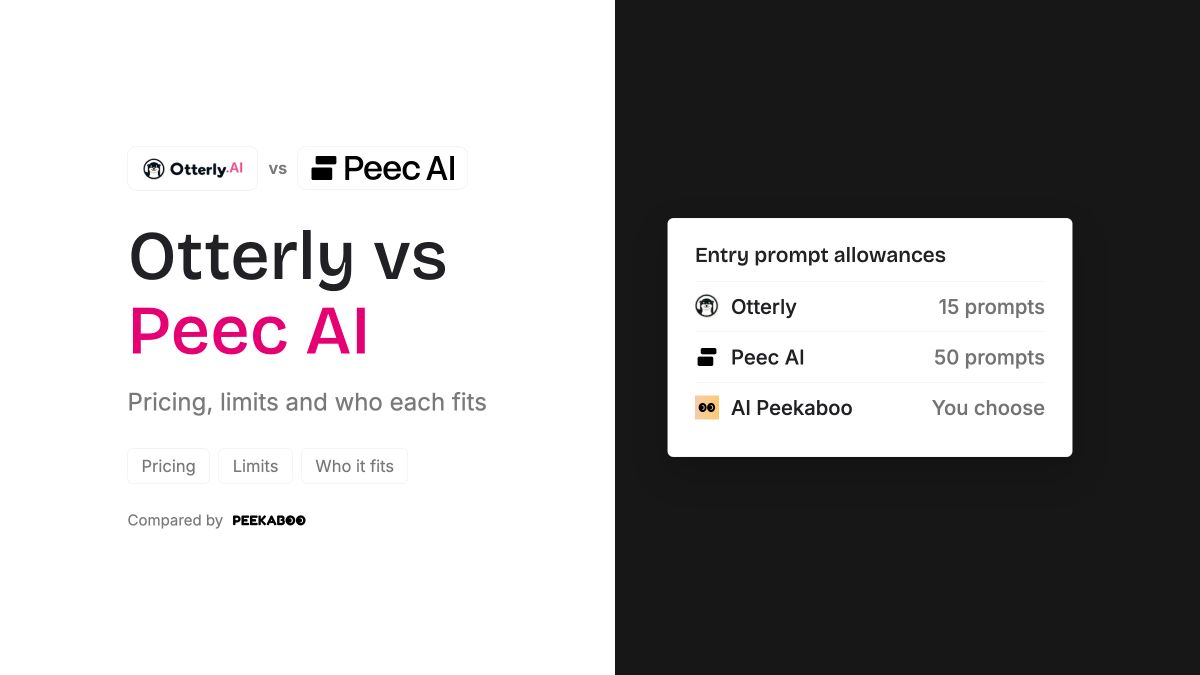
Its Lite plan covers 15 prompts. That can be enough for a tightly defined product or service, rather than a reason to dismiss the plan as too small for useful work. Each prompt has a country, and its history starts with tracking rather than a historical backfill. Choose the questions carefully before interpreting the trend.
The four included platforms are ChatGPT, Google AI Overviews, Perplexity and Microsoft Copilot.
Av. António Augusto de Aguiar 122C 1050-046 Lisboa, Portugal
Minnesota
202 N Cedar Ave, Suite 1 Owatonna, MN 55060, USA
Gemini and Google AI Mode cost extra. Claude is also available as a paid add-on, using API collection; the standard consumer-platform collection uses their websites. You should therefore check the required platform scope before treating the starting price as your budget.
The GEO audit examines one URL at a time for crawlability and content readiness, including structured data. It gives an SEO team a concrete page to investigate. An audit can identify work; it does not establish that making a suggested change will produce a recommendation. I would choose Otterly when the team wants to connect a small recurring panel with pages it can actually improve.
Peec AI source analysis and content recommendations
Peec is the stronger fit when your marketing team needs to understand which sources shape an answer and what to do about them. It combines recurring brand measurement with owned-content and earned-source actions. The Peec AI review explains that source-to-action route in more detail.
Base plans include three selected eligible platforms. Eligible choices include ChatGPT, Google AI Mode, Google AI Overviews, Microsoft Copilot, Gemini and Naver.
Perplexity is additional. Three platforms does not mean any three engines at the same price. Most standard consumer-platform responses use website collection, while Enterprise API-model options are a separate consideration. Peec fits a team able to act on the source evidence and keep that distinction clear.
Otterly vs Peec AI: key differences
Compare three separate requirements:
Page diagnosis.
Source investigation.
Client delivery.
Decision criterion
Otterly
Peec AI
AI Peekaboo
Recurring panel
Daily prompts with one country assigned per prompt
Daily selected-platform tracking with project and country caps
The brands, prompts, platforms and how often prompts run that you pick
Source investigation
Citation exports and raw responses
Domain and URL analysis, retrievals and citation share
Returned source URLs, source types and domain frequency
Work after a finding
URL audits and recommendations
Owned and earned Actions, plus crawlability analysis
Evidence-backed tasks and content briefs
Reporting route
File exports; Looker Studio from Standard
CSV and data connections with entitlement checks
Paid Looker Studio; branded sharing has a separate threshold
If the task is diagnosing a specific page, Otterly's URL workflow is a clear reason to consider it. If the task is deciding between a content revision and external-source work, Peec's distinction between owned and earned actions is more directly useful. An agency that already has writers and SEO specialists should give greater weight to how it separates client evidence and delivers reports.
Visibility, position and sentiment compared
Separate the question each measure answers:
Visibility: Whether the brand appears.
Position: Where it appears.
Sentiment: How it is described.
Peec tracks these three measures against competitors.
Otterly uses a Net Sentiment Score ranging from -100 to +100. AI Peekaboo keeps the full answer text and marks each mention of your brand as positive, neutral or negative.
Those sentiment measures should not be treated as interchangeable scales.
Suppose a hypothetical answer describes your brand as a useful option for small teams, names a rival first and cites an independent comparison article. The favorable description does not settle the other questions:
Presence: Did your brand appear at all, including on questions where the rival appeared and you did not?
Position: Was your brand introduced early enough to matter to someone reading the answer, or mentioned after several alternatives?
Sentiment: Was the description positive, neutral or negative, and which wording produced that interpretation?
Citation: Which page was referenced, and was it your page or an external source?
Competitive standing: How did your mentions compare with the same rivals across the same panel?
A content team worried about being excluded should start with presence. A brand team concerned about how it is described should inspect sentiment alongside the actual wording. Position adds context when several products appear in one answer; it does not establish that the reader preferred the first one.
Compare share of voice across the same prompts, platforms, competitors and dates.
In AI Peekaboo, answers that leave your brand out still count against your visibility score. So a run of positive mentions can sit alongside weak overall presence.
I would compare the brands question by question before using a blended percentage in a report. Adding branded questions or changing the competitor set can change what the percentage describes. Treat a gain on a small commercial panel as evidence about that panel, not a claim that you now lead the whole market.
Using citations for content and outreach
Peec is particularly relevant when your team needs to distinguish a page it owns from a source it must approach differently. Its source analysis covers domains and individual URLs, with retrievals and citation share. Source classifications help separate:
Editorial pages.
Competitor content.
User-generated discussion.
The exact URL is usually where the actionable investigation starts.
Consider another hypothetical case: relevant answers repeatedly cite an external review site's comparison article, while your own comparison page is rarely returned. A domain aggregate tells you that the review site matters. The URL tells you which article to inspect, whether its coverage is relevant and what information about your brand it contains. Two pages on the same domain may address entirely different buying needs.
That finding can create two distinct jobs:
Owned-content work: Inspect your comparison page for missing buying constraints or outdated product details. Decide whether the page answers the question clearly enough before assigning a revision.
Earned-source work: Assess the cited external article for relevance and factual accuracy. A suitable editorial contact or correction request may be worth pursuing, but publication and placement remain outside your control.
Peec's owned and earned Actions align with that split. Otterly's citation and raw-response exports let an SEO team inspect the supporting answer evidence outside the dashboard. AI Peekaboo shows the source URLs and source types behind each answer, which you can use in a brief or a client conversation. None of those routes makes an external mention an automatic outreach opportunity.
A citation establishes that a page was referenced in the returned answer. It does not prove that the page caused the brand recommendation or reveal every source the platform considered. Prioritize a task because the cited page contains a relevant gap your team can address, not simply because its domain appears often.
Audits vs actions vs content briefs
An audit finding identifies a page condition to investigate or correct.
A recommended action proposes work and needs a responsible owner.
A content brief frames an editorial assignment and needs writing and review.
Otterly is a sensible choice for an SEO team whose immediate task is investigating a particular URL, but page investigation is not exclusive to it. Peec offers a crawlability audit across more than 40 bots. AI Peekaboo's technical checks look at whether AI crawlers can reach your pages and link what they find to your prompt results. The decision is how those findings connect to the work your team can complete.
A crawlability problem belongs with the person managing technical access; a weak explanation of the offer belongs with whoever owns the page's content. The monthly audit caps above define investigation capacity, rather than completed fixes. Even a large allowance is of little value if no one can change the affected pages.
Peec combines crawlability investigation with ranked actions for owned and earned sources. That suits a marketing team dividing work between content and external relationships. It also avoids treating every visibility gap as a technical SEO problem. If a relevant external article describes a competitor well and omits your brand, repairing your site's structured data alone does not address that editorial gap.
AI Peekaboo's recommendations turn what it sees in the answers into tasks, each showing the evidence behind it. You can assign tasks and set due dates. Its content briefs give a writer a starting point for each prompt: the competitors and sources showing up in the answers. They are briefs, not finished articles, so the writer still needs to make a defensible article.
For a lean SEO team, I would prioritize the audit evidence and the ability to identify a fix. For a content team, I would prioritize whether the proposed action resolves the actual answer gap. If you need a team to take every article through publication or manage outreach, these monitoring capabilities do not replace that execution team. Plan that responsibility separately before buying a larger panel.
How to choose prompts to track
A smaller panel of useful commercial questions is preferable to a larger one that your team cannot interpret. Otterly assigns one country to each prompt. Peec offers:
Suggested prompts.
Organization by topics and personas.
Intent classification.
Bulk import.
AI Peekaboo's prompt suggestions require your approval. Use suggestions as candidates, then select questions that describe the decisions your customers face.
For a hypothetical software business, three groups could form the core:
Comparisons: Questions such as whether one named product suits a small marketing team better than a direct rival. Include comparisons buyers can reasonably make, rather than every imaginable competitor pairing.
Buying constraints: Questions about a product for a team needing a particular integration or working within a stated budget. These help you see whether the answer recognizes a requirement your offer actually meets.
Objections: Questions about alternatives when an incumbent lacks an important capability, or whether a product fits a specific use case. These expose reasons a buyer might rule you out.
These are hypothetical prompt types, not measured search demand. Select the country where the team sells and evaluate the answer in that context. A multinational team should treat market coverage as a requirement in its own right; Peec's one-country Starter allowance does not cover a three-country project simply because its prompt count has room.
Keep the core questions unchanged when judging progress. Otterly has no historical backfill, and AI Peekaboo has no history before tracking begins. Record when you add a question or change a market so a report does not confuse a different panel with improved visibility. Daily refresh gives you repeated observations of the chosen questions, not a record of everything buyers asked that day. Exact wording and context matter more than filling the allowance.
Otterly vs Peec AI pricing
Otterly starts at USD29 a month; Peec starts at EUR85 a month. Their monthly tiers have different capacities, so preserve both the currency and the panel scope when comparing Otterly pricing with Peec pricing.
Monthly plan
Price
Prompt capacity
Workspace or project capacity
Otterly Lite
USD29
15
One workspace
Otterly Standard
USD189
100
Unlimited workspaces
Otterly Premium
USD489
400
Unlimited workspaces
Peec Starter
EUR85
50
One project
Peec Pro
EUR205
150
Two projects
Peec Advanced
EUR425
350
Five projects
All these plans have unlimited users and daily tracking. Peec's further limits are:
Plan
Countries
Monthly answer cap
Starter
One
4,500
Pro
Three
13,500
Advanced
Three
31,500
Those limits should follow the markets your team actually serves.
Suppose you want the following panel:
25 questions.
One brand.
One country.
Daily monitoring for 30 days.
Platforms: ChatGPT, Gemini and Google AI Overviews.
That requires 2,250 ordinary observations. The relevant monthly offers are:
Option for this hypothetical panel
USD per month
EUR per month
Otterly Standard plus Gemini
248
Not priced here
Peec Starter
Not priced here
85
AI Peekaboo, calculator price for this panel
38
Not priced here
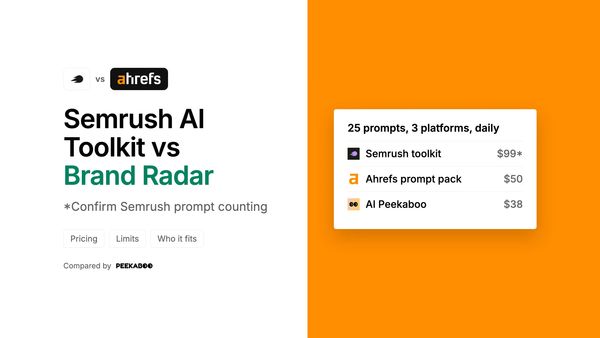
Otterly Lite cannot fit 25 prompts; Standard's Gemini add-on costs USD59 monthly. Peec Starter covers the selected eligible trio and this answer volume. AI Peekaboo's USD38 is the calculator price for this panel; white-label client reports need a plan of USD100 a month or more. These are different currencies and packages, and matching the requirement does not make collection methods or visibility scores identical.
Standard also leaves spare prompt capacity beyond this particular Otterly panel. That is useful if your team expects to expand into more buying situations, but it is not a reason to fill the spare capacity immediately.
For a team expanding into more markets, the country allowance can become the binding limit before prompt capacity.
Collection also changes what the output represents. Otterly uses consumer websites for its standard collection, with Claude using an API. Peec's standard collection follows logged-out platform behavior, where the platform decides the underlying model and whether to search; Enterprise API options are separate. AI Peekaboo tracks Claude through the Claude API, which can answer differently from the Claude app. A matching platform name and question count do not guarantee identical answers. Evaluate each route as an observation of its stated experience, rather than averaging scores across vendors.
Client Reporting and Agency Capacity
Agencies can use all three products, but exporting evidence and delivering a branded client view are different requirements. Decide what the client should receive before choosing the monitoring configuration. An analyst who needs raw answers has different access needs from a client who should only see one brand's results.
Otterly exports citation data and raw responses, with CSV or JSON available for raw answers. It also provides PDF brand reports and GEO audits. Looker Studio starts with Standard. Its Standard or Premium agency partner route requires application and includes branded Looker reports. That makes it relevant for agencies combining SEO investigation with a repeatable report, rather than only in-house teams.
Peec has per-client projects and an agency credit pool shared across those projects. Each project requires a minimum allocation of 900 credits, so many small client panels still need a deliberate allocation plan. Exact totals depend on the selected platforms and frequency. Do not treat the agency examples as a fixed prompt allowance for every configuration.
Peec supports CSV export and data connections; Advanced explicitly includes Looker Studio. API access is explicit for Enterprise, while lower-tier API and MCP entitlements need confirmation. Its agency route includes shareable and white-label dashboard capabilities, but the exact branding entitlement for the selected package needs confirmation. That uncertainty is a reason to settle the delivery requirement before purchase, not to assume Peec lacks an agency offering.
AI Peekaboo includes Looker Studio in every plan and gives each client brand its own prompts, competitors and dashboard. Read-only client links let an agency show selected views without giving the client access to the account. Those links and white-label reports are included once your plan costs USD100 a month or more. This does not mean branding the whole application. How often prompts run is one setting for the whole account, which matters if one client needs daily checks and another needs weekly monitoring.
For a reporting team, choose the output the client can actually use and check whether it preserves the relevant evidence. Otterly and Peec both explicitly offer Enterprise SSO. If company policy requires it, evaluate those Enterprise offers; SSO alone does not establish a broader certification or security comparison.
Trials and Evaluation
Otterly offers a seven-day trial without a card and includes 50 prompts. Its trial platform and add-on coverage need confirmation for your panel. Peec offers a free trial; its duration and card terms need confirmation. I would use either trial to examine one real marketing decision, not to treat a few days of answers as a reliable revenue forecast.
AI Peekaboo plans start at USD30 a month, and you pay for what you track. You build your plan from brands, prompts, AI platforms (up to 7) and how often prompts run.
There is no per-seat fee. Citation sources help the team distinguish the pages referenced in answers from a simple brand mention. An eligible new workspace below USD100 with at least ten prompts per brand gets a 14-day card-backed trial. A plan at USD100 or above bills at checkout.
Use one actual buying question as a common evaluation task. Inspect the returned answer and its cited URLs, then identify a justified action and the evidence you would share with a colleague or client. The task should expose whether the tool supports your workflow, rather than whether its dashboard looks impressive.
A useful evaluation should meet these acceptance criteria:
Relevant context: The selected platform and country match the intended panel, and you can identify the question behind the result.
Inspectable evidence: You can read the answer and distinguish the brand description from the pages it cites.
A justified task: The proposed change follows from a specific finding rather than a general desire to improve visibility.
Usable delivery: The export or shared output carries the evidence the recipient needs, within the package's access rights.
Support provisions differ by plan:
Peec Starter: Chat support.
Peec Pro and Advanced: Chat and email support.
Peec Enterprise: Dedicated support.
Otterly Enterprise: A dedicated customer success manager.
Those provisions can matter to the team operating the panel, but they do not establish comparative response speed. If the trial cannot produce the output you need, resolve that gap before committing to the recurring workflow.
Which tool should your team choose?
Choose the tool that supports the next deliverable your team owns, and fund the reporting access that deliverable requires.
Assign execution to someone before expanding monitoring. If your questions are still undecided, the free AI visibility checker gives a separate limited sample. Take one commercially relevant question from that starting point, define the action it could justify and evaluate the tool on that task.
How we checked this
Last checked: 2 October 2026.
Prices and plan limits: each vendor's public pricing page. Features: vendor help docs and product pages.
Frequently asked questions
Does a Positive Mention Mean the Answer Is Correct?
No. A favorable description can still contain an incorrect product fact. Peec supports fact-checking against facts you set, which is useful for a team concerned about brand portrayal. Give that process accurate product facts and review any flagged wording against them. Sentiment tells you about tone; factual review asks whether the claim is true. AI Peekaboo keeps the answer text next to each mention's sentiment, and Otterly can export raw answers. Use that text to inspect the specific statement rather than approving the whole answer because its sentiment is positive. A claim that your product includes a feature it does not offer deserves attention even when the answer recommends you.
Does Better Visibility Prove More Revenue?
No. A visibility result describes the observed answers, not the sales they caused. AI Peekaboo supports read-only GA4 and Google Search Console connections, but connecting analytics does not turn a brand mention into a tracked purchase. Keep answer visibility separate from referral traffic and conversions in your report. A higher presence rate with unchanged referral traffic may still justify investigating how buyers discover the brand. It does not justify attributing new revenue to the panel. Use business analytics for the outcomes it can measure and answer evidence for the questions the monitoring can settle.
Can You Keep Exported Evidence When Changing Tools?
Yes, you can retain exported evidence as a separate record, but do not assume a new dashboard will import it or continue the old trend. Otterly's raw-response exports are useful for preserving the answers behind a report. Keep the prompt context and observation dates with the files so another analyst can understand them. Historical continuity requires more than possessing a CSV. A new collection route or changed panel can describe a different set of observations. Treat earlier exports as a reference unless an import route and comparable measurement scope are confirmed. This avoids presenting a vendor change as a sudden improvement or decline.
Start with your own visibility.
See where your brand appears in AI answers and which competitors get mentioned.
 Filipe Lins Duarte