Peec AI Review: Pricing, Fit and Where It Falls Short
Peec AI's Starter plan, at €85 a month on monthly billing, makes a strong first tracker for an in-house marketing or SEO team, as long as three AI engines and one country cover your buyers.
Peec AI's Starter plan, at €85 a month on monthly billing, makes a strong first tracker for an in-house marketing or SEO team, as long as three AI engines and one country cover your buyers. You get daily answers on those engines, the sources behind them and a task list your team works through.
Say a buyer asks ChatGPT which project tool suits an engineering team, and the answer names three of your competitors and not you. You spot it by accident on a Tuesday. By Friday you want to investigate three questions:
How often does the competitor appear in your tracked sample?
Which pages do those answers cite?
Which change should your team evaluate first?
Peec supports that investigation without proving why the engine recommended the competitor.
That €85 moves the day your setup grows: a fourth engine adds a monthly fee, a second country takes you to Pro at €205 a month or more on monthly billing, and the three fixed-price brand plans check daily only. If you already know that describes you, the Peec AI alternatives will serve you better than this review.
Who Peec AI suits, and who should skip it
Peec suits marketing and SEO teams at small and mid-sized brands, and agencies running several clients on its separate credit plans. Skip it if you need five or more engines on a small budget, or want checks less often than daily to spend less.
Peec calls itself "AI search analytics for marketing teams", and the plans follow that brief. Picture an SEO lead or content manager at a software company or online retailer with four or five competitors that keep turning up in AI answers. Starter's 50 prompts and one project fit that team. Advanced stretches to 350 prompts and five projects, enough for a mid-sized brand with several product lines or regions to watch separately. Ecommerce teams tracking products and technical SEO teams watching AI crawlers get extra value too.
Agencies have their own plans, built on one credit pool shared across client projects. Peec pitches Growth at "boutique agencies managing 3-10 clients" and Scale at "established agencies managing 11-25+ clients", and it also offers pitch projects, so you can audit a prospect before they sign.
Your brand deserves to be the answer
Start free in 2 minutes. Pay per prompt. Cancel anytime.
Av. António Augusto de Aguiar 122C 1050-046 Lisboa, Portugal
Minnesota
202 N Cedar Ave, Suite 1 Owatonna, MN 55060, USA
Each reason to skip comes down to a plan limit:
Five or six engines on a small budget: every engine past three is billed as a monthly add-on.
Weekly or every-few-days checks to spend less: the three fixed-price brand plans run daily, and among brand plans, weekly tracking appears only on the custom-priced Enterprise plan.
More countries than the plan holds: one on Starter and three on both Pro and Advanced.
If none of those applies, Peec is worth a trial. If two of them do, its price will climb faster than its value to you.
Choosing buyer prompts in Peec AI
Peec's prompt suggestions help you build a panel, but your buyers' decisions should decide what stays in it. Fifty daily prompts are useful only if they cover the choices your marketing team can influence.
Take the project-tool example from Tuesday. A broad question about the best project software might expose the competitor, but it won't tell your content manager which concern kept you out. Give that hypothetical engineering buyer a few more specific questions:
Comparison: which project tool suits an engineering team choosing between two named products?
Buying constraint: which tools work for a small engineering team that needs a particular integration?
Objection: which alternatives make sense for a team worried about migration or reporting?
Those questions earn separate places because the answers could send your team to different work. Ten slight rewrites of the same broad question might fill the panel while leaving the migration concern invisible. I'd rather see fewer useful questions than a full allowance that tells the same story repeatedly.
Peec gives you several ways to build that starting panel:
Suggested prompts and topics help you find questions to consider.
Personas help you check whether you're asking on behalf of the actual buyer.
Intent classification helps you see whether the panel leans too heavily toward general information.
Bulk import lets you bring in a set of customer questions your team already has.
Prompt volume has a score from 1 to 5. Treat it as a prioritization clue, not an absolute count of buyers asking that question. A lower-scored objection could still matter more to your business than a broad topic with a higher score.
Choose competitors that the same buyer could plausibly buy from. A huge category leader can provide context, but comparing only with that leader may miss the smaller rival winning the exact integration question. The panel should leave you able to explain which buyer need each prompt represents. That's a stronger starting point than accepting every suggestion and hoping the dashboard finds the strategy.
Peec AI daily tracking and source analysis
On the three fixed-price brand plans, Peec runs every prompt daily against your competitors, and its source view shows which pages the engines cite instead of you. The daily comparison shows movement in your sample; the cited pages help you decide what to investigate.
Suppose your share of answers on Gemini slips one week while a competitor's rises. Peec's Brand Insights view shows that movement against your rivals through visibility, average position, sentiment and share of voice.
The strongest and weakest engine views add context, alongside a 30-day trend line.
Those measures answer different questions. Suppose Gemini starts naming your project tool more often, but puts it after the same three rivals and describes it as unsuitable for complex reporting. Presence improved; the buyer's reason to choose you may not have. Read the measures together:
Measure
Question it helps you investigate
What to do with the answer
Visibility
Does the brand appear in the tracked answers?
Open the prompts where presence changed and inspect the wording.
Average position
Where does the brand appear alongside alternatives?
Check whether earlier placement accompanies a useful recommendation.
Sentiment
How favorably does the answer describe the brand?
Read the criticism before deciding whether it is fair or incorrect.
Share of voice
How does your presence compare with the selected rivals?
Find the competitor and buyer question behind the movement.
A brand can be mentioned as the option to avoid. Equally, an answer can cite your site for background without recommending your product. I'd want the answer text beside a good-looking score before calling it progress. These are interpretation questions, not interchangeable measures of sales success.
Competitor share needs the same care. If you add several new rivals to the comparison, you're changing the context of that share. If you add prompts on a topic where you rarely appear, the combined picture can worsen without any of the original questions getting worse. Keep the original panel stable when you want to explain a trend, and examine new questions separately before blending them into the story.
That matters in the Monday meeting. A manager asking why visibility fell deserves to know whether the old panel changed or whether the team expanded what it monitors. Daily refresh makes either movement visible; it doesn't make them the same event.
The team can open the source view to inspect:
Cited domains and exact URLs.
Each source's share of citations.
Classification of the cited material.
When a rival keeps getting named and one comparison article keeps getting cited, the source view puts that article in front of you, and now you have something to act on.
Peec usually collects these answers by interacting with the AI platforms' user interfaces in a logged-out context. On most platforms, which model answers and whether it searches the web are decisions the platform makes. Some Enterprise engines are explicitly API-based. That distinction matters if your manager expects the chart to reproduce their own signed-in conversation: the context is different.
A buyer with chat history and a follow-up question may receive a different answer from the tracked prompt. Peec's panel is a repeat view of a defined set of questions, not a census of every conversation about your category. UI collection gives you that particular perspective; it doesn't establish that every customer sees the same recommendation.
For a useful period comparison, retain:
The prompt wording and the buyer need it represents.
The selected engines and country context.
The competitor set and the dates being compared.
When you change one of those, note the change in the report rather than attributing the whole movement to content work. If one answer flips overnight, inspect it before sending the writer a new brief. A repeated gap across relevant questions gives the team a more defensible reason to act than a single surprising answer. Peec is strongest when someone is willing to make that distinction.
If your job is explaining to a manager why a competitor shows up and you don't, that view is the reason to pay for Peec rather than a tracker that only reports a score. If you only need one visibility number for a monthly slide, you'll use a fraction of what you're paying for.
Peec AI Actions and brand perception
Peec's Actions page turns the gaps into three queues of work, and your team is the one that does it. The Optimize section that holds Actions carries a beta label in the product, so expect it to keep changing.
Back to the comparison article that keeps getting cited. That cited comparison article is a lead to investigate. The queues sort the follow-up work:
Site audit fixes: technical changes on your own site that affect how AI engines read it.
Owned actions: pages and content you control, with content briefs for the articles worth writing.
Earned placements: third-party sites, listings and conversations where your brand should appear.
The demo account pictured shows 12 fixes, 8 owned actions and 88 placements to win. They're sample numbers, but the earned column alone could outgrow a small team.
Suppose that recurring comparison article discusses engineering reporting, names your rival and leaves you out. Open the exact cited URL before deciding the task is outreach. The article might exclude you because its stated requirements don't fit your product, or it might describe a feature you now offer. Those lead to different judgments about whether a placement is worth pursuing.
Your own supporting page matters too. If the feature exists but your site barely explains it, a writer has an owned-content job: produce a clear account of the capability, its limits and the buyer it helps. An outreach colleague then has something concrete to offer the comparison publisher. Asking to be added before you can support the claim is a weak handoff.
If the comparison is accurate and your product does not meet the requirement, don't spend the week trying to win that answer. Choose a buyer question where you can make a credible case. The most visible gap isn't necessarily the most useful one to close.
A third path opens if a relevant supporting page has an access problem. Give the developer the affected page and the crawlability issue to inspect, rather than assigning another article. A technical fix and a content brief can both sit under the same commercial goal, but they solve different problems.
The useful task record connects:
The buyer question and rival that exposed the gap.
The cited URL or owned page that needs attention.
The proposed change and the person able to carry it out.
That's the standard I'd hold Actions to. A ranked suggestion helps direct attention; your team still needs to decide whether the proposed work is justified. Follow the same prompts after the change to see what happens, without treating a later citation as proof that the change caused it.
A wrong product claim calls for brand perception:
Attribute scoring of how answers describe your brand.
Objections raised in those answers.
Fact-checking against the facts you set.
If ChatGPT keeps quoting a price you retired last year, that's where you find out.
The response depends on the problem:
An outdated price is a factual error to correct.
A recurring complaint about reporting is a product objection to assess.
A negative opinion about the interface is a perception issue to understand.
For the retired price, use the facts you set as the comparison point, then inspect the information that could be carrying the old figure. A clear current pricing explanation on your own site and a correction request to an outdated third-party article are possible follow-ups. Neither guarantees that the next answer will adopt the correction.
For a reporting objection, ask whether the limitation is real. If it is, the useful response may be better expectation-setting or a product change, rather than more flattering copy. If the answer misses an existing capability, give the content team a specific claim to support with an accurate explanation.
Attribute scoring helps you notice how the brand is framed. It isn't a reason to chase positive wording at any cost. A fair qualification can help the right buyer choose you and the wrong buyer avoid a poor fit. For a brand team, the value is spotting a repeated misrepresentation or objection while there is still something useful to do about it.
Each queue maps to a person on your side: developer time for the fixes, a writer for the briefs, someone doing outreach for the placements. A team with those people will get the most from Peec. A solo marketer without that capacity will watch the list grow. That isn't a flaw in the tool, but it changes what you're really buying.
Peec AI crawler analytics and shopping
For answer tracking, Peec's crawler data and AI Shopping are extras, so leave them out of the decision. For a technical SEO lead or an ecommerce team, though, either one can justify the subscription by itself.
Agent analytics connects to your CDN or server logs (Vercel and Cloudflare) and shows AI bot visit patterns and access failures. It also audits crawlability across more than 40 bots.
AI Shopping does the same kind of job for products. You upload your catalog, then track visibility by SKU and see which merchants come up most often.
For a technical SEO lead, the practical question is whether an important page is accessible to the bots you care about. Visit patterns give that investigation context; access failures give it a possible repair task. A large visit total by itself doesn't tell the content manager which paragraph to rewrite, and a successful crawl doesn't establish that the page will be cited.
Peec also provides AI referral data. Keep the stages separate when the ecommerce manager asks what the subscription produced:
A bot visit shows an automated request to your site.
A referral visit shows traffic arriving from an AI source.
A sale is a commercial event that needs its own evidence.
Those stages can help frame an investigation, but don't join them into a revenue claim just because their charts move in the same direction.
Shopping introduces another useful distinction: a brand can appear while a particular SKU does not. Catalog-level visibility and top merchants give an ecommerce team a narrower question than general brand tracking. Suppose one product appears through a merchant while another gets no attention. The team can inspect those products and their supporting information separately, rather than commissioning a broad brand-awareness article. Choose this capability when product-level questions belong in your weekly work, and confirm its scope for the plan you intend to buy.
For a service or software brand, judge Peec on the follow-up work your team will actually carry through each week.
Peec AI limits, reporting and support
The fit breaks at the fourth engine. On monthly billing, each additional platform carries the fee shown for its plan, and those plans check daily only, so you can't trade frequency for a lower bill.
Picture the moment six months in when your head of marketing asks why Perplexity isn't in the report: that's your fourth engine. The other limits sit on the same plan sheet:
Among brand plans, weekly tracking is listed only on Enterprise, at a custom price on an annual contract.
Starter holds one country; Pro and Advanced each hold three.
Looker Studio integration is listed on Advanced, and API access and SSO on Enterprise.
Reporting can also change the fit before you reach a prompt limit. Peec offers CSV export and MCP data access alongside its Data Studio connector. Agencies can work with per-client projects, pitch projects and white-label or shareable dashboards; confirm the specific reporting entitlements for the agency plan you want.
Picture an analyst handing the monthly findings to an account manager. A CSV may suit someone building their own analysis, while a dashboard may suit a client who needs to revisit the results. The handoff should carry the prompt scope and the actual gap, not just a percentage stripped of its context. Try the required output during the evaluation: if the account manager still has to reconstruct the supporting evidence, extra prompt capacity won't fix that job.
Support channels differ too:
Starter has chat support.
Pro and Advanced have chat plus email.
Enterprise has dedicated support.
Choose the assistance your team needs, without treating a channel name as a promise of response speed. For a marketing team, usability means being able to follow one finding from Brand Insights to the source and then to an understandable task. The screenshots show the parts of that route; your evaluation should establish whether the people doing the work can follow it.
The fair counterpoint is that many brands never hit any of this. If your three selected eligible platforms are where your buyers ask, and you sell in one market, the add-on problem never applies to you. Starter or Pro is then a sensible, predictable buy, and the daily cadence is a feature rather than a cost.
One limit is worth keeping in view whichever tool you pick. Visibility tracking alone does not prove that an AI mention caused a conversion, and AI Peekaboo does not promise proof of sales either. Buy Peec for what it explains about your visibility, not for proof of revenue.
What Peec AI costs for a real setup
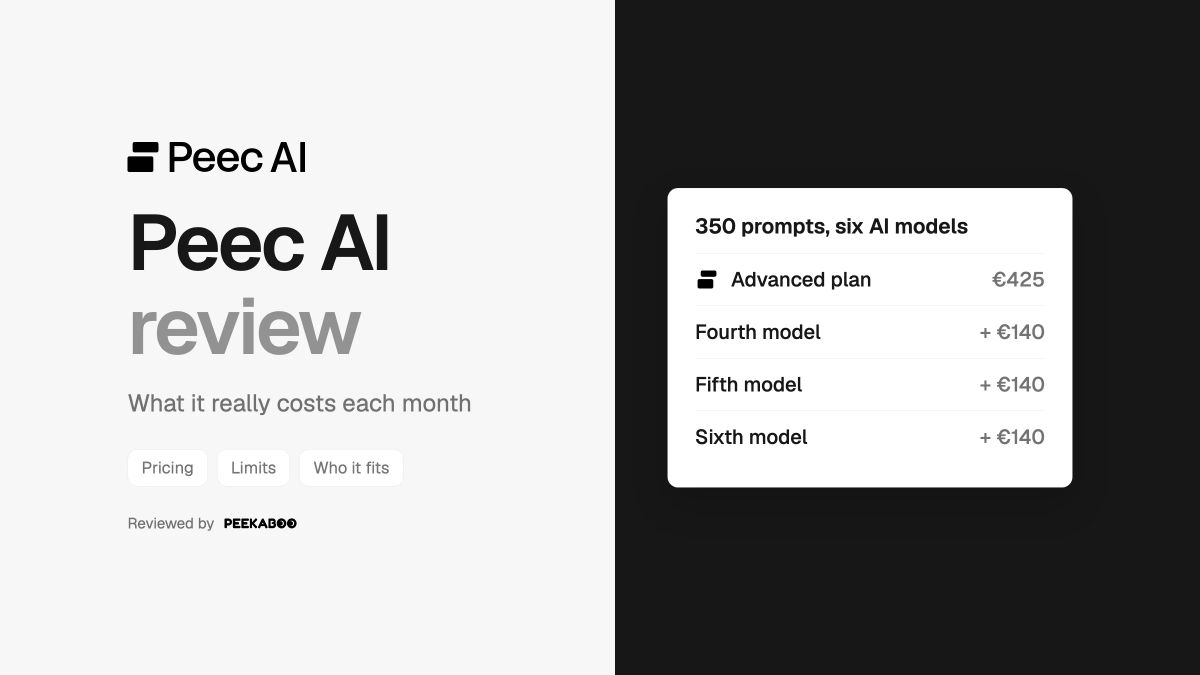
Peec starts at EUR85 monthly on Starter. A 150-prompt, five-platform panel costs EUR345 monthly on Pro with two additional platforms. Peec's pricing page also lists a custom-priced Enterprise plan on an annual contract:
Peec brand plan
EUR monthly billing
EUR per month, annual billing
Daily prompts
Projects
Countries
Additional platform, EUR monthly
Starter
85
70
50
1
1
30
Pro
205
180
150
2
3
70
Advanced
425
360
350
5
3
140
All three include unlimited users and daily tracking. Select your three included platforms from:
ChatGPT.
Google AI Mode.
Google AI Overviews.
Microsoft Copilot.
Gemini.
Naver AI.
On these fixed-price brand plans, Perplexity requires an additional platform purchase. Advanced includes Looker Studio. Enterprise has a custom annual quote with:
Up to thirteen models.
Daily or weekly tracking.
API access.
SSO.
Confirm API or SSO availability if you are considering a different plan.
Every plan includes unlimited users.
The table prices the same setups for one brand on monthly billing. AI Peekaboo bills in US dollars, so read each column in its own currency rather than comparing the figures across it.
Prompts
Frequency
Platform count
Peec AI, EUR monthly
AI Peekaboo, USD monthly
50
Daily
3
85, Starter
75
150
Daily
3
205, Pro
225
150
Daily
5
345, Pro with two additional platforms
375
350
Daily
3
425, Advanced
525
100
Every two days
3
Not offered on the stated brand plans
75
The three-platform comparison selects:
ChatGPT.
Gemini.
Google AI Overviews.
The five-platform example adds Google AI Mode and Perplexity. Google AI Mode could instead be one of Peec's three included selections; this particular example adds it beyond those three. On the fixed-price brand plans, Perplexity requires an additional platform purchase.
Inside Peec, the price stays flat while three engines are enough, then climbs a fixed add-on at a time. AI Peekaboo's price follows how many prompts you track, on how many platforms and how often they run, so running prompts less often is how you lower the bill. The last row is a setup Peec's fixed-price plans don't sell.
Peec's agency plans share an allocation across client projects:
Agency plan
EUR monthly
Allocation credits
Tracking frequency
Essential
205
10,000
Daily
Growth
425
25,000
Daily
Scale
675
65,000
Daily or weekly
Comprehensive
Custom
Unlimited
Confirm quoted configuration
Credits allocate the scheduled prompt/model checks across projects. They are allocation slots, not a wallet consumed and reset each month. A displayed prompt count depends on the selected models and cadence; it is not a fixed prompt allowance.
Peec's brand plans come with a free trial but no free plan, so a small team can start without a sales call. Enterprise goes through sales.
AI Peekaboo plans start at $30 a month. You build your plan from:
Brands.
Prompts per brand.
AI platforms.
Subscription-wide tracking frequency.
The free fourteen-day card-backed trial is available once per workspace when all these conditions hold:
The workspace is new.
Each brand has at least ten prompts.
The verified monthly list price is below USD100.
A plan at USD100 or more starts billing at checkout. White-label reports and client share links require a verified monthly list price of at least USD100. The separate one-time free AI visibility report needs no card.
Profound publishes no brand price: there's a free preset trial, and Enterprise is quoted.
For a single brand that fits inside three engines, Peec's published pricing is easy to predict and easy to budget.
Peec AI alternatives
Price AI Peekaboo if you need more than three engines or want to decide how often your prompts run. Look at Profound only if you're a large enterprise.
In AI Peekaboo you pick up to 7 AI platforms, and five of them are listed below. Your prompts can run daily or less often, and the AI Peekaboo pricing follows how often they run and how many platforms you pick, so running them less often brings the bill down.
The five standard platforms are:
ChatGPT.
Gemini.
Perplexity.
Google AI Overviews.
Google AI Mode.
Microsoft Copilot is also selectable at the standard platform rate. Claude adds USD0.20 per check for API answers with web search; it does not track the consumer Claude app.
For agencies, it's the best overall pick: several client brands tracked in one subscription, recommendations tied to each brand's gaps, and white-label reporting from $100 a month. The trade-off is that one tracking frequency applies to every brand in the subscription, so you can't run one client daily and another weekly.
Peec earns more attention when your team needs:
Crawler log analytics.
Catalog-level shopping tracking.
Brand perception for investigating how answers describe the brand.
Profound is built for large enterprise companies whose AEO, content and PR teams run ongoing programs and want reusable agent workflows on top of tracking. If that's your scale, Profound vs Peec AI sets the two side by side.
Team's next job
Route I'd favor
Trade-off to accept
Investigate a recurring source gap and related site or product evidence
Peec AI
Price the needed engines and confirm the specialist feature scope.
Run several client brands, pay for what you track and add branded delivery
AI Peekaboo
Every brand runs on the same schedule; white-label reports and client share links start at $100 a month.
Build reusable workflows across an enterprise AEO and content program
Profound
Enterprise is quoted and agent runs consume credits.
Profound Enterprise includes SSO/SAML, API access and CSV/JSON exports, with tailored tracking. Those controls give a large team concrete requirements to compare, rather than a reason to assume Peec cannot serve an enterprise. Peec also has Enterprise API access and SSO; the closer question is whether your team needs Profound's workflow builder or Peec's investigation path.
Profound's free brand trial runs 50 preset prompts daily for seven days and does not allow custom prompts or exports. It can show the preset experience, but it won't answer your own engineering-buyer question. A team whose decision depends on that question needs a demonstration suited to its work. Don't let a polished preset answer substitute for the task that brought you to the review.
What to check during Peec AI's trial
Use the trial to see whether Actions names the fix for your biggest competitor gap, and price any fourth engine before it ends. Give it a real job:
Load the questions your buyers actually ask an AI engine, not the keywords you already rank for.
Pick the three engines you'd pay for, since the three fixed-price brand plans include three.
Find a commercially important competitor gap, inspect the cited page, and see whether Actions offers a relevant task your team could carry out.
If you wished for a fourth engine on day one, price the add-on at your plan's rate before the trial ends.
During the trial, complete one gap record and pass it to the colleague who would own the work.
If the content manager cannot turn the suggestion into a concrete brief, find out whether the missing piece is product knowledge, supporting evidence or the suggestion itself. That tells you more about the fit than counting how many tasks are in the queue.
Before committing, resolve only the terms that change this setup:
The cost of every engine your report needs.
The reporting output and feature access on the chosen plan.
Peec's trial duration and card terms for the account you're opening.
Keep the evaluation question narrow enough that you can judge the result. You don't need a visibility lift before deciding whether the tool helps your team choose useful work. Choose Peec only if the evaluation produces a defensible task within your team's budget.
If Peec names a relevant page, placement or fix for that gap, and your team can turn it into a task, it's doing the job you'd pay for. For a quick look at where you stand before any trial, the free AI visibility report shows how ChatGPT and Gemini describe your brand today. It's a one-time snapshot, not ongoing tracking.
How we checked this
Last checked: 2 October 2026.
Prices and plan limits: each vendor's public pricing page. Features: vendor help docs and product pages.
Frequently asked questions
Can I keep monitoring the engineering-buyer questions for free after Peec's trial?
No, Peec has no ongoing free plan. Suppose the trial reveals a useful gap, but the team has no budget for monitoring afterward. I'd treat that as a reason to settle the subscription decision before making Peec part of the weekly meeting. A useful trial finding does not give you a continuing free view of those buyer questions.
Will bringing the writer and developer into Peec add user fees?
No, Peec's plans include unlimited users. When the content manager passes a finding to the writer and the developer, those colleagues do not create an extra per-user charge. That makes a shared investigation easier to budget, but it doesn't remove the team's workload. I'd invite the people who can carry out the proposed change, rather than leave every finding with the analyst.
Does Peec get my product added to the comparison article it identifies?
No, identifying a placement does not mean Peec secures it for you. Suppose the engineering-software comparison omits a capability your product now has. Your outreach colleague still needs to make the case to its publisher, who decides what belongs in the article. I'd value the suggestion for directing that conversation, without treating it as a promised inclusion or AI recommendation.
Start with your own visibility.
See where your brand appears in AI answers and which competitors get mentioned.
 Filipe Lins Duarte