Choose prompts to track from real buyer questions at each buying stage, keep most unbranded, start with 20 to 50 and track competitors on the same prompts. Here's how to build, size and maintain the set.
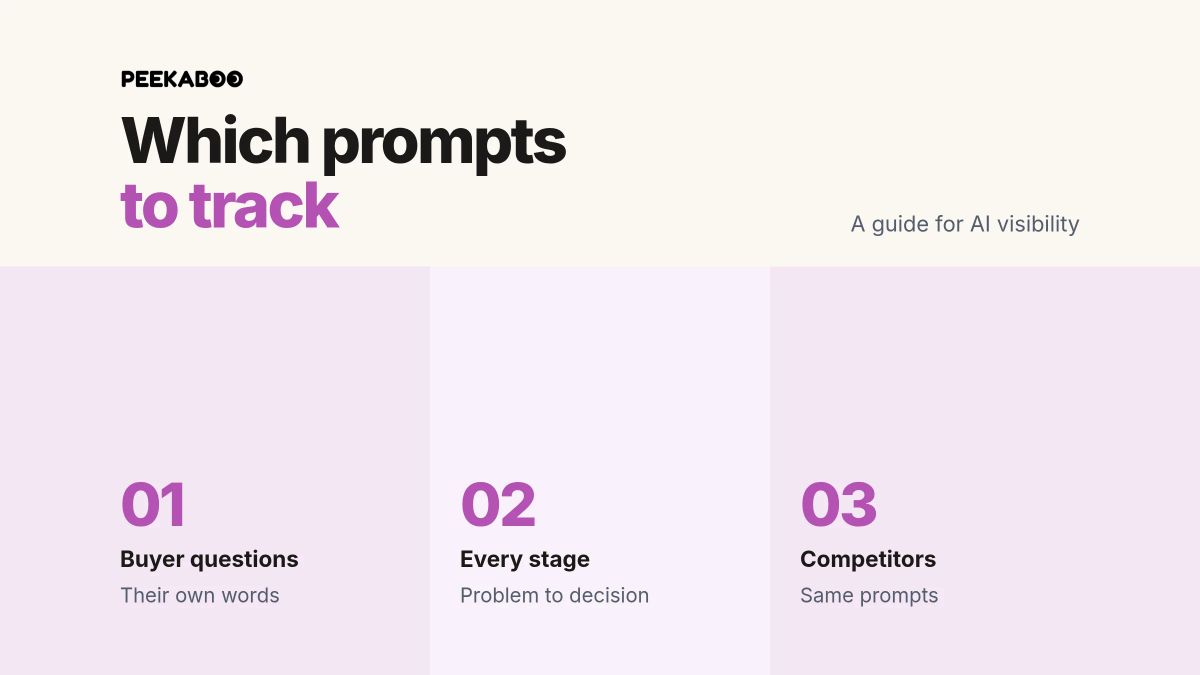
To choose prompts to track for AI visibility, start with the questions real buyers ask at each stage of buying, keep most of them unbranded, begin with 20 to 50, and track your competitors on the same prompts. That set becomes the measuring stick for every AI visibility number you report, and the prompts you choose are the foundation of everything else you measure.
If you've just set up a tracker, or a client wants to know how they show up in ChatGPT and you're staring at an empty prompt list, start here.
Why the prompts you pick decide your AI visibility score
Your AI visibility score is a ratio over the prompts you track, so the prompts decide the score before any AI platform answers a single question.
Two common mistakes show how. Fill the list with branded prompts, such as "is [your brand] good for agencies?", and your score goes up, because an answer to a question that names you almost always mentions you. Fill it with broad awareness questions, such as "what is project management?", and your score goes down, because those answers can name no brands at all.
AI Peekaboo's published methodology makes the same point about its own numbers: scores from different prompt sets shouldn't be treated as directly equivalent without reviewing those differences. The same applies to any tracker. When two trackers disagree about the same brand, a different prompt set is one of the first things to check, and our guide on why your AI visibility tool might be showing you the wrong data covers the other usual causes.
The answers also vary from run to run. A SparkToro study from January 2026 tested this. 600 volunteers ran 12 prompts through ChatGPT, Claude and Google's AI a combined 2,961 times. The study found less than a 1 in 100 chance that ChatGPT or Google's AI, asked the same question 100 times, would give the same list of brands twice. It isn't peer-reviewed, and one of its researchers works at the AI tracking company Gumshoe. Treat your prompt set as a sample of the conversations your buyers have, and read the results as rates across repeated runs. Rand Fishkin, who ran the study, suggests asking at least 60 to 100 times to learn which brands an AI tends to recommend for one prompt. Weekly runs on a single prompt won't get there, so read your results across the whole set, or across a stage or topic over several weeks. Twenty prompts on three platforms give you 60 answers a week, and a stage of six prompts gives 18, or 72 after a month. Treat any single prompt's result as a rough signal.
Av. António Augusto de Aguiar 122C 1050-046 Lisboa, Portugal
Minnesota
202 N Cedar Ave, Suite 1 Owatonna, MN 55060, USA
How to choose prompts to track
Build the list in five passes: collect real buyer questions, check that they cover every buying stage, balance branded and unbranded, add competitor and comparison prompts, and set the location and language.
Start from real buyer questions
Start with questions your buyers have actually asked, in their own words, before you use any keyword tool or AI suggestion. Real questions carry the context buyers give AI platforms: their team size, budget, industry and the problem they're trying to solve.
The best sources are already in your business:
Sales calls and demo notes: the comparisons, objections and "can it do X?" questions prospects raise before they buy.
Support tickets and onboarding emails: the problems customers had before they found you, and the words they used to describe them.
Search Console queries: the longer, question-style searches that already reach your site. These are real searches with real counts, which makes them more trustworthy than prompt volume estimates.
Your site search and chat logs: what visitors type when they can't find something.
Community forums in your niche: the threads where your buyers ask each other for recommendations, which show how people phrase the question when no brand is listening.
Then rewrite each one as a full question, the way someone would type it into ChatGPT. "Payroll software agencies" becomes "what's the best payroll software for a 20-person creative agency in the US?". People ask AI platforms complete questions with context, and the context changes which brands get named.
A few wording rules keep the prompts honest:
One question per prompt. "Best CRM for agencies and how much does it cost?" mixes a shortlist question with a pricing question, and you won't know which part an answer is responding to.
Say who's asking. Team size, industry, budget or location, whichever your buyers usually mention. It's what separates your market from everyone else's.
Keep your brand out of unbranded prompts, including product names and slogans that only you use.
Don't lead the answer. "Why is [competitor] so expensive?" measures how AI platforms respond to a complaint, not who they recommend.
Write it the way your buyers would. If your customers say "client portal" and you say "stakeholder workspace", use theirs.
Be careful with prompt volume numbers. AI platforms don't report how often people ask a given question the way Search Console reports searches, so any prompt volume figure in a tool is an estimate. Use those estimates to break a tie between two similar questions, never to decide what matters to your buyers.
AI suggestions help once you have that core list. AI prompt suggestions in AI Peekaboo are based on competitor and coverage gaps, with the reasons shown so you can edit a question or skip it. AI prompt research shows where your tracked set misses buyer decisions and where near-duplicate prompts take up space without adding anything.
If you're starting from nothing, our free AI prompt finder reads your website and suggests buyer questions grouped by intent. Treat any generated list as a first draft: keep the questions your sales team recognizes, and cut the ones nobody would really ask.
Cover each stage of the buying journey
Cover every stage of buying, not only the moment someone asks for the best tool. Buyers ask AI platforms different questions as they move from a problem to a decision, and a brand can be named at one stage and missing at another.
Stage
What the buyer is doing
Example prompt
Problem
Understanding a problem they have
"How do agencies stop projects going over budget?"
"Best project management tool for a 15-person agency"
Comparison
Weighing named options
"Asana vs Monday for client work"
Decision
Checking price, fit and risk
"How much does [your brand] cost for 15 users?"
Weight the list toward the shortlist and comparison stages, because that's where AI answers name brands and where buyers decide who to look at. Problem and solution questions are still worth a few prompts each. They show whether your content is shaping how AI platforms explain the category, and they're where a competitor's guide could be cited instead of yours.
Write prompts with the same detail buyers use. A detailed question doesn't stay one search: AI platforms can break it into several searches of their own, a technique called query fan-out. Google says both AI Overviews and AI Mode may use it, issuing related searches across subtopics to build one answer. A prompt that includes "for a 15-person agency" and "under $20 a user" can lead to different sub-searches than "best project management tool", and I'd expect different brands in the answer.
Mix branded and unbranded prompts
Keep most of your prompts unbranded and track branded prompts as a separate group. I'd aim for roughly three unbranded prompts for every branded one, and never report the two groups as one number. A brand dealing with wrong or negative descriptions can justify more branded prompts for a while.
Unbranded prompts are the competitive measurement. They show whether AI platforms recommend you when a buyer doesn't already know your name, which is the visibility that brings new customers.
Branded prompts do a different job: they check what AI platforms say about you when someone asks directly. Use them to catch wrong prices, discontinued products, outdated positioning or a description that sends buyers to a competitor. Good branded prompts include:
"Is [your brand] worth it for a small agency?"
"What does [your brand] cost?"
"What are the downsides of [your brand]?"
"Who is [your brand] best for?"
These will mention you almost every time, so their visibility score will look excellent and tell you very little. What matters in branded answers is accuracy and tone: whether the price is right, whether the description matches who you sell to, and which sources the answer relies on.
Add competitor and comparison prompts
Add prompts that name your competitors, and track those competitors as brands on every prompt in your set. Buyers ask comparison questions late in their decision, and those answers can decide which product gets the trial.
Three kinds of competitor prompt are worth tracking:
Head-to-head: "[your brand] vs [competitor] for agencies".
Alternatives: "best alternatives to [competitor]", the question a buyer unhappy with a competitor is likely to ask.
Competitor-only: "is [competitor] good for client reporting?", where you're not named in the question but could be named in the answer.
Tracking competitors as brands is what makes the numbers comparable. When three to five competitors are tracked on the same prompts, you can see who gets named instead of you, on which questions and on which platforms. It's also the basis of AI share of voice, your share of all brand mentions across the competitors you track.
Pick competitors from the answers as well as from your sales team. AI platforms can name brands you don't think of as rivals, and if one keeps appearing on your shortlist prompts, it belongs in the tracked set.
Set the location and language
Set each prompt to the country and language your buyers use, and keep separate prompt sets for separate markets. The same prompt names different brands in different markets, so a prompt run from the US can give a different shortlist than the same prompt run from the UK.
Location matters most for local businesses and for any product sold differently in different countries. A dental clinic, a law firm or a restaurant group should put the city or neighborhood in the prompt text as well, because "best family dentist in Austin" is the question a buyer actually types. A software brand selling in the US and Germany needs one set in English for the US and one in German for Germany, not translated copies of the same list, because a German buyer doesn't phrase a question the way a translated English prompt does, and the answers can name different brands.
Check that your tracker lets you choose the country a prompt runs from. If you're checking by hand, a clean browser session from the right country is the minimum, and note where you ran it so the next check matches.
How many prompts to track
Track 20 to 50 prompts per brand and market to start. That's enough to cover each buying stage with several questions and to see a pattern, and small enough that you'll read the answers instead of only watching a score.
Count answers, because each prompt runs on each AI platform you track, as often as you schedule it, so the workload multiplies:
Prompts
Platforms
Runs per week
Answers per week
20
3
1
60
40
3
2
240
50
5
2
500
Before you commit, run each candidate prompt once on one platform and read the answer. If it names no brands at all, rewrite it closer to a decision or drop it. If it names only giant brands that aren't your competitors, it may belong to a different market.
The platforms multiply the workload too, so choose them as carefully as the prompts. Track the AI platforms your buyers use. Start with the two your buyers mention most in sales calls. If you don't know yet, ChatGPT and Google's AI Overviews are a sensible first pair: one is a chat assistant buyers open on purpose, the other appears inside an ordinary Google search. Then add Gemini, Perplexity, AI Mode, Copilot or Claude where your buyers lean that way. Each platform can name different brands for the same question, so read the results per platform. A prompt set that looks healthy in Perplexity can still have a gap in ChatGPT.
Too few prompts makes the score jumpy. With 10 prompts on three platforms run once a week, you get 30 answers, and a couple of answers changing by chance moves your score by several points. Too many prompts has the opposite problem: a list of 300 near-duplicates costs more, takes longer to review and buries the questions that matter.
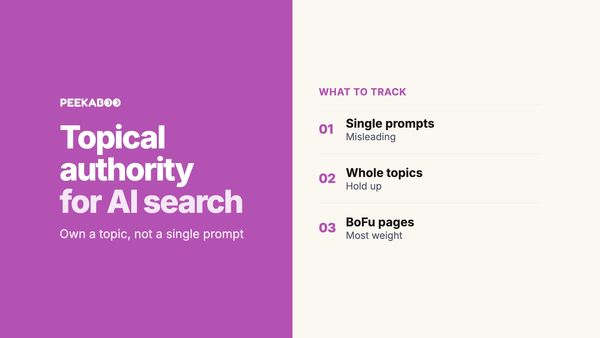
I'd go deep before going wide. Five to ten prompts on each important topic tell you more than one prompt each on 50 topics, because you can see whether a gap is consistent or a one-off. Add topics once the first ones are stable.
Label every prompt with its topic and its buying stage when you add it. Those labels let you read the results in slices: you might be named often on comparison prompts and rarely on shortlist prompts, or strong on one product line and absent on another. A single score across all 40 prompts hides that, and the slice tells you which page to write next.
Run the set at least weekly, and read results as a rate across each stage or topic over several weeks. Two runs a week is better if you can afford the answers. If you're tracking by hand, that's where the time goes, and it's the job AI prompt tracking takes over: the same prompts on the platforms you choose, on your schedule, with every answer, mention and cited source kept. AI Peekaboo tracks ChatGPT, Gemini, Perplexity, Google AI Overviews, Google AI Mode, Microsoft Copilot and Claude API, from $30 a month, and you pick how many prompts each brand gets and how often they run. Whichever way you run it, the reason for the cadence is the same: answers change from run to run, so regular runs give you enough data points to separate a real trend from a lucky week.
Prompt examples for a B2B software brand
Here's a starter set for a hypothetical B2B software brand: a project management tool for small agencies, which we'll call ProjectCo, competing with Asana, Monday.com and ClickUp. It has 20 prompts, mostly unbranded, across every stage.
Problem and solution (4 prompts)
How do small agencies stop client projects going over budget?
What's the best way to track billable hours across client projects?
What software helps agencies manage client approvals?
Do agencies need project management software or is a spreadsheet enough?
Shortlist (6 prompts)
What's the best project management tool for a 15-person creative agency?
Best project management software for agencies with client portals
Which project management tool is easiest for clients to use?
Best project management software for agencies under $20 per user
What project management tool do marketing agencies use for retainers?
Best tool to manage agency projects and time tracking in one place
Comparison and alternatives (6 prompts)
Asana vs Monday.com for agency client work
ClickUp vs Asana for a small agency
Best Asana alternatives for agencies
Best Monday.com alternatives for small teams
ProjectCo vs Asana: which is better for agencies?
Is ClickUp good for managing client projects?
Branded (4 prompts)
Is ProjectCo worth it for a small agency?
How much does ProjectCo cost for 15 users?
What are the downsides of ProjectCo?
Who is ProjectCo best for?
That set has 15 prompts that don't name ProjectCo and 5 that do, 4 branded and one head-to-head, which is the three-to-one mix. Report the head-to-head with your competitor prompts, and the 4 branded ones as their own group. Twelve of the 20 sit at the shortlist and comparison stages, where buyers decide, and the branded cost prompt covers the decision stage. A real set would add prompts from the brand's own sales calls and Search Console data, and grow toward 40 as the first results come in. For the wider program around a set like this, from choosing the prompts to improving the pages that get cited, see our AI visibility playbook for B2B SaaS.
Keep the set in a sheet or tracker with a few fields for each prompt, so anyone on the team can see why it's there:
Prompt: the exact wording you run.
Topic: the product line or theme, such as "time tracking" or "client portals".
Stage: problem, solution, shortlist, comparison or decision.
Type: unbranded, competitor or branded (a head-to-head that names you counts as competitor).
Market: the country and language it runs in.
Added: the date and the reason, such as "sales call, Oct" or "new competitor".
When to change your prompt set
Change your prompt set when your market changes, not when your numbers look bad. A stable set is what makes this month comparable with last month, so every change should have a reason you could explain to a client.
Good reasons to add or replace prompts:
You launched a product, feature or market: add the questions buyers of that product ask.
A new competitor keeps appearing in answers: add it as a tracked brand and add its alternatives prompt.
Buyers' language changed: new terms show up in sales calls or Search Console queries.
A prompt never names any brand: after a few weeks of answers with no brand in them, it isn't measuring visibility, so replace it with a question closer to a decision.
Bad reasons are removing a prompt because you never appear in it, or adding easy branded prompts before a report. Both make the score look better without anything improving, and I think the prompts where you never appear are the most useful ones to keep, because they're where the work is.
Review the whole set every quarter, keep a core of prompts you never change, and note every change in your reports with the date. If you change more than a small share of the set at once, start a new baseline instead of comparing with the old one. A full AI visibility audit is a good moment for that review.
If you haven't built your set yet, our free AI visibility checker gives you a one-time report from ChatGPT and Gemini, with the competitors that show up and the sources available to review. The competitors and sources it shows are a good place to find your first prompts.
Frequently asked questions
How do you do prompt tracking?
You do prompt tracking by running a fixed set of buyer questions on the AI platforms your customers use, on a regular schedule, and recording which brands each answer names and which sources it cites. Run each prompt at least weekly, track competitors on the same prompts, and read the rate across a stage or topic over several weeks, per platform, rather than from a single answer.
Should you track branded prompts?
Yes, but keep them separate from your unbranded prompts. Branded prompts almost always mention you, so they inflate a visibility score, but they're the best way to catch wrong prices, outdated descriptions or negative framing in AI answers. Report them as an accuracy check, and use unbranded prompts to measure how often you're recommended.
How often should tracked prompts run?
Run tracked prompts at least weekly. AI answers change from run to run, so weekly data gives you enough points to separate a real trend from chance. I'd run daily during a launch or in a fast-moving category, while monthly runs are too sparse to tell a real change from noise.
Start with your own visibility.
See where your brand appears in AI answers and which competitors get mentioned.
 Filipe Lins Duarte