Writesonic fits small teams buying article production and AI monitoring together. Basic costs $249 monthly for a complete 100-question daily panel on the three included engines, with article production included. For agencies that already employ writers, a focused tracker and useful briefs may be the better purchase.
Starter is $99 monthly, but its 50 prompts come with only 50 daily answers. Checking all 50 across three engines daily would require 150. The entry plan does not fund that full panel.
Writesonic AI visibility tracking
Writesonic combines visibility analysis with article creation and site audits. The bundle is useful when the same team investigates answers and produces the page work.
A brand mention differs from a URL citation. Inspect the answer and cited page before assigning a rewrite. A third-party source can explain an information gap without being an obtainable outreach placement.
Visibility scores and share of voice help locate a competitive gap. Prompt-level answers explain what the gap contains. Writesonic separates branded and non-branded visibility and supports filtering by market, topic and competitor. Use those distinctions to keep a broad dashboard movement from becoming an unfocused content assignment.
Suppose your software company wants to appear for “Which project management tool suits a small design agency?” This is a hypothetical evaluation question. An answer naming your brand would establish a mention. A link to your comparison page would establish a citation. Neither tells you, alone, whether the answer presents your product as the right fit for that agency.
Read the recommendation in context. Look for the requirement that shapes it: collaboration, client access or a specific constraint. Then compare the same question across the included engines. A competitor's appearance on one engine can justify investigation without proving that your entire category positioning is weak.
Citation analysis covers top cited pages and domains, with source types. Each view supports a different decision:
Av. António Augusto de Aguiar 122C 1050-046 Lisboa, Portugal
Minnesota
202 N Cedar Ave, Suite 1 Owatonna, MN 55060, USA
A cited page shows the specific material supplying evidence. Inspect its relevance to the question before copying its format.
A cited domain shows whether several useful sources belong to the same publisher. Repeated domain presence does not make every page on that site a suitable target.
A source type distinguishes your own content from independent coverage. That changes whether the task belongs to your editor or to someone pursuing third-party mentions.
Keep market and topic scope consistent when comparing competitors. A brand leading in one country-language combination is not necessarily leading in another. A shift after adding different questions can reflect the panel change rather than stronger recommendations. Preserve the commercial questions you need answered, then judge the evidence within that panel.
Writesonic article writing and brand voice
Writesonic's writing support is useful when your team needs help turning a specific information gap into a usable page. Every brand plan includes:
The AI Article Writer
The SEO/content agent
The ability to upload your own data
Content Optimization is Enterprise-only; article creation on Basic does not include every content feature.
Writing styles provide a separate brand-voice allowance.
Brand plan
Writing styles
Starter
1
Basic
5
Growth
10
Enterprise
Custom
One style can suit a single brand with consistent editorial rules. Several styles matter when the same team needs distinct registers for different audiences. They do not substitute for deciding what the brand should say.
Supply the product facts that make the page useful. In the hypothetical design-agency example, a credible draft needs the actual collaboration limits and client-access terms. A smooth paragraph that avoids those constraints leaves the buyer's question unresolved.
Judge the draft against a compact acceptance standard:
Product claims agree with the approved facts, including limits and exclusions.
The page answers the buying objection directly, rather than expanding into a general category introduction.
Recommendations explain who benefits and who should choose something else.
The wording matches the brand's register without obscuring important qualifications.
The editor can identify and finish the remaining work before publication.
That standard also applies to an existing-page refresh. A useful revision may replace one weak comparison or explain a missing limitation. It need not become another full article. Buy writing capacity for the work you can finish, rather than treating every observation as a reason to produce a new page.
Writesonic site audit limits
The audit allowance is a material part of the bundle when the same team owns content and site maintenance. Monthly audit counts and pages per audit are separate limits.
Site audit capacity
Starter
Basic
Growth
Audits per month
10
20
50
Pages per audit
100
1,200
2,500
A hypothetical 800-page website exceeds Starter's per-audit cap and fits Basic's stated page allowance. Ten small audits do not establish the same coverage as one complete 800-page audit. Choose around the site's intended scope, not the larger-looking monthly count.
Automatic AI fixes are included across the brand plans. Review a proposed change for the affected page and its purpose before accepting it. A technical correction should preserve accurate content and the reader's ability to act; an available fix is not proof that it will improve rankings or AI recommendations.
Writesonic's data sources include:
Google Keyword Planner
Google SERPs
Reddit
They can support content strategy, but they answer different questions. Search evidence and discussion topics can suggest what to investigate. Tracked answers show what the selected AI engines return for the monitored prompts. Do not treat one as a substitute for the other.
A small marketing team managing its own website may benefit from keeping these jobs together. An SEO team already using a dedicated audit suite should compare the actual work it would move into Writesonic before paying for overlapping capacity.
Writesonic pricing and plan limits
Prices are US dollars on monthly billing. Confirm the chosen term at Writesonic pricing.
Allocation
Starter
Basic
Growth
Price
$99
$249
$499
Prompts
50
100
200
Daily answers
50
300
600
Monthly AI articles
15
25
50
Users
1
2
3
Projects
1
1
2
Markets
1
1
1
Each self-serve plan includes:
ChatGPT
Gemini
Google AI Overviews
A market combines language and country. Custom markets and the wider ten-platform coverage require Enterprise. Growth expands volume within the three-engine set; it does not add Perplexity.
Basic covers the full 100-question panel with 300 daily answers. Across an illustrative 30 days in one brand and market, that is 9,000 observations. The count describes scheduled monitoring, not buyer demand.
Annual billing lowers the monthly equivalent while increasing the commitment. The annual brand subscription requires 12 months paid upfront.
Annual brand subscription
Monthly equivalent
Upfront annual amount
Starter
$79
$948
Basic
$199
$2,388
Growth
$399
$4,788
These amounts cover the base subscription. The monthly additional-user rate does not establish an annual add-on rate. Keep extra access separate when budgeting an annual contract.
Monthly billing suits a team still deciding whether the monitoring and writing jobs belong together. Annual billing makes more sense once that workload is established and the included scope fits it. A lower equivalent price offers little value if the editor stops using the production tools after the first few weeks.
Upgrades take effect immediately. Downgrades and cancellations take effect at the next billing cycle. Writesonic offers a seven-day, no-questions-asked refund. That refund period is not a statement of trial duration or a promise of proportional refunds throughout an annual term.
Writesonic users, projects and automation limits
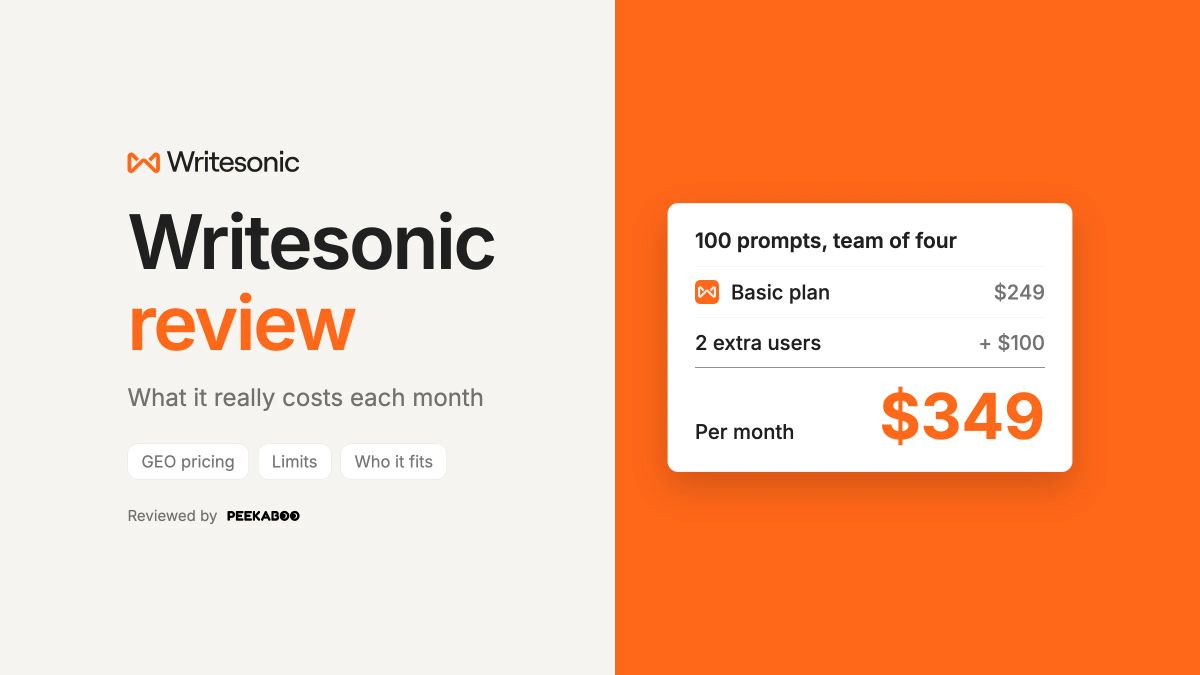
Four users on Basic cost $349 monthly: $249 plus two additional users at $50 each. Prompt and article allocations stay unchanged.
Basic can add three users and Growth two, reaching five on either plan. Starter cannot add users. Six people require Enterprise.
Projects remain a separate constraint. Basic retains Starter's single project; Growth includes two. Adding an editor to Basic gives that person access; it does not create another brand workspace. For an agency managing several ongoing client sites, the project limit can matter before the prompt allowance does.
Agency Starter serves a different job. It includes up to 20 pitch projects per month and 2,000 monthly answers. Each pitch project runs for one to seven days, then pauses. That is useful for a bounded prospect audit, not equivalent to continuous monitoring for 20 clients.
The pitch offer excludes content tools and white-label reporting. An agency needing drafts for retained clients cannot treat it as the brand bundle with more projects. Separate pitch evidence from ongoing client work when choosing the configuration; do not extend a temporary audit allowance into a recurring reporting promise.
Growth adds sentiment analysis and a limited Action Center with:
Five on-page actions per month.
Five off-page actions per month.
Technical actions available.
Full Action Center access is Enterprise.
Sentiment is worth paying for when your team needs to understand how answers characterize the brand. Read the surrounding recommendation before treating a negative theme as a reputation problem. A statement that your product is unsuitable for a particular team may be accurate positioning, rather than information you should try to remove.
The Action Center ranks missing prompts and citation gaps alongside content fixes and technical issues. Choose a task that follows from the observed problem. Suppose an answer describes an outdated product restriction. If your own page still contains that restriction, correcting it is a concrete on-page task. If the answer cites an independent comparison, the relevant work may be seeking a correction or earning better coverage.
Neither route establishes that the next answer will change. The useful distinction is responsibility: your team controls its own page, while a publisher controls an external source. Growth's five monthly actions in each category favor prioritization. They are not an unrestricted backlog-clearing service.
Agentic workflow access lists:
Plan
Agentic workflow trial runs
Starter
10
Basic
50
Growth
100
These trial runs do not establish recurring monthly production budgets.
Google Search Console and WordPress are available on self-serve. GA4 and Looker Studio require Enterprise. The upgrade must solve the actual requirement, rather than merely increase article volume. A WordPress integration does not, by itself, establish automatic publishing or an approval process suitable for your team.
Enterprise also gates user access control and SSO/SAML. Writesonic lists SOC 2 Type II, HIPAA and GDPR in its Enterprise offering. For an organization with formal security requirements, those claims are a starting point for reviewing the relevant controls and contract scope. They do not settle whether a particular deployment or data upload meets your obligations.
On brand plans, shopping and agentic-commerce tracking require Enterprise. A commerce team choosing Writesonic for product recommendations should scope that work explicitly rather than assume Growth's larger article allowance includes it. The relevant requirement is the shopping question your team needs to monitor, not the number of content features on the subscription.
Who Writesonic is for
The bundle's strength is keeping a finding close to the draft it informs. A small team needing writing support can use both parts of Basic. The main limit is duplicated production: an agency with an established editor may need evidence and a clear assignment more than generated articles.
Twenty-five article slots are not 25 finished pages. Size the plan around output the editor can verify and use. A page explaining a real buying objection is more valuable than an unrelated article created to consume an allowance.
AI bot analytics can add context to existing-page work. If a crawler visits a commercial page but the tracked answer cites a competitor, the visit does not explain the citation gap. Investigate what the answer needs and whether your page supplies it. If a page has no observed crawler activity, examine access before rewriting the content solely to address visibility.
Crawl activity and answer inclusion belong to different decisions. Bot analytics helps the person responsible for site access. Prompt answers and citations help the content lead decide what information to improve. Keep those responsibilities clear so a crawler chart does not become a content-performance report.
Team and job
Recommendation
Decisive constraint
Solo marketer maintaining one small brand site
Consider Starter for bounded monitoring and writing
50 daily answers cannot fund every prompt across three engines
Two-person content team answering commercial objections
Basic is the clearest bundle fit
One project and one market must cover the intended work
Larger content team needing more production and sentiment
Consider Growth
Broader engines and full Action Center remain Enterprise
Agency with established writers across client accounts
Compare focused monitoring and briefs
Seats do not expand brand-project capacity
Brand team managing several markets or shopping visibility
Scope Enterprise
The self-serve monitoring panel is too narrow
If ChatGPT already supports your team's drafting, judge Writesonic by the additional job it would perform. Monitoring connected to an article workspace may be useful. Another source of drafts, without a better way to finish the page, is a weaker reason to subscribe. Choose on workflow value and the work required to finish a page.
Writesonic alternatives for different teams
Need to replace the article workspace too? The Writesonic alternatives guide compares that production requirement alongside focused monitoring.
AI Peekaboo: Best Overall for Agencies with Writers
If your agency already pays writers, you probably don't need Writesonic's article generator. What you need is to know which page to assign them next, and that is where AI Peekaboo comes out best overall. It gives you the monitoring evidence, client reports under your own brand and content briefs that turn a finding into a clear assignment. Choose it when your editor needs a well-supported task more than a draft.
Once a client's position in AI answers changes, you can read those answers for yourself and see the sources behind them. Your editor gets a concrete reason for the next brief, and the client gets an example they can actually look at.
Key features
Turn findings into work with prompt suggestions, recommendations and content briefs that show what to track next and give each writer an angle to start on.
Give every client brand a dashboard of its own, with separate prompts and competitors, plus the AI answers and cited sources under every score.
Watch the AI platforms you care about, up to 7: ChatGPT, Gemini, Perplexity, Google AI Overviews, Google AI Mode, Microsoft Copilot and Claude API.
Line up unlimited pitch workspaces for prospects by adding one extra brand slot and reusing it for each new prospect's brand.
Share a read-only link with each client, or push the results into Looker Studio or your own reporting through the API.
Put AI visibility data in front of writers who work in Cursor, using MCP, so the cited sources shape each brief.
See AI visibility and site traffic together by connecting GA4 and Google Search Console.
Pricing
You build the plan from four settings: number of brands, prompts per brand, AI platforms (up to 7) and how often prompts run, and the total updates as you adjust them. Six of the platforms carry the same price per check. Claude API is the one that costs more, so see what it adds before turning it on. Sample plans:
Brands
Prompts per brand
AI platforms
How often prompts run
USD monthly
8
75
3
Monthly
30
3
30
3, one of them Claude API
Monthly
48
1
75
3
Every 2 days
56
3
150
4
Weekly
120
5
40
3
Daily
300
10
100
3
Daily
1,500
These rows work for whichever standard platforms you choose. You pick them; only Claude API is billed at a different rate.
Billed yearly, you save 15% against the monthly list price.
White-label reports and client share links are part of every plan from $100 a month.
However many people join, you pay nothing per seat.
You choose one prompt schedule for the entire account, and every client runs on it, so settle it early.
This review's panel, one brand with 100 questions checked daily on ChatGPT, Gemini and Google AI Overviews, comes to $150 a month. That is monitoring only and does not include anything like Writesonic's article production.
Who should choose it
The best fit is an agency that reports on AI visibility for several clients under its own brand and needs to show what moved and what to do about it. If you are a brand that just wants to find out whether AI answers mention you, and pick up a few ideas for getting mentioned more, it works for that too. The brief points your writer in a direction, and your existing production process still owns the page.
Pass on it if you want the articles produced for you: AI Peekaboo stops at briefs, so it will not replace Writesonic's included article allowance. If a client wants city-level results in the same report, confirm that first, because local-tracking data is left out of standard exports and Looker Studio.
Otterly AI: Daily Monitoring and URL Audits
Standard is $189 monthly for 100 daily prompts on four included engines. Gemini adds $59, making $248. That five-engine panel includes Perplexity and Copilot alongside Writesonic's three, so scope differs.
Unlimited members and 5,000 monthly single-URL audits support existing-page work. They do not supply Basic's articles. Choose Otterly when ongoing observation and URL audits match the team's existing content process. Its broader named panel is a meaningful advantage if Perplexity or Copilot matters to the questions you manage. Do not call the two prices equivalent without preserving that difference in engine scope. See the Otterly AI review.
Profound: AI research and content workflows
Profound fits enterprise answer research connected to Agents workflows. Credits and editorial approval need their own scope. Brand pricing is custom, separate from agency workspace fees. Choose it for an enterprise team funding both answer research and reviewed production. It is a different operating requirement from adding a few article slots to a small-team subscription. Read the Profound review.
How to evaluate Writesonic
Writesonic offers no-card signup. Confirm trial tier and allocations before judging a paid plan.
Use one commercial page:
Read the tracked answer and cited URLs.
Identify an accurate improvement your page can make.
Generate a draft with the relevant product facts.
Have the editor assess the work needed to finish it.
Compare that effort with the existing process.
Keep a decision record for that evaluation. Save the input question and the relevant cited URLs, then identify the precise draft change you wanted. Record whether the editor accepted it and what substantial correction remained. This makes the comparison about a finished task rather than how much text appeared.
Use the same product facts and buying objection in your existing process. If both routes produce a usable page, choose on the work each requires and the monitoring evidence you still need. If neither resolves the objection, increasing the article allowance will not fix the missing information.
For the monitoring side, use a commercial question whose answer could change a real content decision. Keep brand-name questions distinct from category questions. Being present when a prompt already names your company tells you something different from being recommended when the buyer asks for a suitable tool.
AI Search Volume includes five one-time runs on Basic and Growth; it is unavailable on Starter. Brand Explorer requires Enterprise. Use that limited access to inform question selection, not as a recurring monthly research allowance. An estimated topic signal does not establish how many buyers will encounter your tracked question.
Keep the question stable afterward. A crawler visit is not citation evidence, and a citation is not attributed revenue. An answer change does not by itself prove the rewrite caused it.
Should you buy Writesonic?
Get a one-time domain report from the free AI visibility checker, then choose a relevant page to investigate. Buy Writesonic when writing assistance helps finish that work. Retain your writers and buy focused monitoring when evidence is the missing part.
How we checked this
Last checked: 2 October 2026.
Prices and plan limits: each vendor's public pricing page. Features: vendor help docs and product pages.
Frequently asked questions
Does Starter cover 50 questions on three engines daily?
No. It supplies 50 daily answers; the full panel needs 150.
What does Basic cost for four users?
$349 monthly, with 100 prompts and 25 monthly articles unchanged.
Does Growth provide full automation?
No. Its Action Center is limited, and agentic workflow access lists 100 trial runs. Full access requires Enterprise.
Start with your own visibility.
See where your brand appears in AI answers and which competitors get mentioned.
 Filipe Lins Duarte