Clearscope Review: Editing Guidance and Real Plan Limits
Clearscope is a sensible choice for a content team that needs a shared process for recurring work on its content library. Its value is helping editors make coverage decisions consistently. A content grade should support that judgment, not become the publication standard by itself.
Clearscope is a sensible choice for a content team that needs a shared process for recurring work on its content library. Its value is helping editors make coverage decisions consistently. A content grade should support that judgment, not become the publication standard by itself.
I would start with Essentials for a modest ongoing programme. Business makes more sense when the library and tracked query set need room to grow. It does not include more monthly drafts, which is an important distinction if writing volume is your reason to upgrade.
If your main requirement is multi-brand AI monitoring rather than an editorial workspace, the Clearscope alternatives comparison helps separate those purchases.
Clearscope research, writing and content maintenance
Clearscope's main appeal is connecting decisions that a content team has to make repeatedly. Topic Exploration supports research from a topic or URL, with query discovery and intent analysis helping the team decide what the page should answer. Its outline builder and AI drafting then help develop that assignment.
Suppose, as a hypothetical example, your team is refreshing a product review for small businesses. The current article describes features, but gives little help deciding whether the product fits a small team. I would use topic or URL exploration to investigate candidate buyer questions, then use intent analysis to keep the assignment focused on evaluating the product. A related setup question might deserve a short explanation; a full implementation tutorial would change the page's job.
The useful output is an assignment the writer can act on. For this example, I would want:
A defined reader, such as the manager responsible for choosing the product for a small team.
An outline that puts fit and limitations before details that do not change the choice.
A record of which proposed answers have supporting facts and which still need evidence.
The outline builder can help arrange that work. It cannot make an unsupported price or capability safe to include. I would settle the central recommendation before asking for a draft, because otherwise the writer is left to infer the argument from a collection of related terms. Discovery is useful when it clarifies what to cover and what to leave for another article.
Av. António Augusto de Aguiar 122C 1050-046 Lisboa, Portugal
Minnesota
202 N Cedar Ave, Suite 1 Owatonna, MN 55060, USA
The optimizer supplies term suggestions from a Content Report. This can give a writer concrete subjects to inspect rather than a vague instruction to make the page more comprehensive. I would use the suggestions to ask:
Is this concept relevant?
Has the page answered it?
Does the evidence support what we are about to say?
The answer can be no. Adding every suggested phrase would confuse coverage with repetition. An editor still needs to use editorial judgment to produce a supported argument. The available grade is not evidence that the finished article will rank or be cited by an AI answer.
In the same hypothetical review, imagine that a suggested term concerns team access. That is a useful addition if the reader needs several colleagues to participate and the review has not explained the access allowance. The writer should add the supported allowance, then explain which kind of team it suits. Repeating the phrase across existing paragraphs would leave the buyer's question unanswered.
Now imagine a suggestion about enterprise security when the assignment is for small teams and the available evidence does not establish the security feature. I would leave it out. These are illustrative editorial decisions, not examples of actual Clearscope output.
Agree on the accepted gaps before revision so the writer knows what to add and the editor can check the result against the brief.
AI drafting is useful after those decisions, when the team has something definite to develop. The writer still needs to:
Resolve factual gaps.
Explain the recommendation.
Remove claims the evidence cannot carry.
The editor needs to check that the finished argument serves the intended reader. A generated paragraph that sounds complete can still fail to explain why a feature matters or who should choose a different product.
I would divide the responsibilities plainly:
The content lead chooses the assignment.
The writer develops supported answers.
The editor decides whether the piece is ready.
Unlimited users let those contributors participate without a seat cap. They do not create additional draft credits, and they do not establish permission controls for those roles. This is a proposed way to organize the work, rather than a claim about built-in approvals.
Content Inventory adds the maintenance side by monitoring selected published pages. That matters for teams with a library to keep useful after the first draft is done.
Suppose the product review is already published and the editor must decide whether it needs a refresh. Monitoring provides a starting point for inspection. I would then assess:
Whether the recommendation still fits its reader.
Whether important facts remain accurate.
Whether a missing answer changes the choice.
A page that needs one corrected allowance should receive that correction; a page whose argument no longer fits may need a new outline.
That maintenance decision is different from requesting another draft. It also gives the page allowance a practical meaning: choose the published pages you want to keep under review, rather than treating the entire library as automatically covered. For an editor with recurring new and existing-page work, these connected jobs are a credible reason to consider Clearscope. For a team that only needs occasional text generation, much of the subscription would serve a different task.
Clearscope pricing and plan limits
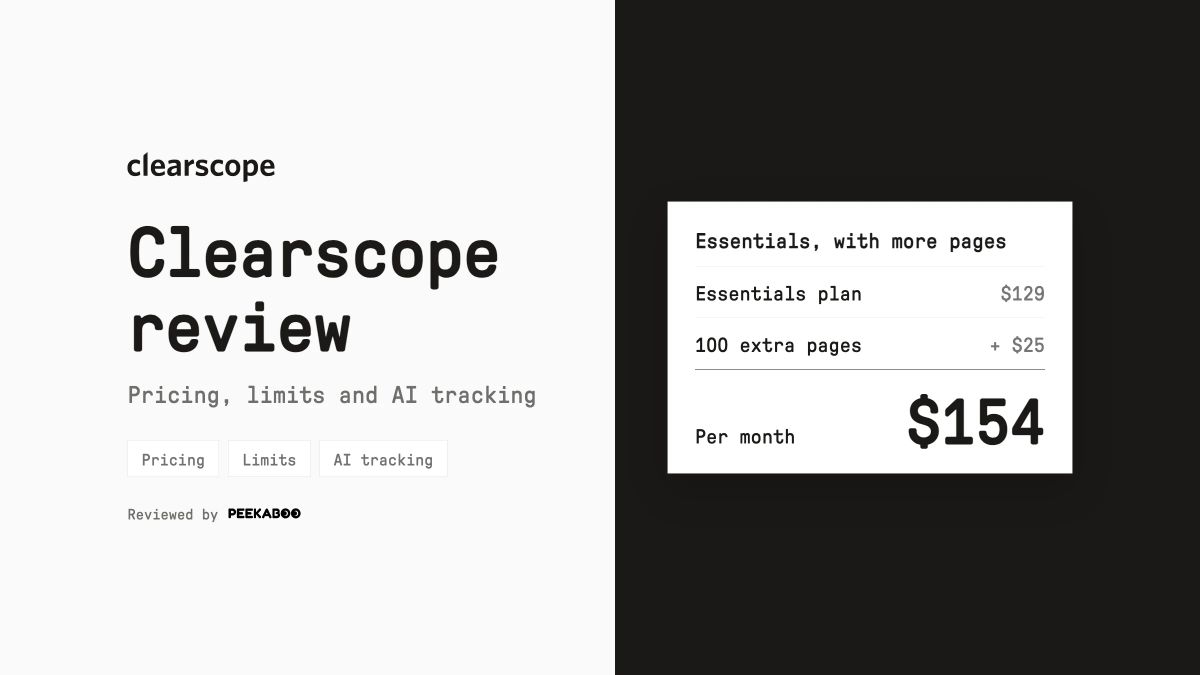
Essentials starts at $129 a month; Business costs $399 and expands research, page and query capacity while keeping the same draft allowance. Choose around the workload that constrains your team.
Users and projects are unlimited on every plan. For a team with several writers and reviewers, that removes a collaboration constraint. It does not remove the plan's finite allowances.
Business expands query and page capacity from 50 to 300 and Topic Explorations from 20 to 50. Drafts remain at 20. I would upgrade for a larger monitored library or research and tracking programme, not on the assumption that the higher plan provides more initial writing output. It also includes a dedicated account manager.
Enterprise adds:
Custom credits.
Custom agreements.
Crawler whitelisting.
SSO.
Those requirements belong in an organizational decision rather than a generic recommendation that a bigger team needs the most expensive tier.
Monthly Topic Exploration and Draft credits do not roll over. Add-ons can be billed automatically when included credits are exceeded. Additional pages on Essentials cost $25 per extra 100 pages. Obtain the exact draft-block and query-expansion terms for your workload before budgeting them; do not assume the base plan is an unlimited production subscription.
A larger library alone does not necessarily require Business. These hypothetical monthly workloads show the distinction:
Workload
Plan configuration
Monthly base plus stated page add-on
40 queries, 40 pages, 15 explorations and 12 drafts
Essentials within included allowances
$129
40 queries, 150 pages, 15 explorations and 12 drafts
Essentials with one extra 100-page block
$154
250 queries, 250 pages, 40 explorations and 18 drafts
Business within included allowances
$399
These totals exclude taxes and other usage charges. I would choose the page block for the middle case because page capacity is its only constraint. The last case needs more of several included allowances, which makes Business a more natural fit. Neither case supports upgrading for additional drafts.
Before choosing, separate your monthly research and drafting needs from the number of pages and queries you want to monitor. Several contributors can share a modest workload; one editor can maintain a large library. Headcount alone gives you little basis for selecting the tier.
A 14-day free trial is advertised. No permanent free plan is listed, and an annual discount should not be assumed from the monthly price.
Support hours are 7am to 6pm CDT, Monday to Friday. A dedicated Business account manager may matter for a team coordinating an ongoing programme, but I would not treat that inclusion as a response-time promise. Refunds are considered case by case rather than offered under a fixed refund policy. The trial is therefore the more useful place to assess fit before committing to recurring work.
Clearscope AI tracking features and limits
Query Tracking gives an editorial team a way to follow chosen buyer questions alongside its page work. It is part of every plan, limited by the tracked query allowance.
Its tracking metrics include:
Brand mention percentage.
Rolling averages.
Competitor benchmarking.
These can help an editor follow a chosen question over time.
Query Tracking includes ChatGPT and Gemini. Claude is advertised, but confirm its entitlement in the intended plan if it is necessary to your programme. Confirm any other required engine before treating Clearscope as a replacement for a broader monitoring panel.
Its query fan-out awareness can add context about related web searches. That context is useful for an editorial assignment, but it does not establish the complete hidden retrieval process or the search volume of every conversational question.
Suppose, hypothetically, you track a question about choosing a product for a small team. Competitor benchmarking and mention percentage give the editor a reason to inspect that question when competitors appear and the brand does not. The next decision is whether the content library contains a useful answer for that reader, rather than immediately commissioning another article.
Topic or URL exploration can support that assessment. If an existing review is relevant, the editor can use term suggestions to consider gaps in its coverage and assign a supported revision. If the question serves a different reader or task, it may need a separate assignment. I would want the handoff to name:
The question being tracked.
The page to examine.
The buyer decision the proposed change should clarify.
That is an actionable use of tracking without treating the metric as an instruction to insert the brand everywhere. The editor still needs a reason to make the change. Revisit the tracked question after revision, but keep the content decision and the observed mentions as separate records.
The important distinction is between observing an answer and improving a page. A mention percentage helps identify a question to inspect. It does not prove which edit caused a later mention, and it is not a measurement of sales generated by the article. I would value this tracking most when a content team can turn relevant observations into editorial work it already needs to do.
Who Clearscope is for
Clearscope fits a content lead coordinating recurring work across writers and editors. The connected workspace keeps recurring editorial decisions close together, and unlimited users allow the people responsible for them to participate.
A small in-house team can fit that description as well as a larger content department. The recurring job is present when the same editor handles these tasks throughout the month:
Commissioning reviews.
Checking coverage.
Revisiting published pages.
I would judge value by whether Clearscope helps that team reach clearer assignments and supported revisions, rather than by how many colleagues can log in.
It is less compelling for an occasional solo writer who has only a few assignments. The monthly allowance may be available without enough repeated work to justify the spend. That is a workflow fit issue rather than a judgment that the editor is inherently overpriced.
Surfer is a relevant alternative for teams comparing editorial guidance with AI tracking. It has a Content Editor with guidelines and a Content Score, while tracking scope depends on the plan. Seats are finite, and tracking scope varies:
Discovery: no AI tracking and one seat.
Standard: ChatGPT tracking and three seats.
Pro: tracking across five supported AI platforms and five seats.
Clearscope's unlimited users and projects make participation a different constraint.
I would compare those setups using the contributors who need access and the platforms the team needs to observe. Those differences can change the choice without assuming either editor produces better articles. Discovery, drafting and maintenance do not by themselves make Clearscope a replacement for a broader SEO suite. If your main need is technical investigation or backlink work, establish the required capability separately rather than buying on the strength of content guidance.
An agency that mainly buys AI evidence and branded client reports should evaluate that as a separate job. With AI Peekaboo, you put together a plan from $30 a month by choosing the brands, prompts, AI platforms and how often prompts run, and your writers get content briefs to work from. Reach $100 a month and the plan adds white-label reports and client share links. Those briefs are a starting point, though: they won't stand in for an article editor or write the pages for you. The three-way Clearscope comparison helps when those buying jobs overlap.
For that agency, the recurring deliverable is evidence a client can review. For the content lead, it is a page ready for editorial approval and later maintenance. I would choose around that deliverable, while allowing that a team doing both jobs may need both kinds of workspace.
How to evaluate Clearscope's free trial
Use the trial to decide whether Clearscope improves a representative assignment. Choose a page the business needs, with a clear reader and factual brief. Ask an editor to use Clearscope on that assignment and assess:
The proposed coverage changes.
The draft's remaining factual work.
The effort required to make it publishable.
The useful outputs are a revised outline and a supported draft. Check:
Whether the outline resolves an actual buyer question.
Whether accepted suggestions led to meaningful answers.
Whether the writer and editor can agree what still needs work.
If maintenance matters, include an existing page from the library too. End that task by choosing one of three actions:
Retain the page.
Make a focused correction.
Commission a fuller revision.
You then have evidence about the editorial job you intend to repeat, rather than a tour of features you may rarely use.
I would buy Clearscope when it makes those recurring editorial decisions easier to coordinate. I would begin with Essentials if the allowances fit, and move to Business when the included allowances constrain the programme. More drafts alone is a different requirement, and a higher grade alone is not a reason to publish.
How we checked this
Last checked: 2 October 2026.
Prices and plan limits: each vendor's public pricing page. Features: vendor help docs and product pages.
Frequently asked questions
Can I keep using Clearscope for free after the trial?
No, Clearscope has a 14-day free trial but no permanent free plan. If you only need help with one assignment, I would treat the trial as an evaluation rather than a continuing source of free editing guidance; the subscription makes more sense when you have useful work to repeat each month.
Can a quiet month's draft credits cover a busier month later?
No, unused monthly Draft and Topic Exploration credits do not carry into the next billing cycle. For a team whose assignments arrive in batches, I would budget around the month when that work actually needs doing, because a low-use month cannot build a reserve for a later publishing push.
Does Clearscope offer single sign-on for a company content team?
Yes, single sign-on is an Enterprise inclusion, and Enterprise pricing is custom. If your company requires SSO for its writers and editors, that requirement deserves a separate budget decision: unlimited users on every plan let more people participate, but that allowance alone does not establish how they can sign in.
Start with your own visibility.
See where your brand appears in AI answers and which competitors get mentioned.
 Filipe Lins Duarte