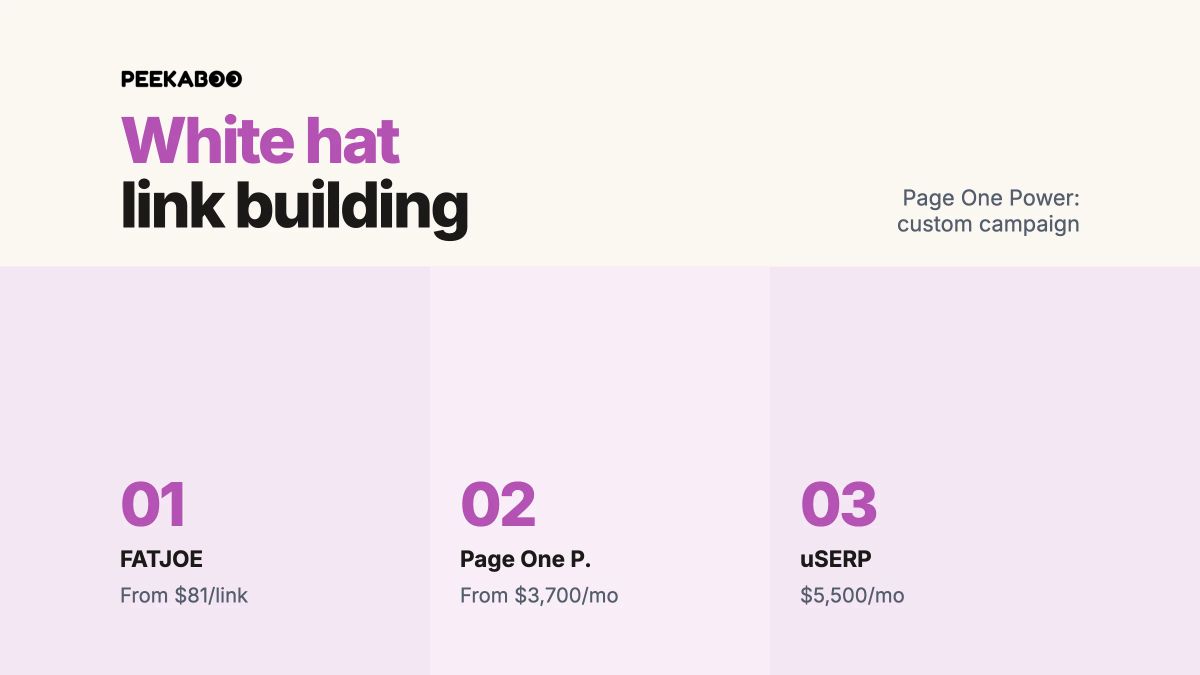
If you need a white hat link building agency to own a custom outreach campaign, Page One Power is my first choice here. Its explicit rejection of bought links and paid placements disguised as editorial is a meaningful reason to consider it. An agency that already owns its client's strategy has a different requirement: FATJOE can fulfill individual orders without adding another strategic retainer.
The other fits depend on the work your team owns:
Stellar SEO is worth considering for competitive markets where publisher approval needs to be part of a custom campaign.
uSERP suits established growth teams with the budget for a sustained program.
Linkscope belongs in the comparison as a marketplace with done-for-you packages, with closer scrutiny of publisher terms and delivery remedies before purchase.
Those are different services. A useful proposal should make clear who decides which pages deserve links and why a publication would want to mention them. A provider's white-hat label doesn't answer those questions or guarantee rankings.
What makes link building white hat?
A white-hat service should be able to explain why a publisher includes your link and whether the publisher is being paid. Paying an agency for research and outreach is a different arrangement from paying a publication for an unqualified link intended to influence rankings.
Google treats purchasing links or linked posts to influence rankings as link spam. Advertising and sponsorship are allowed when links are appropriately qualified with nofollow or sponsored attributes. That makes the commercial arrangement and the link's qualification more useful selection criteria than a provider's description of itself as safe.
Manual outreach doesn't settle this. A person can send a personal pitch and still negotiate a paid ranking link. Equally, a legitimate sponsorship can put your brand in front of a relevant audience without being an editorial endorsement. I'd evaluate that sponsorship for its audience and advertising purpose, rather than expect it to provide the same thing as an independently chosen reference.
Av. António Augusto de Aguiar 122C 1050-046 Lisboa, Portugal
Minnesota
202 N Cedar Ave, Suite 1 Owatonna, MN 55060, USA
Editorial outreach: the agency presents a useful resource or contribution and the publisher decides whether it belongs in the article.
Qualified advertising: the placement has a commercial purpose and the link carries the appropriate qualification.
A purchased ranking link: payment buys an unqualified link intended to influence rankings, regardless of the reassuring name given to the service.
Page One Power's stated rejection of bought links, PBNs and disguised paid editorial addresses this boundary more directly than a generic white-hat claim. It remains the provider's policy, rather than independent certification of every placement. If an offer cannot explain the publisher arrangement, I would leave it out of a campaign whose requirement is earned editorial coverage.
AI Peekaboo: AI visibility tracking for SEO teams
AI Peekaboo is not a link-building agency, and it does not belong in the list below. It is the tool I'd use before hiring one: it tells your SEO team which pages AI answers cite when your buyers ask their questions, so the brief you hand an agency names the publications that count, not just a domain authority target. The citation sources view is where that brief comes from.
Once a campaign has run and your visibility shifts, you can read the AI answers that changed and see which sources they leaned on. You end up judging the agency on placements that actually appear in answers, rather than on a percentage that went up or down.
Key features
See every score with its evidence: each brand gets separate prompts, competitors and a dashboard, and you can click through to the AI answers and cited sources underneath.
Choose the AI platforms that matter to your buyers, up to 7: ChatGPT, Gemini, Perplexity, Google AI Overviews, Google AI Mode, Microsoft Copilot and Claude API.
Plug in GA4 and Google Search Console so AI visibility and site traffic sit on the same screen.
Lean on prompt suggestions, recommendations and content briefs to decide what to track next and to give writers something to start from.
Send a read-only client link, or pull the numbers into Looker Studio or your own reports through the API.
Ask Claude or Cursor which domains AI answers cite for a client's topics, through the MCP server, to pick outreach targets your links team can chase.
Run unlimited pitch workspaces for prospects: one extra brand slot is all it takes, and you reuse it for each new prospect's brand.
Pricing
The price is built from what you track: how many brands, how many prompts per brand, which AI platforms (up to 7) and how often the prompts run. Change any of those and the total changes with it. Six of the platforms cost the same per check, but Claude API is more expensive, so look at the new total before you include it. Sample plans:
Brands
Prompts per brand
AI platforms
How often prompts run
USD monthly
2
75
3
Weekly
30
15
60
3
Monthly
45
1
75
3
Every 2 days
56
8
50
3
Weekly
80
7
40
6
Weekly
112
1
100
4, one of them Claude API
Daily
750
You aren't handed a default platform list. Pick yours; the six standard platforms are priced the same and Claude API is higher.
If you pay for the year, the monthly list price comes down 15%.
From $100 a month upward, your plan includes white-label reports and client share links.
Adding colleagues to the account carries no per-seat charge.
You set how often prompts run once, for the whole account, so every brand you track follows the same schedule. Pick it before you build the plan.
A new workspace on a plan under $100 a month, with 10 or more prompts per brand, gets a 14-day trial backed by a card. Plans of $100 or more are billed at checkout.
Who should choose it
Choose AI Peekaboo if you run an SEO agency that buys or manages link building for clients, and you want to know which publications AI answers cite before you brief a provider, then confirm afterwards that the placements turn up. Keep it as its own budget line, apart from the agency retainer. If you are a brand that simply wants to know whether AI answers mention you, and pick up a few pointers on getting mentioned more, it works for that too.
Skip it if you were hoping it would build the links for you. It measures AI visibility, and no monitoring plan or agency retainer can prove that one backlink changed an AI answer. Before you sign off on delivery, look at the actual publication and link you agreed with the provider.
Link building services and publisher approval compared
Choose a provider by the responsibility your team needs it to take. Publisher selection and content approval are separate rights, so a strategy service shouldn't be assumed to include either without an agreement.
Provider
Work offered
Strategy responsibility
Publisher and content control
Page One Power
Custom editorial outreach and asset support
Provider develops the campaign with your team
Pre-approval rights need agreement
FATJOE
Blogger Outreach, Niche Edits and order-based Grow
Your strategist supplies targets and anchors
No site or content pre-approval for Blogger Outreach or Niche Edits
Stellar SEO
Custom outreach or standard individual placements
Custom campaign includes analysis and strategy
Site approval in custom outreach only; content approval needs agreement
uSERP
Ongoing campaign with planning and reporting
Provider supplies gap analysis and target strategy
Pre-approval rights need agreement
Linkscope
Marketplace or done-for-you packages
Marketplace buyer evaluates placements; packages include specified support
Marketplace metrics visible before purchase; content approval rights need agreement
For a law firm or financial brand, knowing the publication after the placement is live may be too late. Stellar's custom site approval is a concrete reason to consider that offer, but it doesn't automatically establish a right to approve every sentence. Put that requirement into the scope if your team needs it.
An SEO agency with a sound client strategy can reasonably choose fulfillment instead. Its staff can decide the target pages and evaluate delivered work while a supplier handles writing and outreach. The weaker arrangement is one where both sides assume the other owns strategy. A concierge helps move an order; it doesn't necessarily decide whether the campaign is worth commissioning.
I would also distinguish visibility from control. Seeing a marketplace's metrics before buying helps you evaluate a candidate. It doesn't establish how the editor will present your brand, whether changes are permitted or how the link will be qualified. Those remain acceptance conditions for the specific offer.
Which link building method fits your content?
The right method depends on what a publication could use from you. If the agency proposes the same placement order for every target page, the campaign is missing a reason for an editor to care.
Page One Power lists several editorial-outreach methods, while uSERP includes content contributions, resource development and digital PR in its custom mix. FATJOE and Stellar also sell distinct new-content and existing-article services. I would commission the method that fits the opportunity, rather than assume all five providers offer the same work.
Linkable assets and resource outreach: choose this when your team has a genuinely useful reference, or can fund one. Page One Power can develop linkable content and promote assets to resource pages; uSERP includes resource and data-page development. Your input is the substance an editor could recommend to readers. A product landing page may be the commercial destination you care about, but a practical resource can be the more suitable outreach asset. If the only contribution is a sales message, asset work should come before resource prospecting.
Original data: a data-led campaign needs findings your team can substantiate, not merely an attractive chart. Give the agency the population behind the numbers and the limitations of the findings, along with permission to use them. I would favor this route for a team that already produces useful category research and can explain it. If the data is incomplete or confidential, a resource built around documented expertise may be a better assignment. Developing a data page is an input to outreach, not proof that journalists will cover it.
Guest contributions and new articles: choose these when your expertise can support an article relevant to the publication's readers. Page One Power lists guest-post outreach; uSERP includes guest content contributions; Stellar offers guest posts. FATJOE's Blogger Outreach uses new, non-promotional content published as the blogger's own post, without a guest profile. Those formats are not interchangeable if author attribution matters to your brand. Require a topic that stands on its own rather than an article built only to contain your anchor.
Existing-article insertions: use this route when the destination genuinely improves an existing passage. FATJOE's Niche Edits add text and a link to an older article; Stellar also offers insertions into already indexed articles. Page One Power lists editorial update outreach, and uSERP includes contextual insertions. An indexed article is a starting condition, not a reason to accept any edit. The new reference should answer a reader's need at that exact point, and the publisher arrangement still has to meet your policy requirements.
Unlinked brand mentions: choose this assignment when a publication already names your brand but doesn't link to it. Page One Power and uSERP list this method. The existing mention gives the outreach a specific starting point: the relevant destination may help the reader verify or understand the reference. That is different from asking for a fresh article. A brand mention inside an AI answer is also different from an unlinked mention on a publisher's website; the former doesn't establish a publisher outreach opportunity by itself.
Broken-link replacement and own-link recovery: separate the two jobs. Replacing another site's dead resource means offering a useful substitute for what its reader expected. Page One Power lists broken-link building. Recovering a link that used to point to your own page begins with establishing what happened to that destination. I would scope a destination review before asking an agency to acquire new placements to compensate for a page move. Neither job is the same as invoking a supplier's replacement guarantee for a removed paid deliverable.
Digital PR and journalist sourcing: choose an expertise-led campaign when your team has a useful finding or an expert who can contribute something specific. Page One Power lists digital PR, and uSERP includes digital PR and proprietary journalist contacts in its method mix. The buyer's contribution includes access to someone who can answer follow-up questions and approve accurate commentary. If nobody inside the business can support that work, ordinary placement fulfillment won't become a PR campaign simply because the proposal uses the term.
Five link building services compared
1. Page One Power: best for in-house SEO teams
Page One Power is the clearest fit if your in-house team wants a partner to plan and run an editorial-outreach campaign. Its service explicitly rules out paid placements disguised as editorial. I'd take that concrete policy over an impressive publisher count when real editorial judgment is what you need.
It can also build the thing worth linking to. That matters if the page you want to promote is a sales page with little value to a publication: paying for a useful asset is often more credible than forcing an exact-match anchor into an unrelated article.
Services
A backlink gap audit starts the campaign. Expect it to explain which competitor gaps matter for your business and which are irrelevant, not just hand you links to copy.
A custom outreach strategy, followed by placement reports and adjustments to the work as the campaign runs.
Content support: it can use your existing resources or create new content worth referencing. Your team still needs someone who knows the subject to approve it and keep it useful.
Reports show each live URL and the placement's metrics, so you can inspect what was delivered.
White-label partnerships, so an SEO agency can add custom outreach capacity under its own name.
Pricing
Offer
USD price
Commitment
Custom campaign
From $3,700 a month (typical)
Six-month initial contract, then month-to-month
Link volume is agreed in the contract. The starting price is not a per-link rate.
Agree replacement and refund terms in the proposal. A link quota in the contract is not a guarantee of commercial results.
Who should choose it
Choose Page One Power if your team can contribute real expertise and is ready to fund an asset and let the campaign develop. It is the strongest starting point in this comparison for that job. Skip it if you only want one small order: the six-month initial term makes it a poor match. It is also a weaker fit if you hope the agency can invent a reason for an editor to link without your input.
2. FATJOE: best for agency link building fulfillment
FATJOE fits an agency whose strategist already knows which target pages need support. You supply the anchors and URLs and choose a service and authority tier. FATJOE handles the outreach and writing and returns placements through its dashboard, so you outsource fulfillment while keeping the client relationship and the strategy.
Settle the destination before you supply an anchor. An order pointing to the wrong page is still the wrong assignment, even if FATJOE delivers the DR tier you picked.
Services
Blogger Outreach: new, non-promotional content published as the blogger's own post, with your link in the body rather than in an author box. It is not an expert byline service.
Niche Edits: your link and some new text added to an existing article.
Grow: an order-based campaign with a concierge and a white-label report. FATJOE calls it order facilitation, not a fully managed SEO service, and you order it as needed rather than as a monthly retainer.
Each delivery comes with a snapshot of placement metrics and an unbranded white-label CSV export, so you can review the work without handing the client to the supplier.
Removed links are replaced when you tell FATJOE. Later changes in DR are not covered by a refund or replacement.
Pricing
Service
USD price
Unit
Blogger Outreach, DR10+
From $81
Per placement
Blogger Outreach, DR50+
$378
Per placement
Grow Basic
$675
Per campaign of five backlinks
These are the displayed US dollar prices. FATJOE describes the Grow price in USD as an approximate conversion.
Who should choose it
I'd choose FATJOE for repeatable delivery when your strategist owns the plan and can accept its limits. Skip it if your client has sensitive brand-association rules: you cannot pre-approve the sites or the content for Blogger Outreach or Niche Edits, and that may rule out a standard order whatever the price. It is also the wrong pick if you expect the supplier to take over an uncertain SEO plan.
3. Stellar SEO: best for law and finance brands
Stellar SEO is a useful candidate for brands in competitive sectors such as law and finance. If you need to approve where your brand appears, the offer to buy is its custom outreach campaign: site approval is included there, not in the standard guest-post packages.
The pay-per-link offer is easier to budget but gives you less control, because Stellar chooses the sites. You still need to know how each placement will be presented and how any commercial relationship with the publisher is handled.
Services
Custom outreach: competitor analysis, prospecting, publisher vetting and site approval in one campaign.
Standard guest posts and niche edits (insertions into already indexed articles). Stellar picks the sites and checks topical alignment and traffic history.
White-label reports with the live publication URL, the target page, anchor text, DR and traffic estimates. Use them to inspect each placement and plan the next topic or destination.
Keep the DA tier you ordered separate from the report's DR field. They are different metrics.
It does not work with casino, gambling, adult or essay-writing sites, so agencies with clients in those niches should look elsewhere.
Pricing
Standard order
Advertised authority tier
Price per link
Guest post
DA30+
$297
Guest post
DA40+
$397
Guest post
DA50+
$600
Niche edit
Separate existing-article offer
$225
Standard guest posts usually go live in about 30 days.
You can order a single placement without an ongoing contract.
Custom campaigns need a quote for price and terms. Don't use the single-order prices to guess the retainer.
Stellar replaces a link that fails to index or is removed within six months. A separate remedy covers a link that misses the ordered authority at placement. Neither promises higher rankings.
Who should choose it
Choose Stellar's custom outreach if you work in a regulated market and must approve where you appear. Write publisher and content approval into the custom agreement rather than relying on the standard package's vetting description, because site approval does not automatically mean approval of every sentence. Skip Stellar if your client is in one of its excluded niches.
4. uSERP: best for established growth teams
uSERP is a substantial commitment for a SaaS or other established growth team that wants an ongoing campaign. You get competitor-gap analysis and a link-target strategy alongside the placements. Its monthly calls and campaign dashboard suit a team with someone who can turn the agency's strategy into internal priorities.
The plans mix high-authority links with a separate allowance of niche links. That is more honest than assuming every placement will be a top-tier press feature.
Services
Competitor-gap analysis, a link-target strategy and a quarterly content strategy plan your content owner can act on.
Launch and Accelerate include monthly 60-minute strategy calls.
Dominate adds bi-weekly 60-minute strategy calls, target-page optimization briefs and a full-site internal linking strategy. Those extras only pay off if someone owns the page changes.
A client portal with live links and weekly updates, so you can check delivered work first and use the call to decide whether the priorities still make sense.
Removed mentions or features are replaced within six months of a lost link, at equal or better metrics.
Pricing
Plan
Monthly price
DR60+ links per month
DR20–59 links per month
Launch
$5,500
5
10
Accelerate
$10,000
11
8
Dominate
$15,000
16
12
Launch: three-month initial engagement, paid quarterly, then month-to-month with a 30-day out.
Accelerate and Dominate: three-month initial engagement, then month-to-month with a 30-day out.
This is a campaign budget. You cannot buy each quoted authority tier on its own.
Who should choose it
Choose uSERP if you are an established team that can connect outreach with an ongoing content program. Skip it for now if you are still deciding which page should convert your traffic: fix that before committing to this level of spend. If you also need wider product positioning and content strategy, the SaaS SEO agencies guide covers that choice.
5. Linkscope: best for agencies choosing individual placements
Linkscope gives an agency a marketplace for checking placements before buying, plus done-for-you packages. It works when your strategist can judge the publication and take responsibility for the placement policy. A visible DR or traffic figure is not proof that a site suits the client.
The $5 starting price doesn't tell you what a suitable placement for your actual target costs, so judge the publication you pick rather than the size of the inventory.
Services
Each listing shows niche, audience, country, language, turnaround and content guidelines before you buy. A high score doesn't make up for readers who can't use your client's service.
You can supply your own content or have Linkscope write it. Supply your own when the client's expertise or terminology needs close control, and agree what the editor may change.
The managed guest-post offer handles outreach, writing and placement for you.
Its refund policy covers non-delivery and operational failures, with a seven-day contact window. Don't read its broad lifetime wording as a right to a cash refund if a site's metrics disappoint you.
Pricing
Offer
USD price
Links
Marketplace
From $5 per link
No subscription or minimum
Starter package
$499
3
Pro package
$999
6
Growth package
$1,999
12
The packages are shown with monthly notation but also say no subscription is required. Confirm the actual recurring obligation before you order.
The dollar display doesn't confirm the tax treatment or the currency code.
Agree the delivery deadline and the replacement remedy for your chosen offer in writing.
Who should choose it
Choose Linkscope only if your agency has the expertise to evaluate placements and the client's requirements allow this kind of arrangement. If a brand is asking for independent editorial coverage, start with a custom outreach provider such as Page One Power instead.
How to check backlink quality
A useful placement has a clear relationship to the page it references and the people likely to read it. I would use authority metrics to support that evaluation, rather than let the highest number decide it.
Page One Power reports publisher DR and organic traffic alongside the anchor and live URL. Stellar's screening includes topical alignment and traffic history, while uSERP considers site-wide traffic relative to the niche and the relevance of the mention. Those criteria point toward a broader review than checking that a score exceeds the tier on the invoice.
Use the same acceptance criteria across the offers you compare:
Audience fit: the publication covers a subject that gives its readers a reason to use your resource. Country and language matter when the intended customer is tied to a particular market.
Credible editorial context: the article explains the subject coherently and the reference supports a specific statement. An impressive domain doesn't make an unrelated paragraph useful.
Traffic history: consider whether the site's audience appears consistent with its niche and whether material changes need explanation. A current estimate alone doesn't establish a stable publication.
Placement and anchor: inspect the sentence around the link. The anchor should describe what the reader will find, and the destination should fulfill that expectation. A link in an author box isn't equivalent to a contextual reference if your agreement requires the latter.
Destination: confirm the exact target page and make sure it is the asset the campaign was meant to support. A link to the homepage doesn't automatically fulfill an assignment for a specialist resource.
Link qualification: check the commercial arrangement and the actual attributes together. A followed-link promise doesn't settle whether payment to the publisher is compatible with your editorial requirement.
Delivery record: retain the live URL and the publication date, with the placement metrics at delivery. That record helps distinguish an initial delivery issue from a later change.
Referral relevance deserves its own decision. Suppose a specialist article would reach the people who use your research, while a larger general-interest site would mention it in passing. I would favor the specialist reference when the campaign's job is to bring qualified readers to that resource. That is a fit judgment, not a prediction of how many visitors either placement will send.
For search visibility, keep the intended target page in view. A link report can show work delivered; it cannot show that the target is now the best answer to the query you care about. If the page remains unhelpful or its offer is unclear, the campaign still has a problem that more placements may not solve.
Link building costs and contract terms
The useful cost comparison is between assignments your team can actually use. A per-placement order, an order-based campaign and a custom retainer carry different responsibilities, so their smallest displayed prices aren't a common value score.
Offer
Unit you are funding
Commitment to evaluate
Page One Power custom campaign
Monthly custom strategy and outreach
Six-month initial contract; scope and volume agreed
FATJOE individual services
Placement at the selected service and DR tier
Order quantity plus your team's strategic work
FATJOE Grow
Specified campaign bundle
Ordered as needed; order facilitation rather than a managed SEO retainer
Stellar standard placements
Guest post or existing-article edit
Single orders available; custom control is a separate offer
Stellar custom outreach
Quoted campaign scope
Price and term need agreement
uSERP
Monthly campaign with mixed link allowances
Three initial months; Launch initially paid quarterly
Linkscope marketplace
Selected individual placement
Actual candidate price and selected writing arrangement
Linkscope packages
Done-for-you bundle
Recurring obligation needs clarification before ordering
A small agency should include its own strategy time when considering fulfillment. Someone still has to select target pages and review placements, even if the supplier handles the writing. The custom campaign may absorb more of that work, but it also commits the business to an ongoing relationship. I would choose between them by the missing capability, then assess whether the budget supports it.
For an in-house team, the same principle applies to content. A campaign that requires a new research asset needs internal subject expertise and approval time. A lower placement price doesn't remove those dependencies. Set aside a separate asset budget when it isn't included in the agreed scope, without assuming that a provider's starting retainer covers every resource you might need.
Link building replacement and refund guarantees
A replacement promise is useful only when the failure condition matches the problem you might face. Non-delivery and later removal are different events; a declining metric is different again.
Provider
Delivery protection
Boundary that matters
Page One Power
Contractual link quota
Replacement and refund terms need agreement
FATJOE
Removed links replaced when notified; refund where guarantees aren't met
Later DR changes aren't covered by replacement or refund
Stellar SEO
Replacement for nonindexing or removal within six months
Ordered DA at placement has a separate refund-or-replacement remedy
uSERP
Removed mentions or features replaced within six months of a lost link, at equal or better metrics
Don't extend that wording into a general refund right
Linkscope
Refund policy covers agreed-timeframe non-delivery and operational failure
For FATJOE, somebody on your side needs to notice and report a removed link. Its replacement wording doesn't mean your agency can ignore the delivered URLs. Keep the contact responsibility with the person who owns delivery review, rather than assume the client will find the problem first.
Stellar's two conditions should remain separate in the agreement. A link that doesn't meet the ordered DA when placed concerns delivery of the purchased tier. A link that later disappears or fails to index invokes different wording. That distinction helps you record the right evidence instead of treating every disappointment as the same claim.
Linkscope needs particularly clear offer terms because its broad automatic-refund language doesn't settle the restrictive policy's scope. The policy excludes dissatisfaction with visible metrics or site performance, as well as buyer error and change of mind. I would require the remedy for a later deleted link to specify whether it is credit or a refund, and how long it applies. Don't turn an account credit into a promised cash repayment.
None of these protections supplies a business-performance remedy merely because delivery was successful. If your target page doesn't gain the traffic you hoped for, that is a campaign assessment, not automatically a breach of a removal guarantee. A strong agreement defines an enforceable deliverable without pretending the agency controls the later search result.
How to evaluate link building results
Use reports to decide what the agency delivered and what your team should change next. A case study can make a provider worth considering, but its headline growth figure isn't a forecast for your target page.
Stellar claims that a personal injury law firm's monthly organic traffic grew from 3,047 to 14,670 visitors over five months. That campaign also consolidated a 340-page site into 101 pages and included on-site work. The useful buying implication is that the result came from a broader assignment. It doesn't establish a link-only growth rate you can apply to your business.
I would evaluate a case by how closely its starting problem resembles yours. If the example combined extensive page changes with outreach, a proposal limited to placements needs a different justification. A team with a mature resource library has a different assignment from a team that still needs to create something useful. Results from one don't settle the other's required scope.
Keep four kinds of evidence separate in your review:
Accepted delivery: the agreed links are live and their destinations and placement conditions match the brief. This is the basis for accepting the supplier's work.
Audience relevance: the references sit in publications your intended readers could reasonably use. This supports the placement rationale; it doesn't establish referral volume.
Target-page progress: your team completed the asset or page changes agreed as part of the campaign. Record this work separately so you don't attribute a combined result only to outreach.
Commercial and AI observations: referral visits, useful enquiries and changes in tracked answers address the business objective. They need their own context and cannot be inferred from a rising authority score.
A report that lists only domain scores is weak evidence for that last category. Page One Power's live URL and anchor fields, and Stellar's target-page and publication details, make it possible to inspect the reference. uSERP's portal and calls can support a review of whether the work still matches the campaign priorities. The format is valuable when it helps you change an assignment, rather than just demonstrate activity.
If referral traffic matters, look at what those readers do after arriving. A reference that sends a reader to a useful guide may be doing its intended job even if the immediate visit doesn't become a sales enquiry. A campaign aimed at a commercial page has a different purpose. I would agree the purpose before delivery so the agency isn't judged later against a goal it was never hired to support.
For AI visibility, retain the actual answer and cited URL alongside the tracked question. An answer naming your brand isn't the same observation as one citing the new placement. Even when the answer changes after a link goes live, timing alone doesn't identify the cause. Treat the change as a reason to investigate the source and next content opportunity, not as proof that the agency produced it.
How to brief a link building agency
Before commissioning work, name the target page and the reason a relevant publication would reference it. A proposal that only promises a quantity and authority tier leaves the most important part of the campaign unresolved.
Turn that choice into an assignment in this order:
Name the page's job. Decide whether the campaign supports a commercial destination or earns references to a useful resource. Explain how that choice serves your business objective.
Establish asset readiness. Assign an internal owner for accurate subject matter and any page changes. If a resource needs to be created first, put it into the scope instead of expecting outreach to overcome the gap.
Prioritize real opportunities. Use competitor-gap work to identify relevant audiences, then require a reason for pursuing them. A competitor's appearance is a clue, not permission to copy every link.
Set the approval checkpoint. Name who can approve topics or publications where the offer allows it. If approval is essential and the standard offer excludes it, change the offer rather than rely on an informal expectation.
Inspect the outreach rationale. The pitch should explain what the publication's readers gain from the contribution and why the destination is useful. Your business's desire for a backlink isn't that reason.
Create the delivery record. Retain the live URL and target alongside the acceptance checks. Assign responsibility for later removal monitoring and any remedy request.
Suppose your software company has original research on a recurring problem for operations teams. A relevant specialist publication could use a finding to improve its explanation of that problem. The hypothetical pitch would lead with the finding and its usefulness to those readers, then offer the research as the reference. It would also make an expert available to explain the limitations. I'd judge that pitch by the fit between the finding and the publication's readers, rather than a promise of placement.
That example also makes personalization concrete. The agency should connect the contribution to the publication's actual subject, rather than add a first name to an otherwise unrelated request. I would approve the rationale before allowing the team to scale outreach around it.
Keep the decisive provider questions together:
Who owns target selection and asset creation, and what must our team supply?
Can we approve the publication and content at the stage our brand requires?
Is the publisher compensated, and how will the link be qualified?
What counts as accepted delivery, by which deadline, and who handles each remedy?
Link building delivery times compared
Set a deadline for the specific offer you are buying. Advertised placement timing, the initial contract term and a later commercial outcome are three different clocks.
Provider and offer
Delivery wording
Planning implication
FATJOE Blogger Outreach and Niche Edits
From 14 days
A starting estimate, not a fixed completion date
FATJOE Grow
From 14 days; report up to 28 days later
Placement progress and final reporting need distinct expectations
Stellar standard guest posts
Most placements live in about 30 days
Allow for the qualified estimate in your client schedule
Linkscope marketplace
Most orders 7-14 days; premium sites may take longer
Agree timing for the selected publication
Linkscope guest-post packages
Different 2-7-day and seven-day delivery wording
Establish one offer-specific deadline
Page One Power and uSERP
No established per-link turnaround
Agree milestones within the campaign scope
If your team is launching an asset on a fixed date, approve that asset before outreach needs it. A delivery window for a placement doesn't establish how long your own legal or subject review will take. Give the provider one internal decision owner so conflicting feedback doesn't leave a pitch waiting indefinitely.
I would distinguish the status of a live placement from a completed report in client communications. That is especially relevant to Grow's later report timing. It prevents an agency from promising a finished campaign review simply because the first deliverables can begin from fourteen days.
No delivery estimate above establishes a normal period for ranking improvement or getting recommended by AI. Set the later assessment around the business question and the evidence you can observe, while keeping fulfillment deadlines enforceable on their own terms.
If AI recommendations are one reason you're hiring, use a free AI visibility report to bring an example into that discussion. It checks one domain once using generated questions. Use the resulting answer and source as context for the outreach brief, then keep the provider's delivery acceptance separate from any later change in visibility.
How we checked this
Last checked: 2 October 2026.
Prices and plan limits: each vendor's public pricing page. Features: vendor help docs and product pages.
Frequently asked questions
Is white-label link building the same as white-hat link building?
No. White-label describes how an agency can present a supplier's work to its clients; FATJOE, for example, provides an unbranded CSV export, while Page One Power offers white-label partnerships. That arrangement doesn't establish how the links were earned, so an agency reselling the work still needs to evaluate the publisher relationship before calling the service white-hat.
Should my agency use the same link building supplier for every client?
No. I would match the supplier to each client's requirements rather than standardize the whole agency on one offer. A client needing publisher approval has a different assignment from one whose strategy is settled and needs fulfillment. Stellar's custom outreach includes site approval, while FATJOE's standard orders exclude it. Keep consistent acceptance criteria across your clients, but allow the supplier choice to change.
Can a small placement order tell me whether a custom campaign will work?
No. A small order can help you judge a supplier's delivered work, but it cannot establish the outcome of a different campaign scope. Stellar's standard placements, for example, don't include the site approval available in its custom outreach, so I would use an initial order to assess fulfillment and evaluate the proposed custom strategy separately.
Start with your own visibility.
See where your brand appears in AI answers and which competitors get mentioned.
 Filipe Lins Duarte