If you run search for a living, you've probably had the same conversation five times this month: a client, a boss, or a Slack channel asks "wait, what's AI Mode, and is it the thing killing our traffic?" Half the confusion is that Google now runs three different search experiences in parallel (classic blue links, AI Overviews, and AI Mode), and most explainers either mash them together or bury the practical answer under paragraphs of throat-clearing.
This is a straight FAQ. No preamble, no history lesson longer than it needs to be. Just the questions search marketers actually ask about AI Mode, answered plainly. If you want the full playbook on ranking inside it, we've got a separate deep-dive guide for that. This piece is for getting your bearings first.
What is Google AI Mode, exactly?
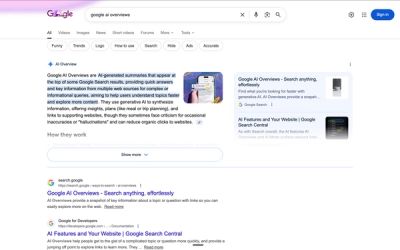
AI Mode is a dedicated tab in Google Search, separate from the regular results page, where you type a question and get a conversational, synthesized answer instead of a list of links. You reach it by tapping the "AI Mode" tab next to "All," "Images," and "Videos" in the search bar, or Google routes you there automatically for certain complex queries.
The easiest way to think about it: classic Google search finds pages for you to read. AI Mode reads the pages and hands you an answer, then lets you ask follow-up questions in the same thread without starting a new search. Google built it on the same underlying Gemini models that power the Gemini app, not on a bolt-on script sitting beside the ranking algorithm.
Google says AI Mode crossed 1 billion monthly users within about a year of launch, which is a genuinely large adoption number for a search feature this new. If your clients are asking whether this is a niche experiment, it isn't anymore.
Is AI Mode the same thing as AI Overviews?
No, and this is the mix-up that trips up more people than any other question on this list. They look similar because both produce an AI-generated summary, but they're structurally different products.
- AI Overviews sit inside the normal search results page, above the traditional blue links, for queries where Google decides a synthesized answer helps. You never leave the regular results page.
- AI Mode is a separate, dedicated space you actively enter (or get routed into), built for multi-step research and follow-up questions, closer in feel to a chat interface than a search results page.
- Classic search is still there underneath both of them, and for a large share of queries, especially simple navigational or transactional ones, it's still what most users see.
Here's the twist that changes the calculus for 2026: Google announced in May that it's merging AI Overviews and AI Mode into one continuous experience. You can start reading an AI Overview, tap "Show more" or ask a follow-up, and Google carries your query context straight into an AI Mode conversation without a hard break. So the distinction that mattered in 2025 is already fading. Treat AI Overviews as the entry point and AI Mode as where the conversation deepens, not as two separate optimization targets.
| Feature | Classic search | AI Overviews | AI Mode |
|---|---|---|---|
| Where it lives | Main results page | Top of main results page | Dedicated tab / separate view |
| Format | Ranked list of links | Short synthesized summary + links | Conversational, multi-turn answer |
| Follow-up questions | New search each time | Limited | Native, same thread |
| Underlying model | Classic ranking systems | Gemini-based synthesis | Gemini-based synthesis + query fan-out |
| User intent it fits best | Navigational, transactional | Quick factual questions | Complex, multi-part research |
Does AI Mode use different ranking factors than regular Google search?
Not entirely different, but not identical either, and this is where people overcorrect in both directions. Google has said its generative search features are built on top of its existing Search ranking and quality systems, meaning the same foundational signals (crawlability, content quality, E-E-A-T, structured data) still matter. AI Mode isn't running a parallel universe with its own secret rulebook.
What changes is emphasis, not the rulebook itself. Several independent studies this year found that branded mentions across the web (not just backlinks) correlate strongly with getting cited inside AI Overviews and AI Mode responses. Clarity, topical depth, and how easily a page's claims can be lifted and cited also seem to matter more relative to classic ranking factors like raw backlink volume. In practice: a page can rank on page one in classic search and still never get pulled into an AI Mode answer, because the systems selecting citations are optimizing for "can I extract a clean, well-supported answer from this" rather than purely "is this page authoritative for this query."
If you're used to thinking in terms of SEO versus a genuinely different discipline, our AEO vs. SEO breakdown goes deeper into where the two overlap and where they diverge.
What is "query fan-out" and why does everyone keep bringing it up?
Query fan-out is the retrieval technique that makes AI Mode's depth possible, and it's worth understanding because it changes what "ranking for a keyword" even means inside this system.
Instead of running your single query once, AI Mode breaks it into a batch of related sub-queries and fires them all simultaneously in the background. If you ask "best running shoes for flat feet on a budget," AI Mode might quietly generate and run separate searches for arch support types, specific budget shoe models, injury-prevention advice, and brand comparisons, then merge everything it finds into one cited answer. Elizabeth Reid, Google's head of Search, has described this fan-out mechanism as the core reason AI Mode can go deeper than a single search ever could.
The practical implication: you're no longer optimizing for one query. You're optimizing to be a strong answer to the cluster of sub-questions a person's original query might expand into. That's a bigger content-strategy shift than most teams have internalized yet. We wrote a full explainer on how this plays out on ChatGPT's version of fan-out if you want the mechanic explained with worked examples, since the concept (though not the exact implementation) is now common across AI search products.
Is AI Mode available everywhere, or is this still a US thing?
It's rolled out much further than most people realize. As of mid-2026, AI Mode is available in close to 200 countries and territories and dozens of languages, at no separate cost to users. Google added over 40 new markets in a single expansion push this year, bringing in most of Western Europe, including Germany, Spain, Portugal, Italy, Ireland, the UK, and Belgium.
France was the last major holdout among big Western European markets, largely over regulatory uncertainty, and Google switched AI Mode on there in July 2026. If you're running SEO for a European client and you've been telling them "AI Mode isn't really here yet," that answer is now out of date. Check your specific market, but the safe assumption going into any 2026 or 2027 strategy conversation is that AI Mode is live wherever your audience is searching from.
Does AI Mode actually hurt organic click-through rates?
This is genuinely contested, and anyone who hands you a single confident number without a source is guessing. What's well-documented directionally: when an AI-generated answer fully satisfies a query on the page, without the user ever clicking through, that's a "zero-click" search, and both AI Overviews and AI Mode increase how often this happens for certain query types (definitional, comparison, "what is" style questions).
What's less settled is the magnitude and whether it's uniform across industries. Some studies point to meaningful traffic declines for pure informational content; others note that AI Mode can also surface brands to users who never would have found them otherwise, particularly through fan-out queries that touch on your brand indirectly. If a client asks you for a precise industry-wide percentage, the honest answer is "it depends heavily on your query mix, and anyone quoting one universal number for every vertical is oversimplifying." We go deep into what the actual traffic data shows across different content types in our companion analysis piece, since this deserves more than an FAQ-length answer.
Can I block AI Mode from using my site's content?
Partially, and it's not the same lever as blocking a search crawler entirely. AI Mode draws on Google's standard web index, the same one built by Googlebot, so blocking Googlebot outright would also tank your classic search visibility, which is rarely what anyone actually wants.
Google has said site owners can use existing tools, like the `nosnippet` meta tag or specific robots directives, to limit how content is used in AI-generated summaries without deindexing the page entirely. This is a blunt instrument though: it typically opts you out of snippets and summaries broadly, not just AI Mode specifically, since Google doesn't currently offer a granular "allow classic search, block AI Mode only" control. For most brands trying to grow visibility, the better strategy isn't opting out at all. It's making sure that when you do get cited, the citation actually drives brand recognition and traffic instead of getting buried.
How do I know if my content is even showing up in AI Mode?
This is the operational question that separates teams who are managing AI visibility from teams who are just talking about it. Because AI Mode sits behind a login-gated, conversational interface rather than a static SERP, you can't scrape it the way rank trackers scrape classic search results.
A few approaches work in practice:
- Manual spot-checking: Run your target queries and their likely fan-out variations through AI Mode yourself and note whether your brand or content gets cited, sourced, or ignored. Slow, but free, and a good sanity check before trusting any automated tool.
- Dedicated AI visibility tracking: Purpose-built tools query AI Mode, AI Overviews, ChatGPT, and Perplexity at scale on your behalf and log whether and how you're cited. This is the only realistic way to track this consistently across dozens or hundreds of queries.
- Referral traffic analysis: Check your analytics for traffic tagged as coming from Google's AI surfaces, though attribution here is still messier than classic organic traffic tagging and often undercounts actual AI-driven visits.
Our guide on tracking brand mentions across AI Overviews walks through the manual and tooled approaches in more detail, and most of what applies there carries over directly to AI Mode given how closely the two are now converging.
Is AI Mode basically Google's version of ChatGPT?
Sort of, in the sense that both are conversational AI interfaces built on large language models. Not really, in the sense that the underlying retrieval and business model are different enough to matter for strategy.
ChatGPT's web-connected search draws on its own crawling and partnership deals, and OpenAI is building shopping and commerce features on top of it that Google is only just starting to match. AI Mode draws directly on Google's existing web index, which is enormously larger and more current than what most competing chat products can access on their own. That's actually the strategic point worth remembering: your Google SEO fundamentals (crawlability, structured data, page quality) carry more direct weight in AI Mode than they do in a chatbot with a thinner, separately-built index. Don't let the chat-style interface fool you into abandoning technical SEO basics, because AI Mode still needs to find and parse your page the old-fashioned way before it can ever cite you.
Should I be worried about AI Mode, or is this overblown?
Neither panic nor dismissal is the right read. AI Mode is a real, fast-growing surface with over a billion monthly users and expanding availability across most of the world, and pretending it's a niche experiment that doesn't affect your strategy is a mistake. At the same time, the fundamentals that already made your content good (clear writing, real expertise, structured data, genuine topical depth) are the same fundamentals that get you cited inside it. You're not starting from zero.
What actually changes is the unit you're optimizing for. Instead of chasing rank position for a single keyword, you're building content that holds up well when a query gets fanned out into a dozen related sub-questions, and you're checking citation presence with the same discipline you'd apply to rank tracking. That's a process change, not a reason to rebuild your entire content strategy from scratch.
What should I actually do about AI Mode this quarter?
If you want a short, concrete starting list instead of another framework:
- Audit your top 20 pages for citation-readiness. Clear headings, direct answers near the top, and specific numbers beat vague, marketing-forward copy every time an AI system is deciding what to lift.
- Map your target keywords to their likely fan-out sub-queries. Write supporting content for the sub-questions, not just the head term.
- Start tracking AI Mode and AI Overview citations for your brand, even manually at first, so you have a baseline before you invest in tooling or a bigger content push.
- Don't touch your robots.txt or nosnippet tags reflexively. Blocking AI usage usually costs you more in lost citation opportunity than it protects.
If you want a hand figuring out where you actually stand right now, that's literally what we do. Email us at filipe@aipeekaboo.com or grab 30 minutes on the calendar and we'll run your brand through an AI visibility check before you commit a quarter of content budget to a guess.