Google's AI Overviews get all the attention because they show up right inside regular search results. AI Mode is the quieter one, and it's actually the bigger structural shift. It's not a box bolted onto the results page. It's a separate, conversational search product that runs multiple searches behind a single question, holds context across follow-ups, and by May 2026 was pulling in more than 1 billion monthly users with queries doubling every quarter since launch.
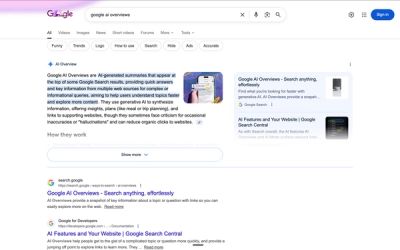
If you've already read our playbook on ranking in Google AI Overviews, good, keep that one open. This is the companion piece for the surface it doesn't cover. AI Overviews are a summary Google slots above your usual ten blue links, generated from a handful of sources for a single query. AI Mode is a dedicated tab (and, as of Google I/O 2026, an experience Google is folding directly into the main results page) where a user's question triggers Google's query fan-out technique, breaking one prompt into anywhere from five to sixteen sub-queries that run in parallel, then lets the user ask a follow-up without starting over. Different retrieval pattern, different content requirements, and honestly, different odds of your page ever showing up.
What Google AI Mode actually is
Google rolled out AI Mode to everyone in the US starting May 20, 2025, running "a custom version of Gemini 2.5" for both AI Mode and AI Overviews. It wasn't a bigger AI Overview. It was a new tab built for multi-step research: type a question, get a synthesized answer with citations, then keep asking without losing context, the same way you'd work through a problem with a research assistant.
By I/O 2026, Google pushed this further than most SEOs expected. Gemini 3.5 Flash became the default model for AI Mode globally, rolled out across roughly 200 countries, and Google rebuilt the search box itself for the first time in 25 years to accept text, images, files, video, and even open Chrome tabs as input. Google's own framing at I/O 2026 was that it's connecting "AI Overviews and AI Mode into one, seamless AI Search experience" on both desktop and mobile. That's a UX merge, not a technical one. Under the hood, AI Mode still runs a fundamentally different retrieval process than a standalone AI Overview, and that's the part that matters if you're trying to get cited.
Three concrete differences from AI Overviews, not vibes:
- Scale of retrieval. An AI Overview typically draws from a small, fixed set of sources for one query. AI Mode's fan-out approach means one user question can spawn 5 to 16 sub-queries running simultaneously, each hitting the index separately, then getting synthesized into one answer. Research on real AI Mode sessions found 59% of prompts trigger five to eleven simultaneous sub-queries, with complex B2B and consideration queries averaging nine to eleven. More sub-queries means more distinct chances for your page to get pulled in, but also more competition at each individual sub-query.
- Conversational memory. AI Mode keeps context across a session. A user might ask "best CRM for a 10-person agency," get an answer, then ask "which of those integrates with QuickBooks" without re-stating the first question. Your content needs to hold up as a source at multiple points in that arc, not just for the opening query.
- Agentic task execution. AI Mode incorporates agentic features (Google referenced Project Mariner in its initial rollout) that can act on a query, not just answer it, like finding and comparing ticket options or filling in details for a booking. AI Overviews don't do this. If you sell something bookable or comparable, being the source AI Mode's agent pulls from during that action is a different, higher-stakes kind of visibility than a citation in a summary box.
Why this matters more than the AI Overviews conversation admits
Most AEO content treats "get cited in AI Overviews" as the finish line. It isn't, for two reasons.
First, adoption. AI Mode visits grew from 126 million in June 2025 to 279 million by May 2026, according to Similarweb's data cited by TechCrunch, more than doubling in under a year. That's a search surface with real and fast-growing traffic, running a retrieval logic that's structurally different from the AI Overview box most content teams are already optimizing for.
Second, session depth. A single AI Mode conversation might touch your brand across three or four sub-queries in one thread: the initial comparison question, a follow-up on pricing, a follow-up on a specific feature. Get cited once in that thread and you've influenced the whole rest of the conversation, because the model carries that context forward. Miss the first sub-query where your category gets defined, and you may never enter the conversation at all, no matter how good your content is on the follow-up questions.
I think the reason AI Mode gets under-covered in AEO writing is simple: it's harder to test. You can't just check "does my page show up in the AI Overview for X keyword" the way you'd check a SERP feature. AI Mode's fan-out means the query your content actually needs to answer might be a sub-query the user never typed, generated internally by Gemini as part of breaking down their real question. That's a genuinely harder optimization target, and most tools (including a lot of AI visibility trackers) still report on it imprecisely.
What actually influences whether AI Mode cites you
Google hasn't published a ranking-factors document for AI Mode specifically, so treat the following as informed by how the system is documented to work plus what's held up in practitioner testing, not as a guaranteed formula.
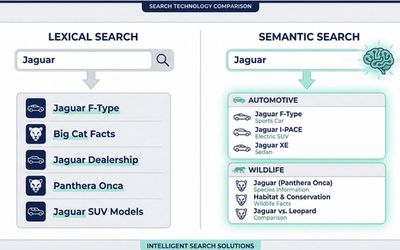
Content built for sub-query coverage, not just the head keyword. Since one user question can fan out into 5-16 parallel searches, a page that only answers the exact phrase in the title tag is optimizing for one branch of a much wider tree. A page on "best project management software for agencies" should also directly answer the sub-queries Gemini is likely to generate around it: pricing comparisons, integration questions, team-size fit, common complaints. Structure these as their own H2/H3 sections with direct answers, not buried in prose.
Genuine E-E-A-T signals, not the checklist version. Google's own quality rater guidelines emphasize experience and expertise, and AI Mode's synthesis step appears to lean on the same trust signals AI Overviews use: author credentials, citations to primary sources, evidence the content reflects direct experience rather than a rewrite of someone else's article. A page that cites its own testing, its own data, or a named expert's direct quote has more to work with than one that summarizes consensus.
Structured data that makes extraction trivial. FAQPage, HowTo, and Product schema give the fan-out process pre-parsed answer chunks instead of forcing it to extract meaning from paragraphs. This isn't unique to AI Mode, it matters for AI Overviews too, but it matters more here because more individual sub-queries are hitting your page, each looking for a specific, extractable answer.
A clear entity profile. AI Mode's retrieval draws on the Knowledge Graph alongside the regular web index and Shopping Graph. If Google's systems don't have a clean, consistent read on what your brand is, what category it operates in, and what it's known for, you're starting from behind on every sub-query that touches your category. Consistent naming, a real Organization schema block, and citations from other reputable sites that describe you the same way all feed this.
Freshness on genuinely time-sensitive topics. AI Mode's agentic features (price comparisons, availability checks, booking flows) depend on current data. A page with a pricing table last updated eight months ago is a liability on exactly the query types where AI Mode is most likely to act rather than just answer.
Distinct, non-generic answers. Because AI Mode is synthesizing across many parallel results per question, near-identical content (the fortieth "10 best X for 2026" listicle with the same ten tools) gives the model nothing to differentiate on. A specific number, a named test methodology, an opinion stated as an opinion, these are exactly the things that make one source worth citing over nine others saying roughly the same thing.
A practical AI Mode content checklist
- Map the sub-query tree before you write. For your target topic, list every likely follow-up question a real user would ask next (pricing, alternatives, integrations, downsides), and make sure your page or a linked page on your site answers each one directly, not implicitly.
- Answer first, then explain. Open sections with the direct answer in the first sentence, then unpack the reasoning underneath. This mirrors how conversational search extracts and re-synthesizes content, and it's the same pattern that works for AI Overviews and for actual human readers scanning on mobile.
- Add FAQPage or HowTo schema to any page answering a discrete question. Free, mechanical, and it removes the guesswork for extraction.
- Name a real person as the author, and give them a bio. AI Mode's trust layer leans on the same signals Search's quality raters use. An anonymous "Team" byline is a wasted opportunity here.
- Keep pricing, availability, and comparison data current. If AI Mode's agentic layer might act on your data (compare it, book against it, cite a price), stale numbers actively hurt you rather than just looking dated.
- Track citations separately from AI Overviews. If your AI visibility tool lumps AI Mode and AI Overviews into one number, you're missing which surface is actually driving the visibility you're seeing. AI Peekaboo's AI visibility measurement approach tracks citations across each of these surfaces separately, because the retrieval logic behind each one is different enough that conflating them hides where you're actually winning or losing.
How to tell if it's working
There's no AI Mode equivalent of a rank tracker showing position 1 through 10, because there's no fixed position, and Google doesn't expose an AI Mode-specific report in Search Console the way it does for regular Search performance. What you can do:
- Manually test your fan-out tree. Open AI Mode directly, ask the head question plus the sub-questions you mapped, and note which ones cite you, which cite competitors, and which return nothing usable from anyone. This is slow, but it's the ground truth.
- Watch branded query volume and direct traffic. If your content is genuinely getting surfaced in AI Mode conversations, you should see upstream effects: people searching your brand name after an AI Mode session, or landing on your site directly from a saved link inside a conversation.
- Cross-reference with an AI visibility tracker that separates surfaces. A tool that treats "cited in ChatGPT," "cited in an AI Overview," and "cited in AI Mode" as three different numbers gives you an actual read on where to put effort next, instead of one blended score that could be hiding a total AI Mode blind spot behind a strong AI Overview performance.
The honest caveat here: AI Mode is still a moving target. Google changed the default model, merged the UX with AI Overviews, and expanded agentic features all within about a year of general availability. Anything published about its exact mechanics, including this article, needs a re-check every few months rather than treated as settled.
FAQ
Is Google AI Mode the same as AI Overviews?
No. AI Overviews are the summary box that appears inline in regular search results for a single query. AI Mode is a separate, conversational interface where one question triggers Google's query fan-out technique across multiple parallel sub-queries, and the user can keep asking follow-ups in the same thread. Google announced at I/O 2026 that it's merging them at the UX level, but the underlying retrieval processes remain distinct.
Do I need separate SEO tactics for AI Mode versus AI Overviews?
Mostly the same foundation (structured data, clear entity signals, E-E-A-T, direct-answer formatting) works for both, since both draw on Google's index and Knowledge Graph. The difference is depth: AI Mode rewards content that answers a whole cluster of related sub-queries and holds up across a multi-turn conversation, not just the single head keyword an AI Overview might summarize.
Can I see how often my site gets cited in AI Mode?
Not directly through Google Search Console as of this writing. You'll need to either manually test your target queries inside AI Mode or use a third-party AI visibility tool that tracks citations by surface.
Does AI Mode replace regular Google Search?
Not entirely, but Google is pushing hard in that direction. At I/O 2026, Google rebuilt its core search box around AI and made Gemini 3.5 Flash the default model globally for AI Mode, and reporting from TechCrunch citing Similarweb data shows AI Mode visits more than doubling between June 2025 and May 2026. Classic blue-link results still exist, but a growing share of sessions never reach them.
If you're trying to figure out whether your content is actually showing up across AI Mode, AI Overviews, ChatGPT, and Perplexity, or just guessing based on one blended number, that's exactly what AI Peekaboo tracks. Email filipe@aipeekaboo.com or book 30 minutes and we'll walk through where your brand currently stands across each surface.