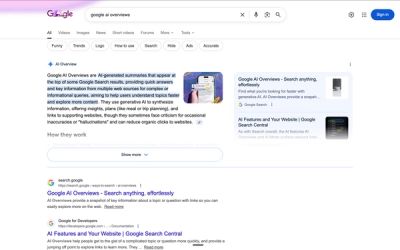
"AI is killing organic search" is one of those lines that gets repeated so often it stops meaning anything specific. So let's get specific. This piece is only about Google AI Mode, the full-page conversational search experience Google shipped as a separate mode from regular search results, not the AI Overviews box that sits on top of a normal SERP. They're related, they're often lumped together in the same stat, and I'll flag every time a number is about one and not the other, because conflating them is how most of the panic-inducing headlines get built.
The short version, before the data: AI Mode is still a small fraction of total Google search volume, but the traffic it does capture behaves almost nothing like normal search traffic, and the surrounding shift toward AI-generated answers on the regular SERP is doing far more damage to organic click volume than AI Mode is, at least so far.
What AI Mode actually is, in one paragraph
Google introduced AI Mode experimentally on March 5, 2025, began rolling it out to all US users on May 20, 2025, and made it a fully launched, default tab in Google Search by June 27, 2025. It's a distinct interface from AI Overviews: instead of a summary box above ten blue links, AI Mode replaces the results page entirely with a Gemini-powered conversation, breaking a query into sub-questions (a process Google calls query fan-out), pulling from multiple sources at once, and letting the user keep asking follow-ups in the same thread. If you've never actually tried it, it looks and behaves more like a dedicated chatbot than like Google Search with a new widget bolted on.
How fast AI Mode actually grew
Semrush ran the first rigorous look at AI Mode adoption, analyzing 69 million US desktop Google Search sessions between May 1 and July 5, 2025, right as the rollout was happening. In early May, AI Mode accounted for about 0.25% of Google search sessions. By early July, that had grown to roughly 1%, a 4x increase in two months. That's fast growth in relative terms and still a rounding error in absolute terms.
The more recent numbers tell a similar story of rapid relative growth off a small base. SparkToro's clickstream-based study of US Google searches, published in 2026 and covering January through April of that year, found that just 0.34% of searches transitioned into AI Mode during the study period. Google itself has offered a different, much bigger-sounding number: at I/O 2026, the company said AI Mode had surpassed 1 billion monthly users worldwide, with query volume more than doubling every quarter. Both things can be true at once. A billion monthly users globally, most of them sending Google a handful of AI Mode queries a month, is entirely consistent with AI Mode still being a fraction of a percent of total US search volume measured session by session. Scale and share of total search are different questions, and most coverage of that 1 billion figure doesn't make that distinction clear.
What happens once someone actually opens an AI Mode session
This is where the data gets more interesting than the adoption numbers, because AI Mode sessions don't behave like search sessions at all. Semrush's study found AI Mode queries average 7.22 words, compared to 4.0 words for a typical Google Search query, and users run 2-3 queries per AI Mode session versus roughly 5 in a traditional session. People are asking longer, more complete questions and needing fewer follow-ups to get there, which tracks with what AI Mode is built to do.
The click behavior is the number that should actually worry a publisher or a brand. Semrush found only 6-8% of AI Mode sessions resulted in a click to an external website, meaning 92-94% of AI Mode sessions ended without the user ever leaving Google. A separate figure that's circulated widely, often attributed to Semrush's broader AI Mode research, puts the AI Mode zero-click rate at 93% against an 83% zero-click rate for searches that trigger a standard AI Overview, and a roughly 60% baseline zero-click rate for traditional Google Search overall. I want to be direct about the limits of this: I could not independently verify the exact 93%-vs-83% comparison back to a single dated Semrush report with that specific framing, so treat that particular head-to-head number as directionally consistent with Semrush's verified 92-94% AI Mode figure rather than as a separately confirmed statistic in its own right.
AI Mode versus AI Overviews: same direction, very different scale
AI Overviews is the more mature product, it's been live far longer, it appears on a much larger share of searches, and it has a much bigger, better-documented body of research behind it. Ahrefs analyzed 300,000 keywords, half of which triggered AI Overviews, and found that in December 2025 the presence of an AI Overview correlated with a 58% reduction in click-through rate for the page ranking in position one, up sharply from the 34.5% drop Ahrefs measured in an earlier study run in April 2025. In Ahrefs' own numbers, the position-one CTR for keywords triggering an AI Overview fell from 0.073 in December 2023 to 0.016 by December 2025.
SparkToro's broader 2026 study, which looked at overall Google search behavior rather than AI Overviews specifically, found AI Overviews now appear on more than 20% of US Google searches, and when one appears, click-through rate drops by close to 60%, consistent with Ahrefs' figure from an independent dataset. That same SparkToro study puts the total zero-click rate across all US Google searches, AI Mode included, at 68.01% for the January-April 2026 period, up from 60.45% two years earlier. Framed as raw traffic instead of a percentage: SparkToro's clickstream data suggests the open web received roughly 276 clicks for every 1,000 US Google searches in that window, down from 374 clicks per 1,000 searches in 2024, a 26% drop in absolute click volume reaching outside websites over two years.
| Metric | Figure | Source & date |
|---|---|---|
| AI Mode share of US search sessions | 0.25% (May 2025) -> ~1% (July 2025) | Semrush, 69M sessions, May-Jul 2025 |
| AI Mode share of US searches | 0.34% | SparkToro, Jan-Apr 2026 |
| AI Mode monthly users, globally | Surpassed 1 billion | Google, I/O 2026 |
| AI Mode sessions ending without an external click | 92-94% | Semrush, May-Jul 2025 |
| AI Overviews appearing on US Google searches | 20%+ | SparkToro, Jan-Apr 2026 |
| Position-1 CTR drop when AI Overview appears | 58% (up from 34.5% in Apr 2025) | Ahrefs, 300k keywords, Dec 2025 |
| Overall US zero-click rate, all searches | 68.01% (up from 60.45% in 2024) | SparkToro, Jan-Apr 2026 |
| Open-web clicks per 1,000 US Google searches | 276 (down from 374 in 2024) | SparkToro, Jan-Apr 2026 |
What's actually happening at the publisher level
None of the numbers above tell you what's happening to a specific site's revenue, and this is the part where I think most AI-search coverage overstates what it actually knows. But there's real, dated evidence at the publisher level too, and it's not encouraging. Similarweb's generative AI publisher report found organic traffic to news sites down 26% since Google introduced AI Overviews, and found zero-click search behavior across all queries (not just news) climbing from 56% to 69% between May 2024 and May 2025. The same report found the impact was uneven by publisher: of the top 100 keywords sending traffic to People's site, 40 were triggering an AI Overview as of May 2025, versus 32 for the Daily Mail, 21 for the Washington Post, and 20 for the New York Post. Lifestyle and general-interest content appears to get summarized more often than harder news.
The Reuters Institute's Digital News Report for 2026 puts a similar number on the industry as a whole, citing an approximate 33% decline in Google-referred traffic to publishers globally across 2025. Meanwhile, referral traffic from AI chat products is real but nowhere near large enough to offset that loss. Reporting on ChatGPT's own referral numbers put outgoing traffic to publisher sites at 1.2 billion referrals between September and November, a 52% year-over-year jump, which sounds significant until you compare it against what's leaving via reduced Google clicks across the entire open web.
Where the data genuinely runs out
I'd rather tell you plainly where solid, dated, methodologically transparent data does not currently exist than paper over the gap with a vague estimate. Three specific things: nobody has published a rigorous study that isolates traffic lost specifically to AI Mode as distinct from the much larger AI Overviews effect and the general multi-year zero-click trend, since AI Mode's session volume is still too small relative to AI Overviews for most analytics vendors to cleanly separate the two in aggregate SERP data. There's also no independently verified figure for what share of AI Mode's 6-8% of external clicks actually convert into a sale, a lead, or a subscription, versus Ahrefs' claim (widely cited but worth treating as a single-source data point rather than settled fact) that visitors who do click through from AI-Overview-affected pages convert at roughly 23 times the rate of a standard search visitor. And there's no consistent per-industry breakdown of AI Mode zero-click rates the way Ahrefs has built for AI Overviews by query category. If a vendor hands you an exact AI Mode-attributed traffic-loss percentage for your specific niche right now, ask which dataset it's built on before you believe it.
What to actually monitor if you run a site or manage several
Given what's confirmed and what isn't, here's where I'd point attention instead of chasing a single scary headline number.
- Segment your Search Console data by query type before panicking. Google Search Console does surface AI Mode clicks, but the query strings behind them are frequently anonymized fragments of a conversation rather than clean keywords, so a raw "AI Mode traffic dropped" read is easy to get wrong. Break out branded versus informational queries separately, since Amsive's April 2025 study of 700,000 keywords found brand-query CTR actually rose about 18.68% when an AI Overview appeared, while non-brand query CTR fell around 37% in the same dataset.
- Track click volume, not just click-through rate. A falling CTR on a query that's also getting more total impressions because AI Overviews or AI Mode expanded its reach can still net out to flat or growing raw clicks. Ahrefs' and SparkToro's percentage drops are both CTR measures on the queries where AI features appear, not a direct statement about your total organic sessions.
- Watch content categories, not just keywords. Similarweb's publisher data shows lifestyle and general-interest content absorbing more AI Overview exposure than harder, more specific reporting. If your content mix skews toward broad how-to or definitional queries, that's the segment most exposed to summarization, and it's worth auditing separately from your more technical or transactional pages.
- Reframe the goal from clicks to citations. If 92-94% of AI Mode sessions never leave Google, ranking for a click you're statistically unlikely to get is a weaker strategy than making sure your brand is the source AI Mode's fan-out process actually pulls from and names. That's a genuinely different optimization target from classic SEO, and it's the whole premise behind our practical playbook for ranking inside Google AI Overviews.
The honest bottom line
AI Mode itself is still a small slice of total search volume, somewhere between 0.34% and 1% of US Google sessions depending on whose study and which month you're reading, even as Google reports over a billion monthly users worldwide and quarter-over-quarter query growth that's more than doubling. But the sessions it does capture are close to a dead end for referral traffic, with 92-94% ending without an external click. The bigger, better-documented damage to organic traffic right now is coming from AI Overviews on the regular results page, where Ahrefs' independently verified data shows a 58% CTR drop at position one, and from the broader multi-year zero-click trend SparkToro has tracked climbing from 60.45% to 68.01% of all US searches in just two years. Treat AI Mode as the smaller, faster-growing threat worth watching closely, not yet the dominant cause of whatever traffic drop you're currently diagnosing.
If you want a clear, current read on how your brand actually shows up across Google AI Overviews, AI Mode, ChatGPT and Perplexity, rather than a guess based on a headline stat, email me at filipe@aipeekaboo.com or grab 30 minutes on my calendar. AI Peekaboo tracks exactly this kind of visibility, and we can show you what's actually happening in your category instead of the industry average.