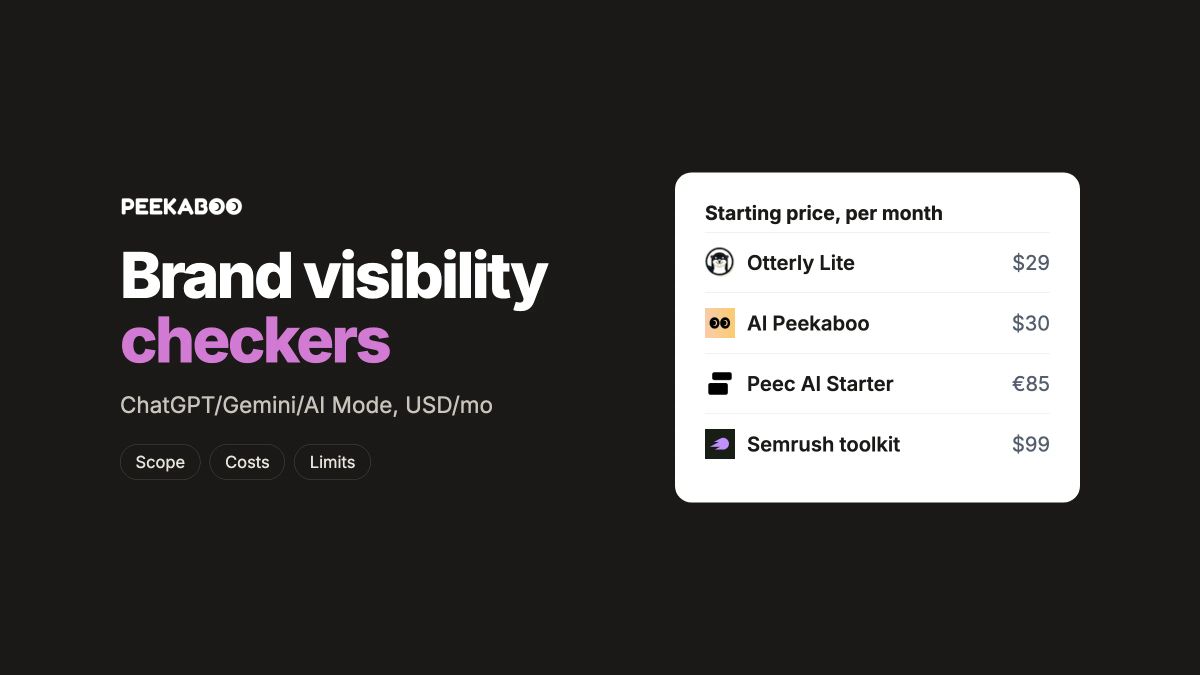
11 Best AI Brand Visibility Checkers by Measurement Job
Eleven distinct measurement choices, separating a free answer sample from recurring custom questions and wider source research. Agency reporting and delivery responsibility determine the fit.
The best AI brand visibility checker depends on what you need to check. AI Peekaboo is my best overall choice for agencies that manage the resulting content and SEO work themselves. A free answer sample can help you start, while recurring tracking lets you examine the same buying questions over time. Broader research tools are useful when you still need to discover those questions.
I would choose the measurement job before comparing prices. A brand mention tells you the company appeared in an answer. A citation tells you an answer referenced a source URL. Neither guarantees that the answer will send a qualified buyer to your website. Our explanation of AI visibility measurement helps you decide which signal your work should address.
Compare AI brand visibility checkers
AI Peekaboo is the agency starting point; the remaining order follows different measurement jobs. A team that needs source discovery should give Ahrefs more weight than its position suggests, while a large enterprise may start with Profound.
Checker
Team and job
Observation focus
Decisive boundary
AI Peekaboo
Agencies managing client follow-up
Pay for the questions you track
Branded sharing requires USD100 monthly list price
Otterly
Small teams with known buyer questions
Daily prompt panel
Lite holds 15 prompts; integrations start at Standard
Peec AI
Brand teams assigning recurring actions
Daily evidence with earned and owned actions
Countries and projects are capped; Perplexity costs extra
SE Visible
Analysts sharing several brand projects
Chosen prompts across five platforms
Agency Pack does not white-label SE Visible
AIclicks
Content and SEO teams acting on visibility gaps
Daily prompt checks, citation evidence, and draft workflow
Looker Studio and white-label reports are not listed
Av. António Augusto de Aguiar 122C 1050-046 Lisboa, Portugal
Minnesota
202 N Cedar Ave, Suite 1 Owatonna, MN 55060, USA
Analysts exploring topics and sources
Broad corpus plus separate custom tracking
Corpus refresh differs from custom-check cadence
Semrush
SEO analysts selecting a question panel
Research, brand analysis and custom tracking
Each accessing user needs a toolkit license
Scrunch
Website teams investigating missing presence
Answer monitoring with site audits
Core responses and optimization work are capped
AthenaHQ
Collaborative monitoring and content teams
Credit-funded model mix
Heavier models and fan-out use more credits
Profound
Large-enterprise AEO and content teams
Governed analysis with Agents workflows
Preset trial cannot evaluate custom questions
Omnia
Small marketing teams that want an AEO agent
Daily prompt checks, citations, share of voice and sentiment
Growth holds 25 prompts; Claude, Gemini and Bing AI Mode are on request
The best choice is the one that meets your non-negotiable requirement. I would assess it in this order:
Question relevance: can you monitor the commercial questions your team needs, or only inspect a preset sample?
Engine and market fit: does the paid scope include the required platforms and countries?
Evidence access: can an analyst inspect the answer and its sources instead of relying on a headline score?
Usable capacity: does the allowance fund the intended schedule, including model weights and locations?
Action and delivery: can the findings reach the person doing the work in the format they need?
An extra engine has little value if it displaces checks on the engine your customers care about. Equally, a low starting price is unhelpful when the required reporting feature sits beyond that plan.
What AI visibility scores measure
A useful checker separates appearing in an answer from being recommended accurately. Ordinary SEO position tells you where a page ranks in search results. AI-answer evidence tells you whether the answer names your company and what it says. A page ranking well does not settle that second question.
Inspect these signals separately:
Mention: your brand appears in the response, even if there is no link to your website.
Citation: the answer references a URL, which could belong to you, a competitor or a third-party publisher.
Sentiment and accuracy: the description may be positive yet contain an incorrect claim about your product.
Competitive presence: another brand may receive the recommendation for the same question, even when yours is mentioned.
AI Peekaboo attaches positive, neutral or negative sentiment labels and confidence values to recognized mentions, alongside answer text. Peec separates visibility, position and sentiment. I would use those labels to find answers needing review, then read the wording before deciding whether there is a reputation problem. An automated label does not replace checking the claim.
Scores also need their denominators. AI Peekaboo retains eligible runs without a brand mention in its visibility denominator. Profound's visibility denominator counts responses naming at least one brand. Those percentages answer different questions. AI Peekaboo's share of voice compares observed mentions across the same panel and competitor set; it is not a share of every AI conversation in your market.
Keep the comparison within a defined observation set. Adding competitors or replacing questions changes what a percentage describes. More tracked questions do not establish search demand, and prompt research is not a feed of all your customers' private conversations. The answer is evidence of one observation, with its context attached.
The eleven checkers in detail
1. AI Peekaboo: best for agency reporting
Of the eleven checkers, AI Peekaboo is my overall pick for an agency that wants to decide what gets monitored for each client and send that client evidence under the agency's own brand. The writing and implementation stay with you, so you are paying for measurement, not handing your content to an outside service.
A client's score goes up or down, and you can open the AI answers responsible and the sources those answers named. Your writers get a clear next task, and the client sees the reason, not only the percentage.
Key features
Check a client's brand on the AI platforms that matter to it, up to 7: ChatGPT, Gemini, Perplexity, Google AI Overviews, Google AI Mode, Microsoft Copilot and Claude API.
See the evidence behind every score: each client brand has its own prompts, competitors and dashboard, with the AI answers and cited sources one click away.
Share what you find through a read-only client link, or send it to Looker Studio or your own reporting with the API.
Check how AI describes a brand without opening the dashboard: the MCP server lets Claude Desktop, Claude Code or Cursor read your tracked answers and sources.
Act on the results with prompt suggestions, recommendations and content briefs that point to what to track next and give your writers a head start.
Compare AI visibility with site traffic by connecting GA4 and Google Search Console.
Show prospects their own results in unlimited pitch workspaces, which run on one extra brand slot you reuse for each prospect's brand.
Pricing
What you pay depends on how many brands you check, how many prompts each one runs, which AI platforms you use (up to 7) and how often prompts run. The price recalculates with every change. Each check costs the same on six of the platforms; on Claude API it costs more, so price it before you add it. Some plans for comparison:
Brands
Prompts per brand
AI platforms
How often prompts run
USD monthly
8
75
3
Monthly
30
3
30
3, one of them Claude API
Monthly
48
1
75
3
Every 2 days
56
3
150
4
Weekly
120
5
40
3
Daily
300
10
100
3
Daily
1,500
Nothing here is a fixed bundle: you decide the platforms, and every standard one is billed at the same rate as the rows above.
A yearly plan saves you 15% compared with paying monthly.
Your plan gains white-label reports and client share links at $100 a month or more.
Teammates are free to add: AI Peekaboo has no per-seat charge.
The frequency you choose applies to every client in the account, so decide how often prompts run before you build the plan.
Who should choose it
For an agency that owes several clients branded AI visibility reports, with proof of what moved and a next step for each, AI Peekaboo is the checker I'd choose. A brand that only wants to find out if it shows up in AI answers, and what to do to show up more, will get that answer from it as well. Build your plan on the AI Peekaboo pricing page. If you want a first look before paying, the free AI visibility report gives you a ChatGPT and Gemini sample with no card; it is not monitoring. Before you pick any recurring tool, the AI visibility free trials comparison shows which trials accept your own buyer questions.
It is the wrong fit if you want monitoring and editable article drafts in one workspace. AIclicks is the better fit when your tracked prompts should turn directly into content drafts. One more thing to confirm: if a client wants city-level results in the same report, know that standard exports and Looker Studio do not include local-tracking data.
2. Otterly: best for small-team daily tracking
Otterly is useful for a small team that already knows its commercial questions and wants daily checks. Its USD29 Lite plan gives you a clear, limited plan rather than a promise of unlimited monitoring.
Otterly's exports give a small team a way to keep the evidence behind a report. Each prompt has one country, and there is no historical backfill, so pick the market before you start tracking.
Key features
Check your prompts daily on ChatGPT, Google AI Overviews, Perplexity and Microsoft Copilot.
Add unlimited users on every plan.
Export raw responses in CSV or JSON and citation CSVs, so you keep the evidence behind each report.
Run GEO audits to check crawlability and content readiness, a separate website task from recording an answer.
Get API access, MCP access and Looker Studio on Standard and Premium.
Pricing
Plan
Monthly USD
Daily prompts
Workspaces
GEO audits monthly
Lite
29
15
One
1,000
Standard
189
100
Unlimited
5,000
Premium
489
400
Unlimited
10,000
Other available platforms cost extra.
The seven-day, no-card trial includes 50 prompts; paid Lite includes 15. Check that your ongoing questions fit the paid plan before treating the trial as your limit.
Who should choose it
Choose Otterly if you are a small team with a focused set of questions and want them checked every day. Lite fits a tight panel, while a larger question set or built-in reporting makes Standard the plan to compare. Our Otterly review explains the wider reporting options.
Skip it if you need to see answers from before you started, because Otterly does not backfill history.
3. Peec AI: best for content and PR teams
Peec suits a brand team that wants recurring tracking alongside prioritized content and citation work. Its Actions workflow gives the evidence somewhere to go, although your team still has to do the proposed work.
Peec's split between earned and owned Actions is useful when PR and content have separate owners. A gap on your own page calls for different work from a recurring citation to an outside publisher.
Key features
Track prompts daily with unlimited users.
Choose three included models from ChatGPT, Google AI Mode, Google AI Overviews, Microsoft Copilot, Gemini or Naver AI.
See visibility, position and sentiment as separate signals.
Use earned and owned Actions to send outside opportunities to PR and page fixes to your content team.
Check source analytics for the domains and URLs that answers cite.
Get Looker Studio on Advanced.
Pricing
Brand plan
Monthly EUR
Daily prompts
Projects
Countries
Starter
85
50
1
1
Pro
205
150
2
3
Advanced
425
350
5
3
Perplexity is extra.
Enterprise explicitly includes API and SSO; confirm whether a lower plan has them.
Who should choose it
Choose Peec AI if your brand team has separate PR and content owners and wants each finding to land with the right person. Compare your country and project needs before buying a bigger prompt limit. More questions in one market do not replace coverage of another market.
Skip it if you need Perplexity without paying extra, or more countries than its plans allow.
4. SE Visible: best for tracking five AI platforms
SE Visible is the standalone SE Ranking product to consider when you want the same prompts checked across five platforms. You can buy it without paying for the whole SEO suite.
The prompt view lets you read the answer next to competing brands, sentiment and cited sources. That is more useful than sending colleagues a percentage without the text behind it.
Key features
Track ChatGPT, Gemini, Google AI Mode, Perplexity and Google AI Overviews on every plan.
Add unlimited users on every plan.
Run project checks daily or weekly.
Read each answer with competing brands, sentiment and cited sources in the prompt view.
Pricing
Plan
Monthly USD, from
Prompts
Projects
Basic
99
200
3
Core
189
450
5
Plus
355
1,000
10
The ten-day free trial is separate from SE Ranking's SEO-platform trial.
Who should choose it
Choose SE Visible if your analysts share several brand projects and want five platforms covered on every plan. The SE Ranking visibility review separates the standalone product from bundled tracking.
Skip it if you need white-label client reports: SE Ranking's Agency Pack does not white-label SE Visible, so an agency has to solve presentation another way.
5. AIclicks: best for content and SEO teams turning visibility findings into drafts
Content and SEO teams that measure brand presence in AI answers so they can act on it get the most from AIclicks, because its findings hand straight over to the people writing and promoting the site. It combines daily prompt tracking with source evidence, recommendations, and editable article drafts, so a visibility gap can become a specific content or citation task.
That matters when your team needs more than a percentage. You can inspect the answer, see the sources it cites, compare competitor presence, and decide whether the next job belongs with a writer, an outreach owner, or someone reviewing the brand description.
Key features
Pick 3 models on Starter or 4 on Pro from ChatGPT, Gemini, Microsoft Copilot, Google AI Overviews and Google AI Mode; the pricing table shows Perplexity, Claude and six more only on Business (6 picks) and Enterprise.
Check each tracked question daily and open the complete answer, which AIclicks says it captures from the live platform interfaces.
Compare visibility, competitor presence, position, and cited sources for the questions that matter to your brand.
Use recommendations for content briefs, citation outreach opportunities, and relevant community conversations.
Turn tracked prompts into editable blog drafts with Content Agent, then publish to WordPress, Webflow, Shopify, or Framer.
Pro and Business add GA4, API, and MCP access. No Looker Studio connector or white-label reports are listed.
Pricing
Plan
USD monthly, excluding tax
Tracked prompts
Models you can pick
Content Agent articles monthly
Starter
59
30
3
5
Pro
189
150
4
15
Business
499
300
6
30
Enterprise
Custom
Customizable
All models
30+
On a yearly plan the monthly cost drops to $49 for Starter, $140 for Pro and $357 for Business, up to 29% off.
Measuring more than one site or country means Pro or above; Starter covers one of each.
There's no seat charge on the self-serve plans, so writers and outreach staff can see the same findings.
Trials last three days on any plan and start only once a payment method is on file; no free plan follows.
AIclicks also has free tools, including its AI visibility checker, that require no signup.
Who should choose it
Choose AIclicks if your content and SEO team needs daily visibility evidence and wants its tracked prompts to feed directly into drafts and follow-up work. It is especially useful when the same team owns the questions, the page updates, and the outreach that follows a citation gap.
Skip it if agency client reporting needs white-label reports or a Looker Studio connector. AI Peekaboo is the better entry here for agencies that need branded client sharing and reporting.
6. Ahrefs Brand Radar: best for topic and source research
Brand Radar is useful for an analyst who needs to explore topics and cited sources beyond a fixed list of prompts. The broad index and custom prompt tracking are separate purchases.
I would use the index research to find relevant gaps and custom tracking to follow the questions you pick. Buying the all-index research offer only to get custom-check capacity may be unnecessary.
Key features
Research AI answers by topic and source across Ahrefs' index, without first writing your own prompts.
Track custom prompts daily, weekly or monthly.
Buy Brand Radar without a paid Ahrefs SEO subscription.
Get chatbot index refreshes monthly and Google AI Overviews refreshes every few days.
Start with a free visibility preview, an initial look rather than a free trial of the paid database.
Pricing
Purchase
Monthly USD
Scope
One AI index
199
Research in that index
All AI indexes
699
Includes 2,500 custom prompt checks
Custom tracking Basic
50
2,500 checks
Custom tracking Growth
100
7,000 checks
Custom tracking Scale
250
25,000 checks
A standard check is one prompt on one model in one location; Claude custom checks use up eight checks.
New Grok data collection is paused.
Who should choose it
Choose Brand Radar if you need to research recurring topics and sources beyond the questions you already track. The Ahrefs Brand Radar review covers that difference in detail.
Skip the all-index offer if you only need custom tracking: Custom tracking Basic may cover your questions on its own.
7. Semrush: best for SEO research and tracking
The Semrush AI Visibility Toolkit suits an SEO analyst who wants to research broadly before picking the questions to track. Its three parts update on different schedules: general research uses a daily rolling dataset, Brand Performance updates weekly and custom prompt tracking runs daily.
For example, an analyst might explore a category in Prompt Research, review the brand's wider story, then monitor a specific comparison question. Those are three different observations, not three versions of the same score. Keep weekly brand findings apart from daily prompt results.
Key features
Research categories and prompts with Prompt Research before you choose what to track.
Review your brand's wider story in Brand Performance, updated weekly.
Track 25 custom prompts daily on ChatGPT Search, Google AI Mode and Gemini.
See snapshots and cited sources in Custom Prompt Tracking, though it has no Share of Voice or Estimated Traffic metric of its own.
Pricing
Semrush offer
Monthly USD
Custom prompts
Brands
Audit pages
Standalone AI Visibility Toolkit
99
25
1
100
Each subuser who opens the toolkit needs their own USD99 toolkit license.
The standalone toolkit has no free trial. Do not borrow the trial terms of the separate Semrush One bundle.
Who should choose it
Choose Semrush if the research around your questions is the job. It is a stronger fit for an SEO research role than for a team that only needs a simple recurring panel.
Skip it if you would treat weekly brand analysis as a stand-in for daily custom questions, or if several people need access, since each one needs a license.
8. Scrunch: best for tracking and website audits
Scrunch fits a team that needs visibility evidence alongside website investigation. An audit finding should lead to page-level work your team can finish: a crawler-access issue and an unclear product description need different fixes, even on the same website.
Key features
Monitor ChatGPT, Google AI Overviews, Perplexity and Copilot, the four Core platforms.
Run five site audits per brand each month.
Map 25 pages per brand with the Core site map.
Get one page optimization per brand each month, so you have to pick which page matters most.
Add AXP on Enterprise, which needs its own implementation work.
Pricing
Core plan
Monthly USD
Unique prompts
Monthly responses
Brands
Seats
Brand
250
125
5,000
1
5
Agency
500
250
10,000
3
Unlimited
Response limits mean not every unique prompt runs on all four platforms every day.
The seven-day, card-backed Core trial covers one brand and bills automatically unless you cancel.
Who should choose it
Choose Scrunch when your team will act on website findings, not because a monitoring score alone explains why an answer changed.
Skip it if you expect to optimize every page an audit flags: a long audit list is not a right to optimize every page, so you will need to prioritize.
9. AthenaHQ: best for collaborative content teams
Athena suits teams that want monitoring connected to content work and can manage a credit budget. Its base content optimization work can suit a collaborative team.
I would use Essential to check a small, relevant sample, then estimate the real mix of models you need each month. Do not treat the free credits as an unlimited tracker or assume they refill monthly.
Key features
Track eleven models, each with its own credit cost.
Give your whole team access with unlimited members on Starter.
Use content optimization work connected to your monitoring.
Add API access on Starter; Advanced Optimization belongs to Enterprise.
Pricing
AthenaHQ plan
Monthly USD
Credits
Members
Essential
Free
300
Not published
Starter
295 per website
3,600
Unlimited
Standard requests use one credit; heavier-model requests use five credits.
Query fan-out multiplies credit use by four times.
API access is a paid Starter add-on.
Who should choose it
Choose AthenaHQ when your team can define and manage the monthly credit workload.
Skip it for a narrow monitoring job: a fixed daily prompt plan may be simpler.
10. Profound: best for large enterprises
Profound fits large enterprises that need controlled visibility analysis alongside Agents content workflows. Its custom language and region options matter for a large brand whose teams look at more than one market.
The Agents workflow uses credits, so budget its content work separately from monitoring in the agreement.
Key features
Track up to nine platforms on Enterprise.
Control account access with SSO/SAML.
Move analysis into other tools with CSV/JSON exports and API access.
Get SOC 2 support as part of the enterprise offer; it does not set a privacy or retention policy for your organization.
Set custom languages and regions for teams working across markets.
Pricing
Enterprise pricing is custom.
The free seven-day trial tracks 50 industry-preset prompts daily on ChatGPT, Gemini and Google AI Overviews.
The trial excludes custom prompts, exports and API access, and historical data.
Who should choose it
Choose Profound if coordinated AEO, content and PR teams need these controls, even when a smaller tracker covers their first questions. Evaluate your own questions and integrations with the proposed paid plan.
Skip the trial as a buying test for a custom client panel: it shows how Profound presents industry evidence, but it cannot check your own questions or your full enterprise integration.
11. Omnia: best for small marketing teams that want an AEO agent
Omnia is built for small marketing teams that want daily visibility tracking and an agent that can act on the gaps, after you approve what ships. It monitors ChatGPT, Perplexity, Google AI Overviews and Google AI Mode on every plan, and reports mentions, citations, share of voice and sentiment against competitors.
The Omnia Agent works from that monitoring data: it finds buyer prompts, audits cited sources, drafts or edits pages, and can pitch publishers from your inbox. You approve before anything is published or sent. That is a different job from a checker that only records answers.
Key features
Track ChatGPT, Perplexity, Google AI Overviews and Google AI Mode daily on every plan. Claude, Gemini and Bing AI Mode can be added on request, for up to seven engines.
Re-run every tracked prompt every 24 hours in real browser sessions from the countries and languages you choose.
Record citations, share of voice and feature-level sentiment alongside mentions, and benchmark the same metrics for competitors.
Use Prompt Discovery to find questions people ask in a category, then have Omnia Agent propose Projects from the daily data.
Connect Claude, ChatGPT or Cursor through Omnia MCP, or pull the same data through the API, which is included on every plan.
Pricing
Growth is EUR79 a month, or EUR63 a month billed annually, and holds 25 prompts. Pro is EUR279 a month, or EUR223 a month billed annually, and holds 100 prompts. Enterprise starts at EUR499 a month, or EUR399 a month billed annually, for 200 or more prompts.
Every plan includes Omnia Agent, Prompt Discovery, sentiment analysis, unlimited brands, regions and languages, MCP access and API access.
Growth has a 14-day free trial with no credit card required. Enterprise starts with a demo.
Who should choose it
Choose Omnia if you are a small marketing team, startup or scaleup that wants an agent to draft content and outreach from the monitoring data, and you can work within a 25- or 100-prompt cap on the self-serve plans.
Skip Omnia if you only need a daily answer log and do not want an agent in the workflow, or if you need Claude, Gemini or Bing AI Mode guaranteed without an on-request setup. Otterly is the closer daily-tracking option for a tight prompt panel.
What 25 daily prompts across three platforms cost
AI Peekaboo and Ahrefs can fund this panel, with different extra capacity and answer-capture methods. Suppose one brand needs 25 questions on ChatGPT, Perplexity and Google AI Overviews in one location, daily for 30 days.
Hypothetical requirement
Calculation
Monthly ordinary observations
Fixed three-engine panel
25 questions x 3 engines x 30 days
2,250
Offer
Monthly USD
Fit for this requirement
AI Peekaboo plan for this panel
38
25 prompts checked daily on ChatGPT, Perplexity and Google AI Overviews
Ahrefs Custom Basic
50
2,500 ordinary custom checks can fund the workload
This is a capacity comparison, not proof of identical answer capture or a cheapest-tool ranking. Ahrefs' ordinary checks apply to one model and location; the heavier Claude weight would change a different panel's budget. AI Peekaboo's USD38 plan also remains below the branded-sharing threshold.
Otterly Lite cannot hold 25 questions. Standard at USD189 monthly holds 100 daily prompts and includes the required three platforms among its four base engines. AIclicks Business at USD499 can cover the panel: 25 prompts across ChatGPT, Perplexity, and Google AI Overviews produce 2,250 answers in a 30-day month, below its published 55,800 monthly LLM responses. The pricing table shows that Perplexity is available on Business, not Starter or Pro. More stored prompts do not resolve either mismatch.
Client reports and reporting integrations
An analyst dashboard and a client report are different deliverables. I would require a report to retain its question scope and date range, with enough answer evidence to explain the recommended work.
Choose the delivery route around the recipient's job:
Shared analysis: give colleagues who investigate answers access to the working dashboard. Team access serves investigation; client presentation still needs its own delivery choice.
Branded read-only sharing: an agency sending clients AI Peekaboo reports or share links should budget for the USD100 monthly list-price threshold. A custom domain is not a standard entitlement.
Downstream reporting: a team already delivering through Looker should compare connector access at the tier its panel requires. AI Peekaboo's paid API and Looker Studio connector also support analysis outside the dashboard.
For an account lead, I would prioritize a client view that explains the proposed work. For an analyst maintaining an existing reporting system, the connector may matter more than a second branded report.
How to act on AI visibility findings
The next action should follow the type of gap. Suppose an answer names a competitor and cites an external comparison article. Inspect that URL for relevance and accuracy before considering outreach. If your own product page is cited but the description is wrong, examine the claim and supporting page instead. A missing recommendation calls for a broader comparison of answers and sources, not an automatic rewrite.
Assign the investigation to the team that can act on it:
AI Peekaboo's evidence-linked To-dos support assignments, and its content briefs need at least three runs in the selected 7, 30 or 90-day window.
Peec's earned and owned Actions help separate external opportunities from changes to your pages.
Scrunch's audits suit technical investigation by the website team.
AIclicks turns tracked prompts into editable article drafts and can publish them to its supported CMS platforms.
None of those capabilities proves why an engine omitted your brand. Give the owner a specific source or answer to investigate, then observe the same question after the work.
How to start tracking AI brand visibility
Choose the smallest scope that answers a real commercial question and supports its follow-up. Expand when another market or investigation adds a distinct requirement.
For the first recurring panel, select commercial questions about comparisons or purchase requirements. Save the exact wording and choose relevant competitors. Set the location and engine panel before collecting a baseline, then keep those settings stable during review. AI Peekaboo and Otterly do not backfill observations from before tracking started.
A manual check can help you read one answer in context, but it cannot establish a trend. Review repeated observations over a defined interval and look for recurring source or description problems before reacting to a single movement. If you change the questions or markets, mark that change rather than interpreting the new chart as continuous evidence. Add a second tool only when it supplies a distinct job, such as wider source discovery that your chosen panel does not cover.
How we checked this
Last checked: 2 October 2026.
Prices and plan limits: each vendor's public pricing page. Features: vendor help docs and product pages.
Frequently asked questions
Should a brand mention without a website citation count as a failed check?
No, if your job is to check whether AI recommends your brand, a missing website citation does not by itself make the observation a failure. I would record the mention and inspect the recommendation, then track citation presence separately when source discovery matters. Combining those signals into one pass-or-fail result would hide which job needs attention.
Is there a visibility percentage I should aim for across every checker?
No, a percentage alone is not a useful target across these tools because their denominators differ. A brand could look stronger in a score that excludes answers naming no brand, so I would judge progress against the same defined panel and ask whether the resulting recommendations describe the product correctly before treating a higher number as success.
Can a new checker recover answers from before I started monitoring?
No, starting AI Peekaboo or Otterly now will not recover observations from before tracking began. If you are switching, retain the evidence you already have, such as Otterly's raw response and citation exports; I would keep that earlier record separate from the new series rather than imply the new checker observed those past answers.
Start with your own visibility.
See where your brand appears in AI answers and which competitors get mentioned.
 Filipe Lins Duarte